When an anti-detect browser plan includes proxy traffic, it is usually a fixed quantity of residential gigabytes, resold from a proxy seller and drawn down as your profiles browse. That is a sample, enough to see a profile open on a residential exit. It is not a supply. The thing that decides whether two profiles stay apart is not how many gigabytes you have but whether each profile gets its own session, and so its own exit.
Mosaic sells no proxies and includes no traffic. You bring the seller you already use. This piece is about why we made that choice and what to check on a plan that does bundle traffic.
What bundled proxy traffic is
A residential proxy seller does not sell addresses. It sells access to a gateway, one host and port, and bills by the data that passes through it. You pick a country, and sometimes a city, by writing options into the username, and a session id in the same username decides which exit you get and for how long you keep it.
An anti-detect browser that bundles traffic has an account at such a seller and gives you a slice of it. The browser fills in the gateway, the options and the session for you, and counts your usage against the plan. You never see the line.
That is convenient on the first day. Nothing to buy elsewhere, nothing to paste.
Why the gigabytes run out first
Residential traffic is priced per gigabyte because the seller pays for it per gigabyte, and every page you load through it is counted: the images, the video, the scripts, the fonts. A profile that scrolls a social feed or plays a video moves far more than one that opens a dashboard. A warm-up, which exists to browse ordinary sites so a profile has history, spends traffic on purpose.
So an included allowance tends to last as long as the evaluation does. When it ends, you buy more traffic through the browser vendor, at the vendor's price for the seller's traffic, or you go to a seller yourself. Either way, the included amount was the trial. The proxy bill is a separate line, and it is worth pricing on its own from the start.
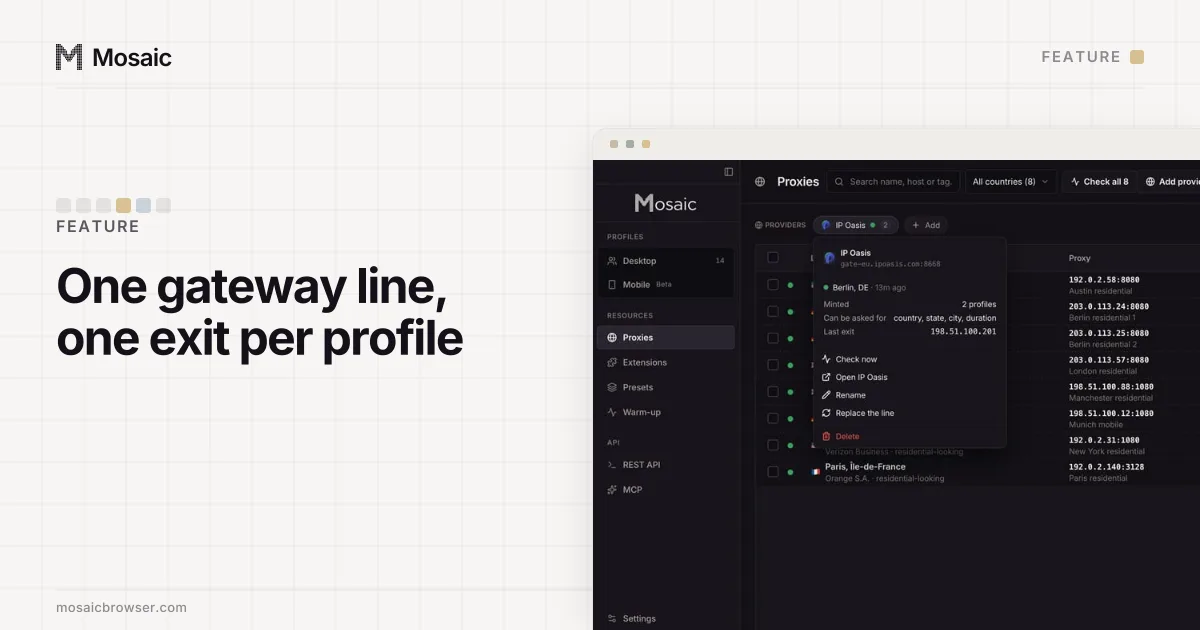
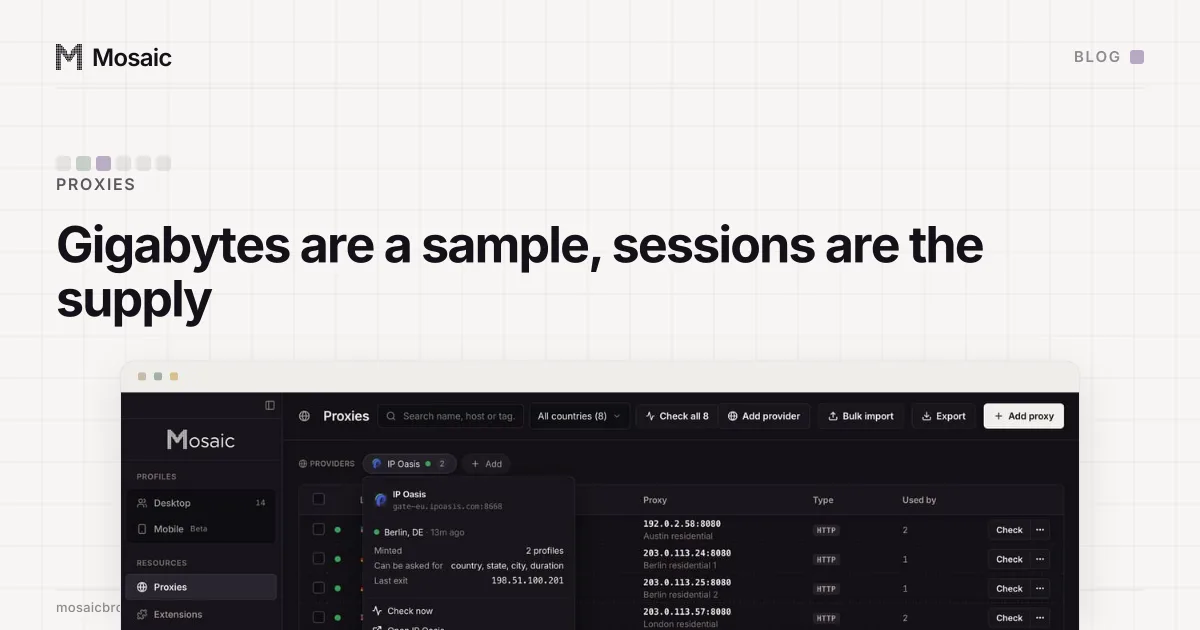
Paste one gateway line. Every profile mints its own exitIn Mosaic: Provider minting. One gateway line, a separate exit for every profile. Free holds 3 profiles. Pro is $49 a month for any number.
Mosaic is a desktop app
Email yourself the link and open it on your computer.
How it works: Provider minting
The session, not the gigabyte, keeps profiles apart
Two profiles with different fingerprints that leave from one exit address look to a site like two browsers behind one connection. On a residential gateway, what picks the exit is the session id. Same id, same exit, for as long as the session holds.
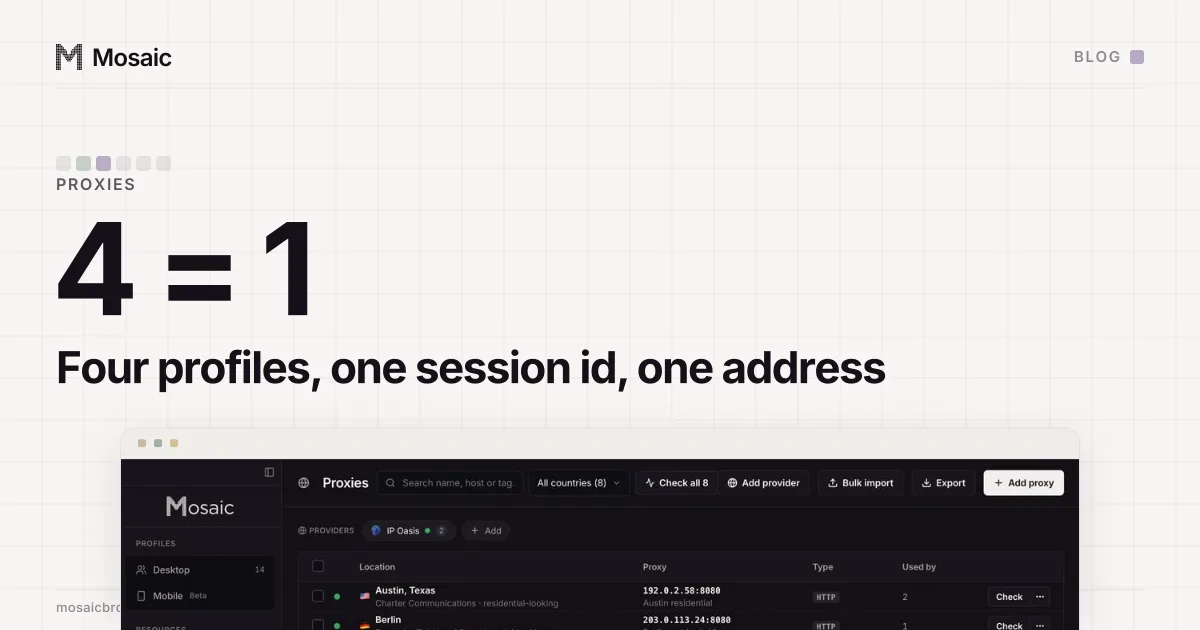
We know this one from the inside. On 18 September 2026 a batch create of ours took one provider and handed four profiles the same minted credential: one session id, one address. Our store happened to refuse the combination, which is the only reason we saw it. Without that refusal a batch of five hundred would have shared one exit and nothing in the app would have looked wrong. The fix is that each profile is given the provider and mints its own session (forty profiles, forty exits has the whole run).
The same question applies to any bundled plan. Does each profile get its own session, and can you see it? If the gateway line is hidden, you cannot check, and a fault like ours stays invisible.
Four questions for a plan that includes proxy traffic
- Does each profile get its own session id, and does it keep it between launches?
- Can you see the gateway line, host, port and username, that a profile is using?
- When the included traffic runs out, what does a launch do: refuse, warn, or fall back to your own address?
- If you leave the bundled traffic, can you point the same profiles at a seller you choose without remaking them?
The third matters more than it looks. A browser that quietly opens on your own address when the proxy stops answering has moved the profile somewhere its timezone and language do not match, and nothing on screen says so.
How Mosaic does it without selling proxies
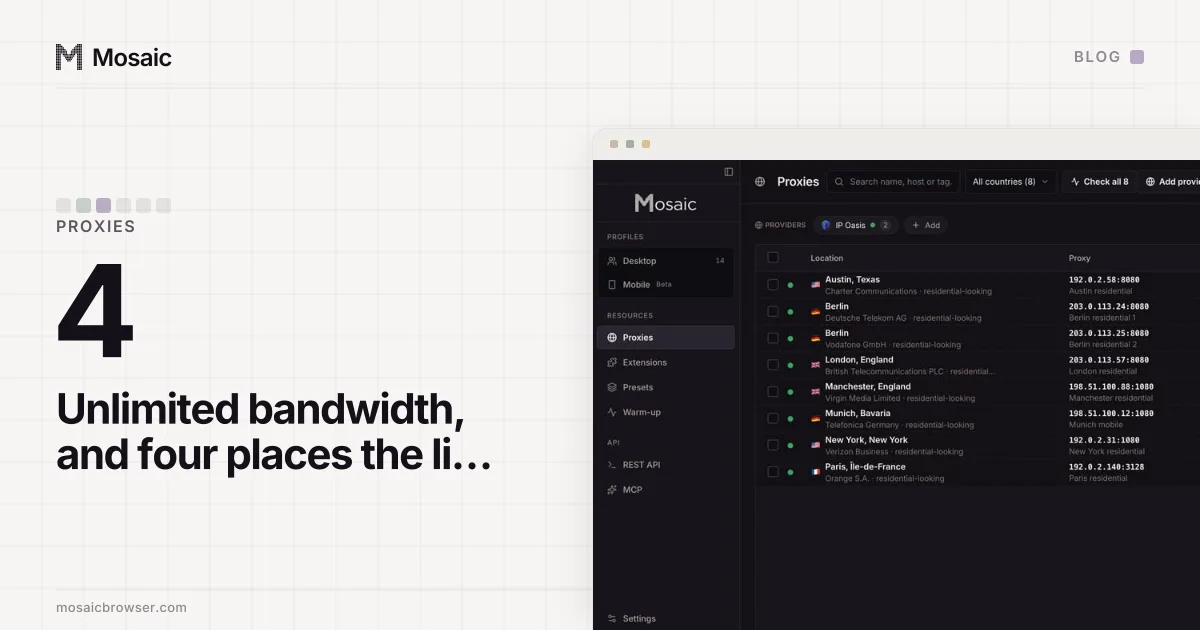
You keep your account at a seller and paste one gateway line from its dashboard into Mosaic as a provider. Mosaic reads that seller's format back off the line: which part carries the country, how a session id is spelled, how long a session lasts. Every profile pointed at the provider then mints its own session in that format. A pick the seller's format has no word for, a city at a seller with no city option, is refused by name rather than dropped, because a dropped option authenticates fine and exits somewhere else (proxy providers shows the screen).
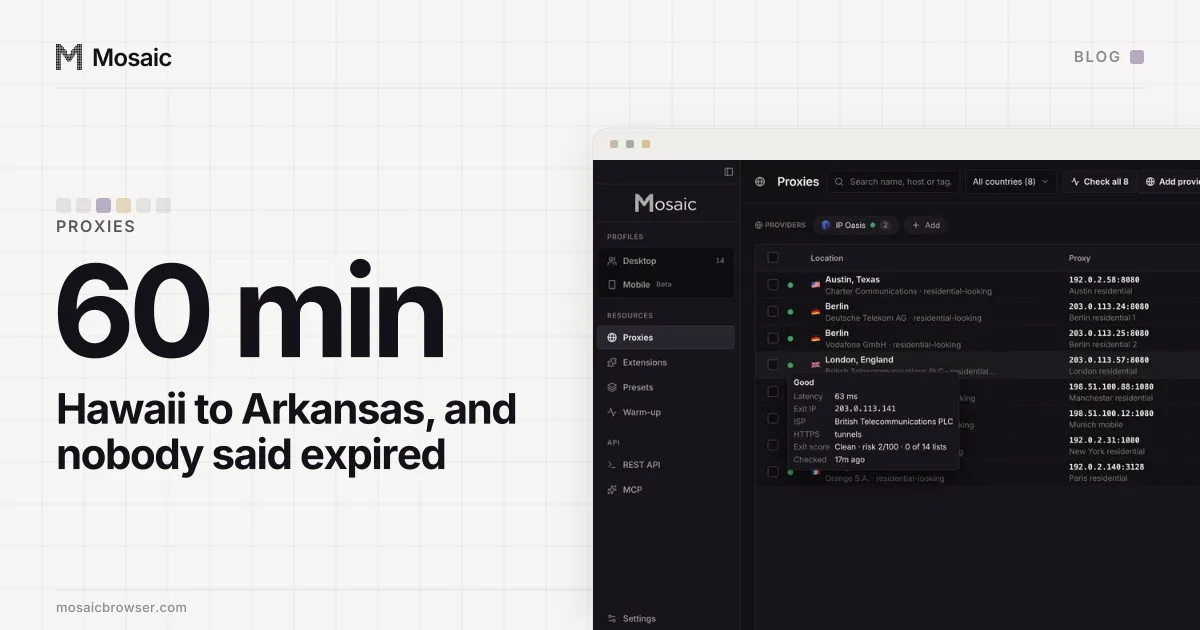
Two more rules come from the same work. A launch does not open until the proxy has answered and tunnelled, and when a minted session reaches nothing, Mosaic asks for a different session rather than retrying the dead one. A session you pinned by hand is never moved. When a sticky session expires the symptoms are confusing in their own way, covered in what an expiring sticky session looks like.
The cost of this is that you need a proxy seller before your first profile goes anywhere. We think that is the honest order. Your traffic is billed by the company carrying it, you can see every line a profile uses, and changing seller is pasting a different line. And Mosaic keeps no meter on your traffic, because none of it passes through us.