
Mosaic's anti-detect browser REST API runs on your own computer, at http://127.0.0.1:7317/api/v1 by default. You make a key on the API screen, send it as Authorization: Bearer <key>, and every route answers in JSON. As of 2 November 2026 the reference documents 181 routes, and starting a profile hands back a DevTools endpoint, so Puppeteer and Playwright can attach to a browser that already wears its fingerprint, proxy and cookies.
The rule behind it is that the interface, the API and the MCP server are peers. Anything the window can do, a script can do, through the same code. When we first measured that, there were 175 REST routes against 122 MCP tools and whole areas missing from one side, so the build now runs a check that maps every route to the tool that does the same job.
The shortest useful call
An empty body is a valid POST /profiles. Leave everything out and you get a profile in the system project with a freshly drawn fingerprint. Add a proxy as a plain string and it is attached to that profile alone, without filling the Proxies page with one row per session:
curl -X POST -H "Authorization: Bearer $KEY" -H 'content-type: application/json' \
  -d '{"name":"Scrape","proxy":"socks5://user:pass@gw.provider.com:1080"}' \
  "$BASE/profiles"
A profile created with a proxy is drawn for that proxy's exit. Mosaic measures where the proxy really comes out before it generates the identity, and the timezone, languages and geolocation follow that address. Every response carries an exitMatch object saying whether a measured exit decided the locale, and why not if it did not. Before that field existed, the same pasted European gateway gave America/New_York on one call and America/Chicago on the next, and the two responses looked identical. Pass count (1 to 500) to create a batch in one call.
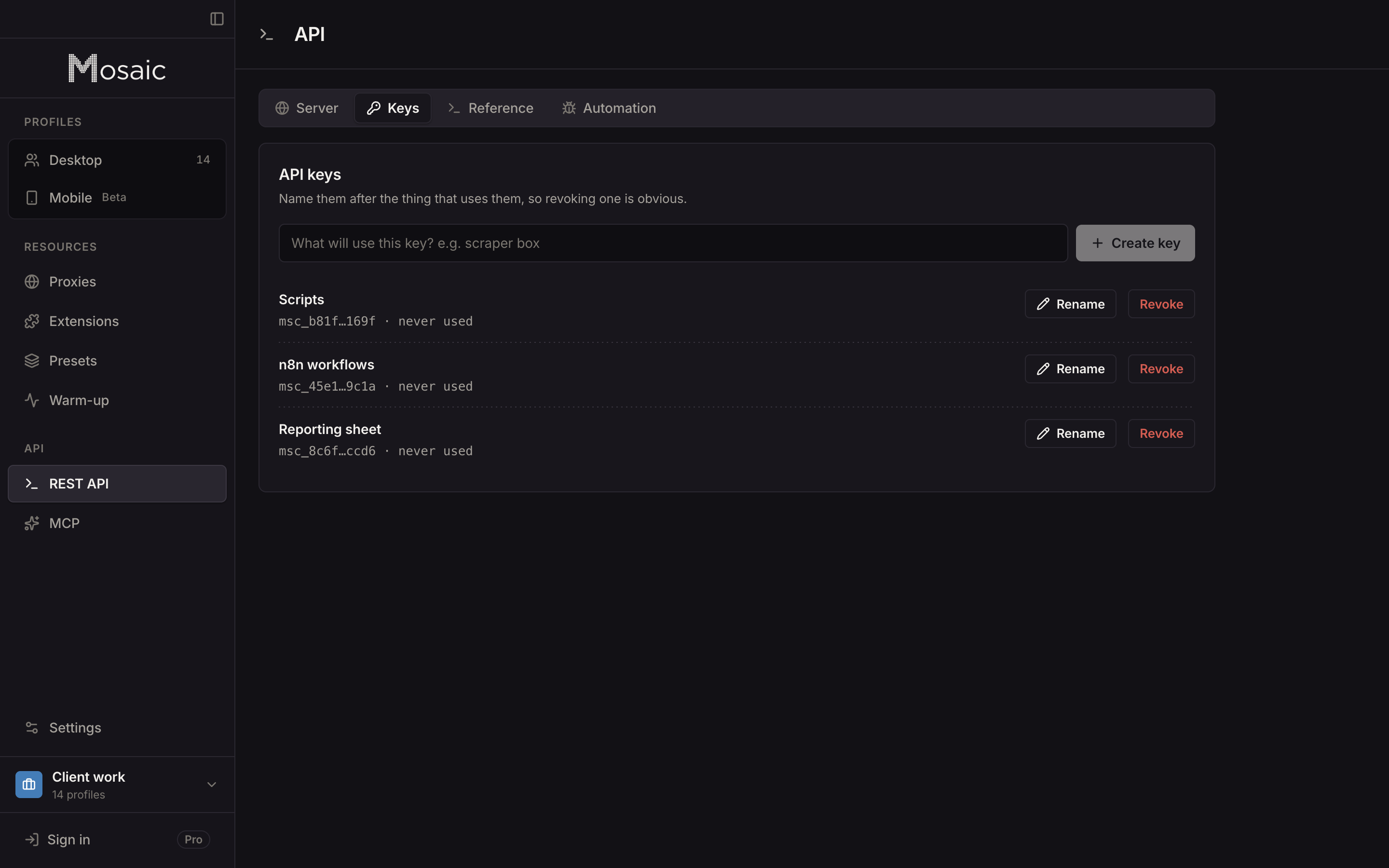
Everything the window does, from a script on your own computerIn Mosaic: REST API. Everything the window does, from your own scripts. Free holds 3 profiles. Pro is $49 a month for any number.
Mosaic is a desktop app
Email yourself the link and open it on your computer.
Starting a profile and attaching Playwright
POST /profiles/:id/start launches the browser and returns { profileId, status, pid, debugPort, wsEndpoint, cdpUrl, startedAt, error }. Connect to wsEndpoint with puppeteer.connect or Playwright's chromium.connectOverCDP, and you are driving Tesseract Chrome, Mosaic's own engine, with the profile already applied.
Two details save time. A profile with a proxy is not started until that proxy has answered and tunnelled a connection; if it has not, the call returns a 502 that names the proxy and quotes what it said, and no browser opens. And for work nobody will watch, pass "offscreen": true. The window is parked off the screen but the browser stays headed, so it keeps the real User-Agent and the real GPU. A headless Chrome names itself in its User-Agent, which is why we treat headless as the wrong tool for anything a site will see.
If you would rather not use Playwright at all, the page-control routes read the page as an accessibility tree with refs, and click and type through Mosaic's human-input code. They never enable the DevTools Runtime domain, which we measured flipping a bot detector's verdict.
Errors written for the caller
A misspelled field and a stored one look the same from outside, so an unknown key is a 400 that names the field. A value out of range is refused, never clamped: "count": 9000 is an error, not a quiet batch of 500. A 4xx message is written for whoever sent the request. A 500 means the bug is ours.
Destructive routes work the other way round from a PATCH. An absent field on an edit leaves the value alone; an absent scope on something irreversible, such as emptying the trash, is a 400, never "all of it". We learned that one the hard way, and it is now enforced at every door.
What the anti-detect browser REST API covers
The groups in the reference are the groups in the app: profiles, running a profile, fingerprints, proxy providers, proxies, credentials, cookies, bookmarks, warm-up, human typing, projects and tags, downloads, trash, backups, import and export, extensions and presets, tabs and page control. Bulk routes take lists of ids. Starting or stopping a batch answers { ok, skipped, failures }, with a reason for each profile that failed, because "started 40" over eight failures is not an answer. The full reference is inside the app on the API screen, and the same text can be saved as Markdown.
GET /health is the one route that needs no key, so a supervisor can check that Mosaic is up without holding a credential.
Limits
The API binds 127.0.0.1 only. It is a desktop app with a local API, not a server you deploy, so there is no Docker image, no cloud endpoint and nothing to reach from another machine. The REST API is part of Pro: $49 a month, one plan, with a 14-day free trial. Free has no API access. Pro does not charge per profile, so a script that makes 500 profiles costs the same as one that makes five. Each proxy still needs to work before a launch, as checking a proxy before you use it explains, and provider accounts give each profile in a batch its own exit.