An anti-detect browser does two things: it keeps each profile's cookies and storage apart, and it changes the values a page can read about the computer, such as the graphics card, screen, timezone and language. Neither of those is unlawful in itself, so in general anti-detect browsers are legal. They are the same things a privacy browser does and the same things Chrome lets developers do by hand. The legal questions are about the person using it, and they are the same questions that apply without one. We make an anti-detect browser, so read this with that in mind; we are not lawyers, and this is not legal advice for your country.
The technique is already in ordinary browsers
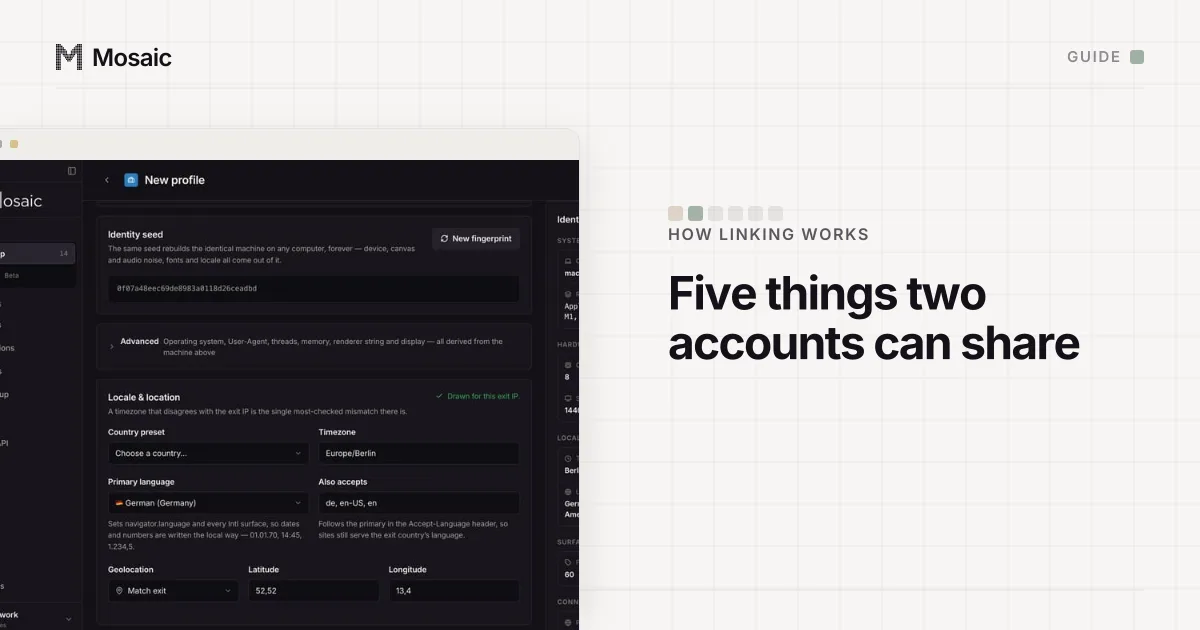
Changing what a browser reports is not a fringe idea. Brave randomises some fingerprint values per site and per session so trackers cannot use them to follow you (Brave). Tor Browser takes the opposite route and makes every user report the same values, so nobody stands out (Tor Project). Chrome's own DevTools can override the User-Agent (Chrome DevTools) and set a different location and timezone in its Sensors panel (Sensors), because developers need to see a site as other visitors do. All four pages were read on 2 November 2026.
An anti-detect browser does this per profile, persistently, and with values that agree with each other. That is a difference of convenience and consistency, not of kind.
Your profiles, cookies and proxies stay on your computerIn Mosaic: Local first. Profiles, cookies and proxies stay on your computer. Free holds 3 profiles. Pro is $49 a month for any number.
Mosaic is a desktop app
Email yourself the link and open it on your computer.
Are anti-detect browsers legal? What the law looks at
Laws that touch this area are about conduct: fraud, identity theft, impersonating a real person or company, harassment, breaking into systems you have no right to enter. A browser that reports a different screen size does none of those, and a person who commits them is liable whichever browser they used.
In the United States, people sometimes worry that breaking a website's terms with a tool like this is a computer crime. In Van Buren v. United States (2021) the Supreme Court read the Computer Fraud and Abuse Act's "exceeds authorized access" clause narrowly: it asks whether you entered a part of a system you were not entitled to, not why you used access you had. The Court left open whether limits written in contracts or policies could count (opinion, PDF, read 2 November 2026). Elsewhere, the law is your country's, and a local lawyer is the person to ask.
What a website's terms say
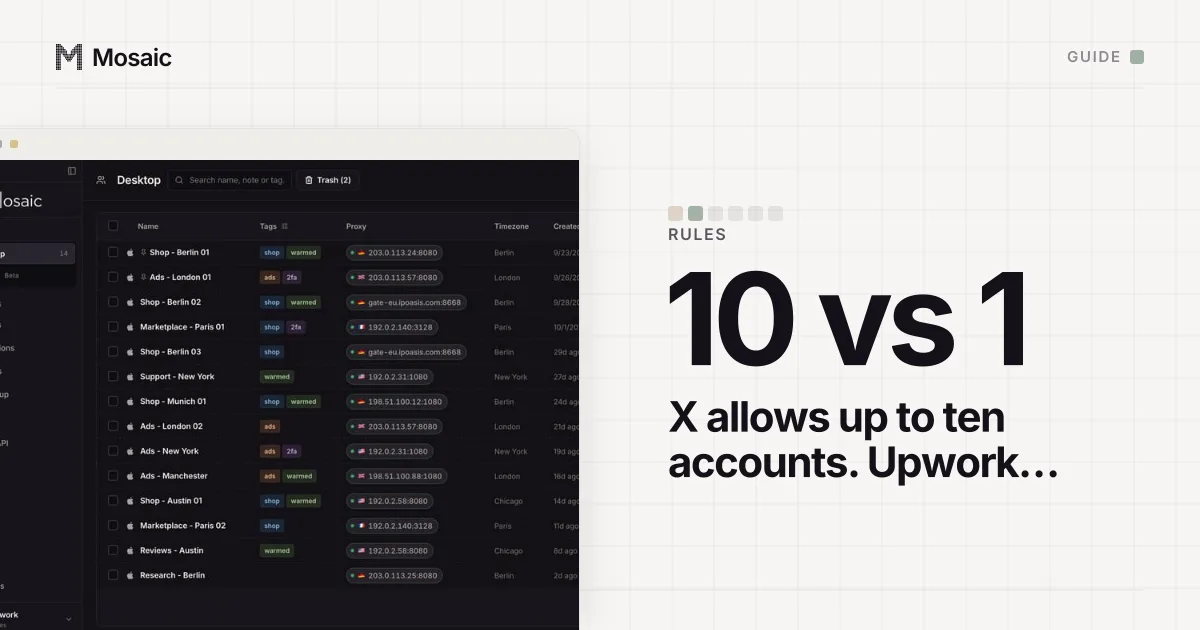
Terms of service are a contract between you and the site, and they apply whatever browser you use. Few of them mention anti-detect browsers by name. Many forbid things the tool could be used for. X, for example, forbids "employing workarounds to exceed the technical limits of account creation" while allowing up to ten accounts for different purposes (X Authenticity policy, read 2 November 2026).
So the honest answer has two halves. Running accounts you are allowed to run, each in its own browser profile, is ordinary account hygiene. Using any browser to come back after a ban, or to hold more accounts than a platform permits, breaks the platform's terms, and the platform can close those accounts. The rules, platform by platform, are in is it legal to have multiple accounts.
Who uses them, legitimately
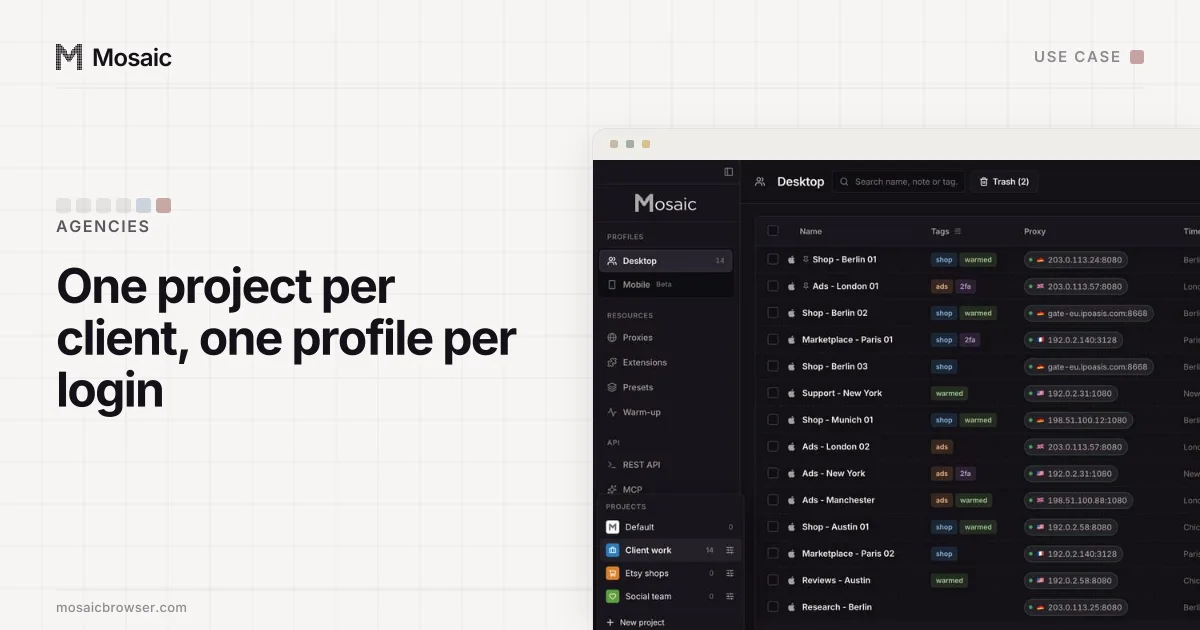
- agencies and social media managers keeping each client's accounts and two-factor codes in a browser of their own
- sellers running stores on marketplaces that allow more than one
- media buyers running ad accounts inside the platforms' business tools
- QA teams testing an app as several users, and advertisers checking their ads from other countries
- people who want work, personal and research browsing kept apart and not followed by fingerprint
None of that needs a platform's rules bent. The reason these people need more than Chrome profiles is technical: every Chrome profile reports the same computer, which how websites detect multiple accounts explains.
What we will not help with
We built Mosaic for the list above, and we say no to the rest in writing: no guides or features for evading a ban for prohibited conduct, fake reviews or engagement, airdrop or bonus abuse, payment or identity-verification evasion, phone-verification bypass, buying or selling accounts, or ad cloaking. Mosaic keeps accounts you are entitled to run apart; it does not change what a platform allows, and it does not promise that a platform will never act on an account.
Where your data sits
One legal point is about the browser rather than the user: who holds the data. Profiles, cookies and proxies in Mosaic stay on your computer, and Mosaic has no cloud copy of your profiles. Our server knows your email and plan, which computers you use Mosaic on, when a profile is created or opened and how long it stays open, by a random id only, and one random key per account that, together with the files on your computer, opens your library. It never receives a profile's name, notes, fingerprint, cookies, logins, proxy or anything you browse. The full list is on local-first. If you hold clients' logins, that is worth knowing for your own obligations to them.
Sources
- Brave: Fingerprint randomization, read November 2, 2026
- Tor Project Support: Fingerprinting protections, read November 2, 2026
- Chrome DevTools: Override the user agent string, read November 2, 2026
- Chrome DevTools: Sensors panel, read November 2, 2026
- X Help Center: Authenticity, read November 2, 2026
- Supreme Court of the United States: Van Buren v. United States, No. 19-783 (2021), read November 2, 2026