A free anti-detect browser plan with cloud profiles only means every profile you make on it lives on the vendor's servers. That includes the cookies from the first accounts you sign in to while you are still deciding whether the product is any good. Several anti-detect browsers do it this way. We think the reasons are mostly about the vendor's costs and control, and the price is paid in where your sign-ins are kept.
What a cloud profile is
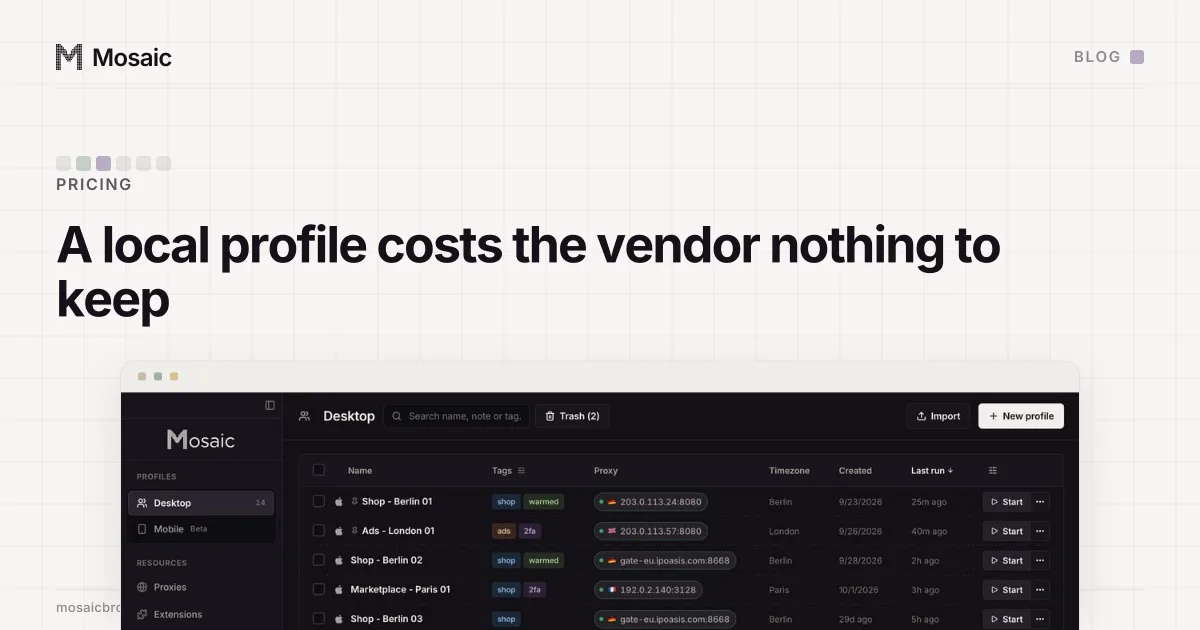
A browser profile is a folder: cookies, local storage, IndexedDB, history, saved settings, and in an anti-detect browser the fingerprint record that says which machine the profile claims to be. Ours, measured on disk, run from 16 to 53 MB and from 488 to 849 files each.
A local profile keeps that folder on your computer. A cloud profile keeps the master copy on the vendor's servers. When you open it, the app typically downloads the folder, runs the browser, and uploads the changes when you close it. That is what makes the useful things possible: opening the same profile on a second computer, or handing it to a colleague.
Make 500 profiles in one go, then work on all of them at onceIn Mosaic: Bulk actions. 500 profiles per batch; start, edit and type into many. Free holds 3 profiles. Pro is $49 a month for any number.
Mosaic is a desktop app
Email yourself the link and open it on your computer.
Why a free anti-detect browser offers cloud profiles only
This is our reading of the economics, not any vendor's stated policy.
The first reason is counting. A profile on the vendor's server is a row the vendor can see. It can cap a free account at a number of profiles, stop a sixth one being made, and delete one that has not been opened in a while. A local profile is a folder on somebody else's disk, and the only way to limit it is to trust the app on that disk.
The second is that cloud storage is the product being sold higher up. Sync between computers and sharing within a team are what paid tiers charge for, and they cost the vendor real storage and bandwidth. A free tier built on the same storage shows the paid product working.
The third is cost control in the other direction. A free cloud profile costs the vendor disk for as long as it exists, which is exactly why the vendor wants to be able to retire it. Why anti-detect browsers cost what they cost has the arithmetic of storing other people's profiles.
None of that is sinister. It is a sensible way to run a cloud product. It does mean the free tier is shaped around what the vendor needs to measure, not around where your data is safest.
What it means for your first logins
The first week with a new browser is when people sign in to their real accounts to see whether the profiles hold. In a cloud-only free plan, every one of those sign-ins ends up as cookies in a folder on the vendor's servers.
A cookie jar is a credential. A valid session cookie signs a browser in without the password and, on many sites, without the two-factor code, because the site already saw both. So a cloud profile with your shop's or your client's session in it is a working sign-in, stored by a company you met a few days ago, under its encryption and its retention rules.
Three questions are worth answering before you sign in to anything that matters:
- Where is the profile stored, and is it encrypted with a key the vendor holds?
- What happens to a free profile you stop opening, and to all of them if you leave?
- Can you export a profile, with its cookies, in a format another product can read?
The second question has a longer answer in what happens to your profiles when the subscription ends: a cloud vendor holds your cookie jars when the plan stops, and a local app leaves them on your disk. Some free tiers meter use instead of storage, by launches per day, which daily launch limits works through.
Where a cloud profile is the right choice
If you need to open the same profile from two computers, or several people need it, a cloud product is doing a job a local one cannot. Mosaic has no cloud sync, no access from a second computer and no team sharing. If those are what you need, that is a real reason to pick a product that stores your profiles, and to accept what that means for where the cookies live.
Mosaic's free plan is local, like Pro
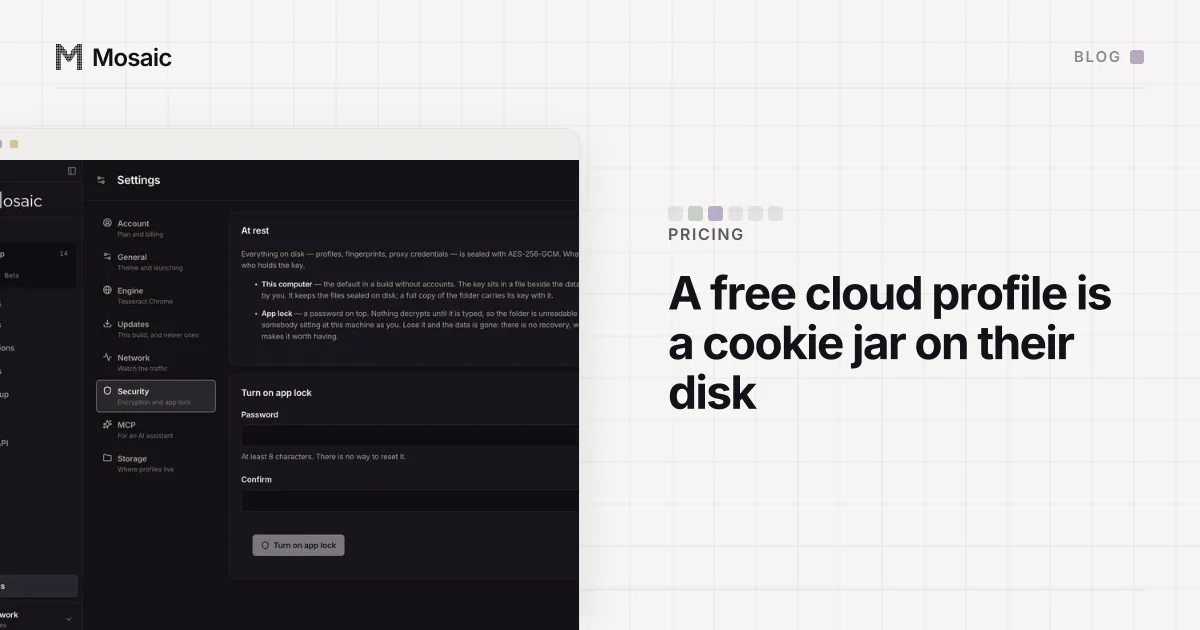
Mosaic is local-first on every plan. Profiles, cookies and proxies stay on your computer, and Mosaic has no cloud copy of your profiles. The store and cookie jars are encrypted on disk, and with app lock on, nothing decrypts without your password. The free plan runs the same engine as Pro; the difference is limits and the two automation surfaces, the REST API and MCP. Because a profile on your own disk costs us nothing to store, there is no storage reason for the free plan to be any different from the paid one. The free plan's limits and Pro's price are on the pricing page.