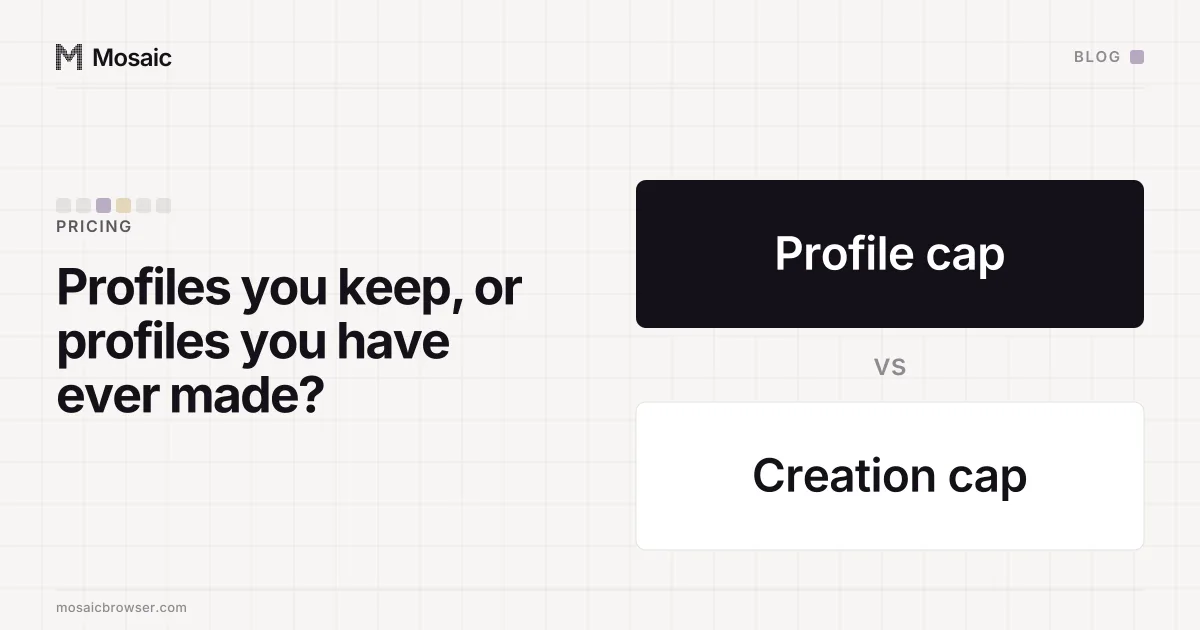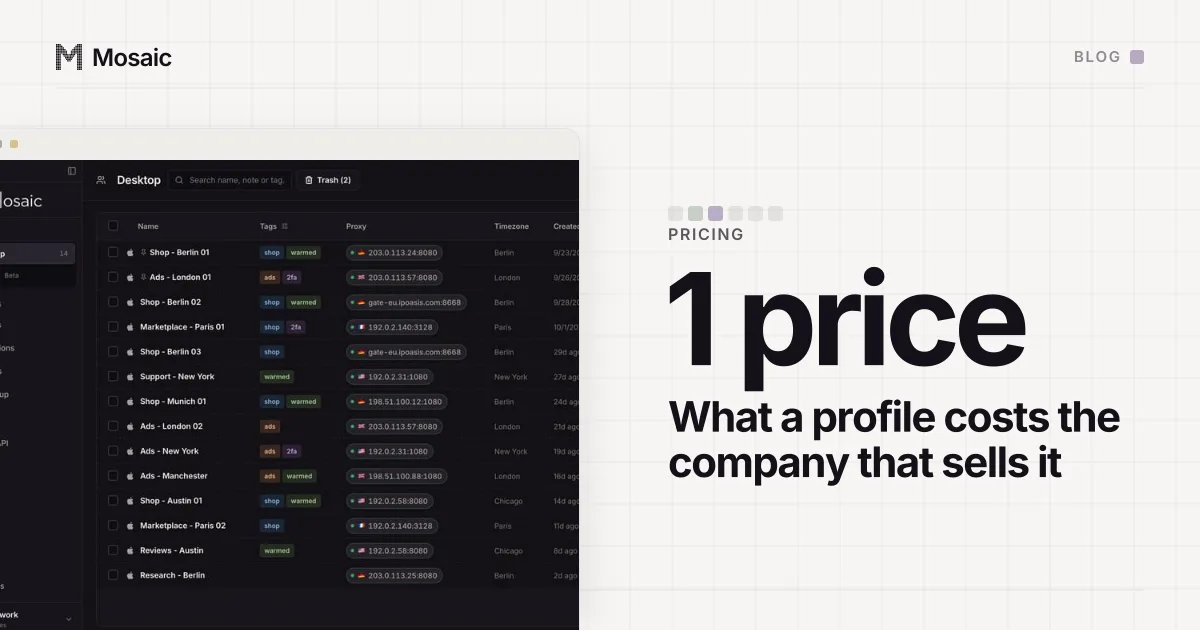
Anti-detect browsers are expensive because most of them charge per profile, and for most of them a profile is something they store, sync and serve from their own servers. Every profile in their cloud is disk, bandwidth and backup they pay for, so the price climbs with the count. When a profile lives on your own disk instead, it costs the vendor nothing, and that is the whole case for one flat price.
Why anti-detect browsers are so expensive: the per-profile price
Open almost any anti-detect browser's pricing page and you find a table: a number of profiles in one column, a monthly price in the next. Move past a row and you move up a plan. That shape is not arbitrary. It follows a cost that really does grow with each profile, in three places.
The first is storage and sync. A cloud profile carries its cookies, local storage, history and fingerprint, and the vendor keeps a copy so you can open it from another computer. Each one is a few tens of megabytes; ours, measured on disk, run from 16 to 53 MB and 488 to 849 files each. Multiply by thousands of customers and you have a storage bill, plus the bandwidth of moving each profile every time it opens somewhere new.
The second is people. Team plans let several users open the same profile, which means the vendor holds the profile, the permissions and a record of who did what. Seats are priced because each one adds load to that server and support to that team.
The third is metered extras. Where a plan bundles proxy traffic or cloud phones, those are resources the vendor buys by the gigabyte or by the minute and resells. They are honest line items. They are also why the cheapest row of a table rarely matches what a busy account needs.
Make 500 profiles in one go, then work on all of them at onceIn Mosaic: Bulk actions. 500 profiles per batch; start, edit and type into many. Free holds 3 profiles. Pro is $49 a month for any number.
Mosaic is a desktop app
Email yourself the link and open it on your computer.
The cost that does not grow with profiles
Under all of that sits a fixed cost every serious vendor pays, which is the browser itself. Most anti-detect browsers run their own build of Chromium, patched to change what pages can read, and Chrome ships a new major version roughly every four weeks. Every one of them has to be rebased, rebuilt and measured again.
We know what that costs because we pay it. Our engine, Tesseract Chrome, is stock Chromium source with more than sixty patches of ours. On our build machine, moving it up one Chrome major took a 93-minute, near-full rebuild of a 150 GB tree, and changing one patch takes one to two minutes after that. The rebuild is the cheap part. The measuring afterwards, against detectors and against a real Chrome of the same version, is where the days go.
That cost is real, but it does not change whether you run five profiles or five thousand. It is a reason for a browser to cost something. It is not a reason for the thousandth profile to cost more than the first.
What happens when the profile never leaves your computer
In Mosaic a profile is a folder on your disk and a browser process on your CPU. Its cookie jar, its proxy and its fingerprint are stored there, encrypted, and Mosaic has no cloud copy of your profiles. There is nothing on our side that grows when you add one.
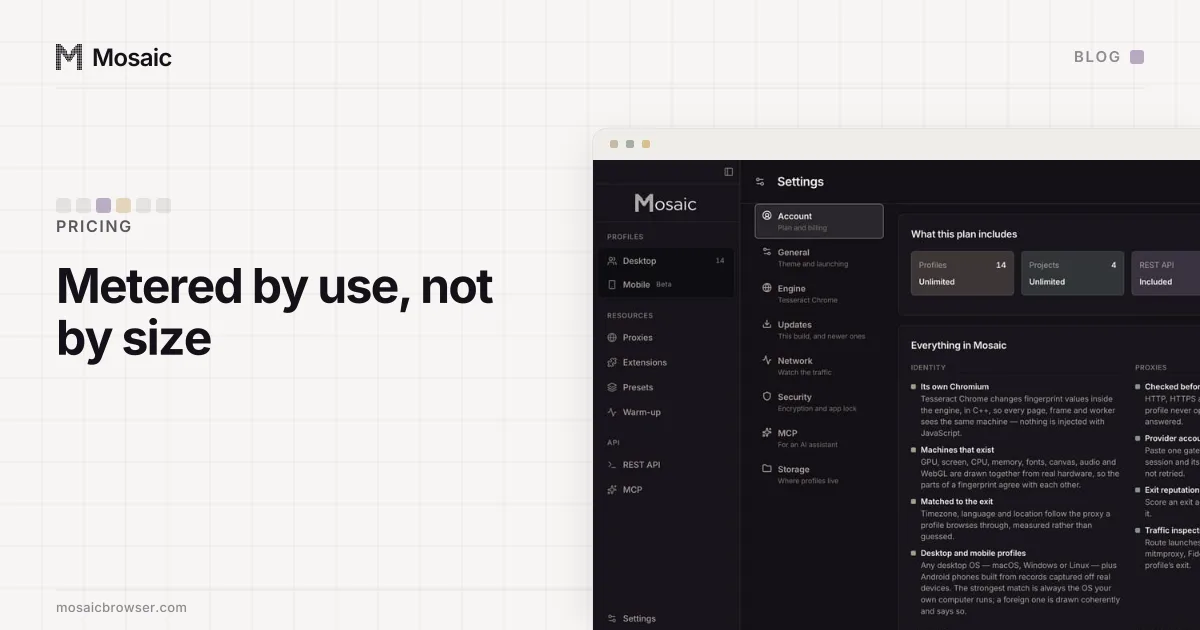
Our reasoning is short: a fixed price with no tiers, because the things a tier would meter (profiles, projects, API calls) cost this product nothing to give away, since everything runs on the customer's own machine. So Mosaic has two plans. Free: 3 profiles and 10 profile creations. Pro is $49 a month. One plan, everything unlimited, and the 1,000th profile costs the same as the first.
Where per-profile pricing is the better deal
A flat price is not the lowest price for everyone. If you run three accounts, a small per-profile tier elsewhere may cost less than $49 a month, and our Free plan may be all you need.
And the things a cloud vendor charges for are things some people need. Mosaic has no cloud sync, no way to open a profile from a second computer and no team sharing. If your work depends on those, a product that stores your profiles is doing a job we don't, and its price includes that job.
What to compare before you pay
Price per profile is only meaningful next to what each profile gets. Three questions sort most products quickly: where the profile is stored, whether its fingerprint is changed inside the browser engine or by a script injected into pages, and what the plan does when you outgrow it. What an anti-detect browser is covers the second question from zero, and our launch post explains the choices behind Mosaic's engine.
The plans, side by side, are on the pricing page.