Residential vs datacenter vs mobile proxies comes down to one thing: whose network the exit address belongs to. A datacentre proxy leaves from a server in a hosting company's range. A residential proxy leaves through somebody's home connection. A mobile proxy leaves through a cellular carrier. Everything else, from price to how a site treats you, follows from that, because a site can look the address up before your page has loaded.
How a site tells them apart
IP databases classify address ranges, and sites query them on the first request. ip-api, the lookup Mosaic's own proxy check uses, returns three flags for any address: mobile for a cellular connection, proxy for a known proxy, VPN or Tor exit, and hosting for "Hosting, colocated or data center" (ip-api JSON documentation, read 2 November 2026).
Two cheaper clues sit beside the database. The network's name, its ASN and ISP, often says "hosting" or names a cloud provider outright. And the reverse DNS name of a server address often does too: a PTR record containing amazonaws, hetzner or vps is not somebody's living room.
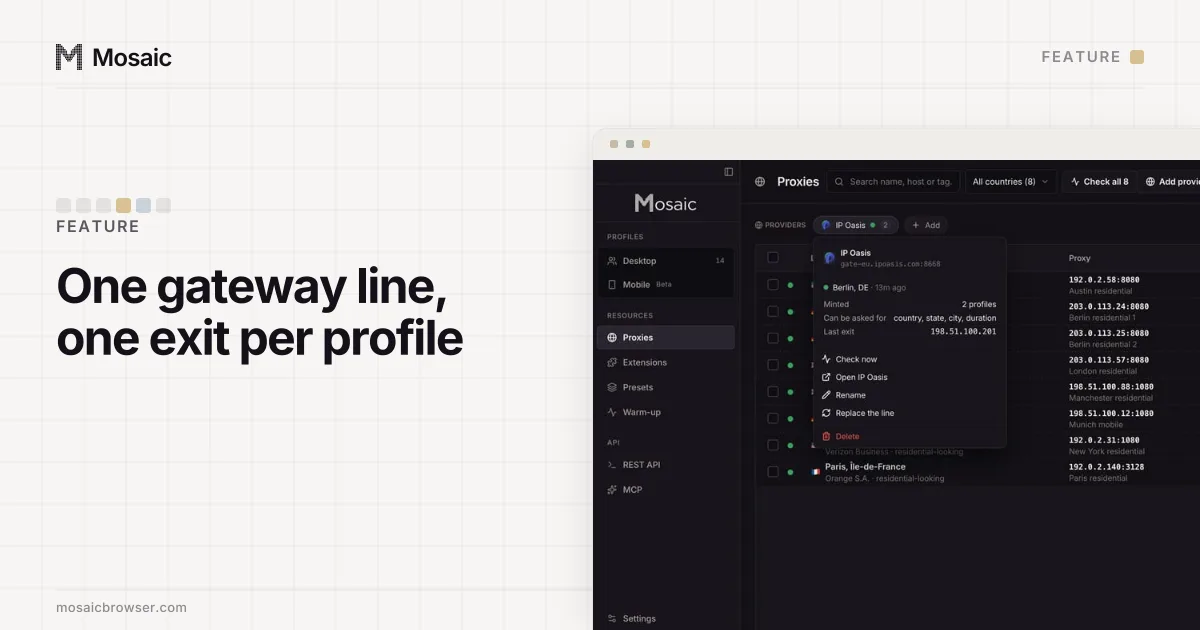
Paste one gateway line. Every profile mints its own exitIn Mosaic: Provider minting. One gateway line, a separate exit for every profile. Free holds 3 profiles. Pro is $49 a month for any number.
Mosaic is a desktop app
Email yourself the link and open it on your computer.
How it works: Provider minting
Residential vs datacenter vs mobile proxies side by side
| Datacentre | Residential | Mobile | |
|---|---|---|---|
| Exit address belongs to | a hosting company | a home internet provider | a cellular carrier |
| IP databases usually say | hosting | an ISP, nothing flagged | mobile |
| Who else is on the address | other customers of the proxy | one household, plus other proxy users | many subscribers at once, behind carrier-grade NAT |
| How stable the exit is | fixed while you rent it | sticky for a session, then it can move | changes when the carrier reassigns |
| Fits | public pages, APIs, bulk fetching | signed-in accounts, local results | phone-shaped traffic, many users on one IP |
The mobile column needs a word of explanation. RFC 6598 reserves address space specifically for carrier-grade NAT, where a carrier puts many customers behind a small pool of public addresses (RFC 6598). That is why a mobile address carrying many users is ordinary, and also why its location is fuzzy: Google's help page says activity on a mobile network can show a location that is not yours (How IP addresses work on Google).
Which one to choose
Pick by what the job does, not by which kind is said to be best.
For reading public pages with no login, a datacentre proxy is fast, cheap and stable, and the hosting label rarely matters. For accounts you sign in to on consumer platforms, a residential exit looks like what it claims to be, a person at home, and a sticky session keeps it in one place; rotating vs sticky proxies covers asking for one. For traffic that should look like a phone, or several users that would naturally share one carrier address, mobile fits.
Whatever the kind, the profile has to agree with it. A residential exit in Lyon with a browser set to Chicago time is a mismatch no proxy type fixes. The number of accounts you put behind each exit matters too, and how many accounts per proxy works through that case by case.
What Mosaic's proxy check reads
Mosaic does not take a seller's word for which kind you bought. Each check reads the exit address through the proxy and labels it.
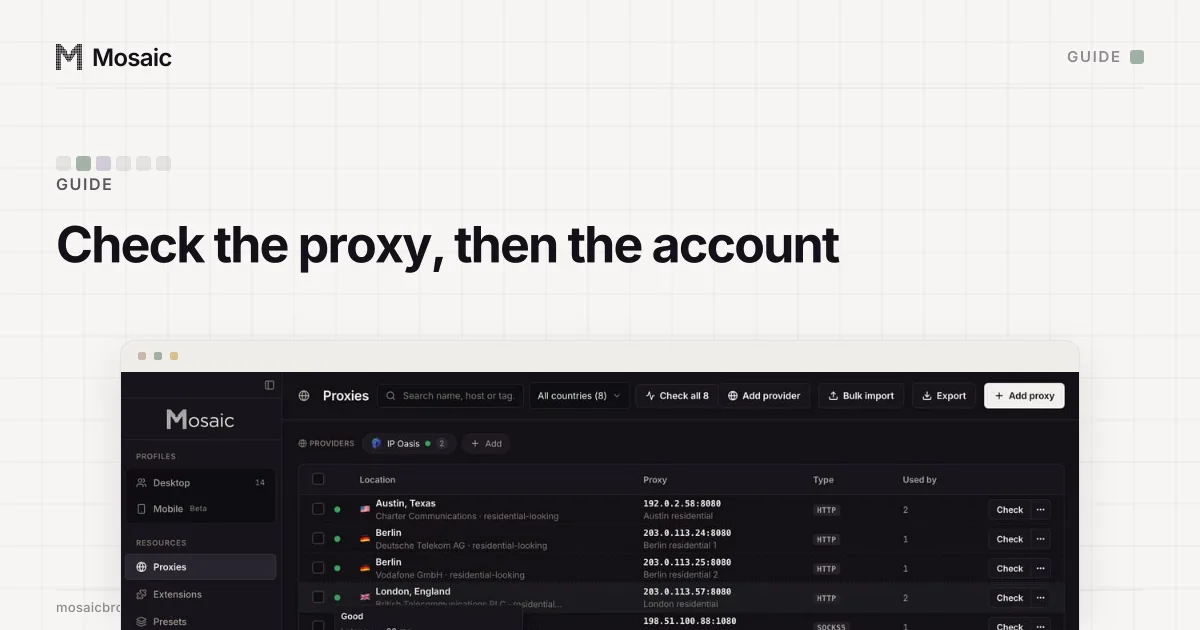
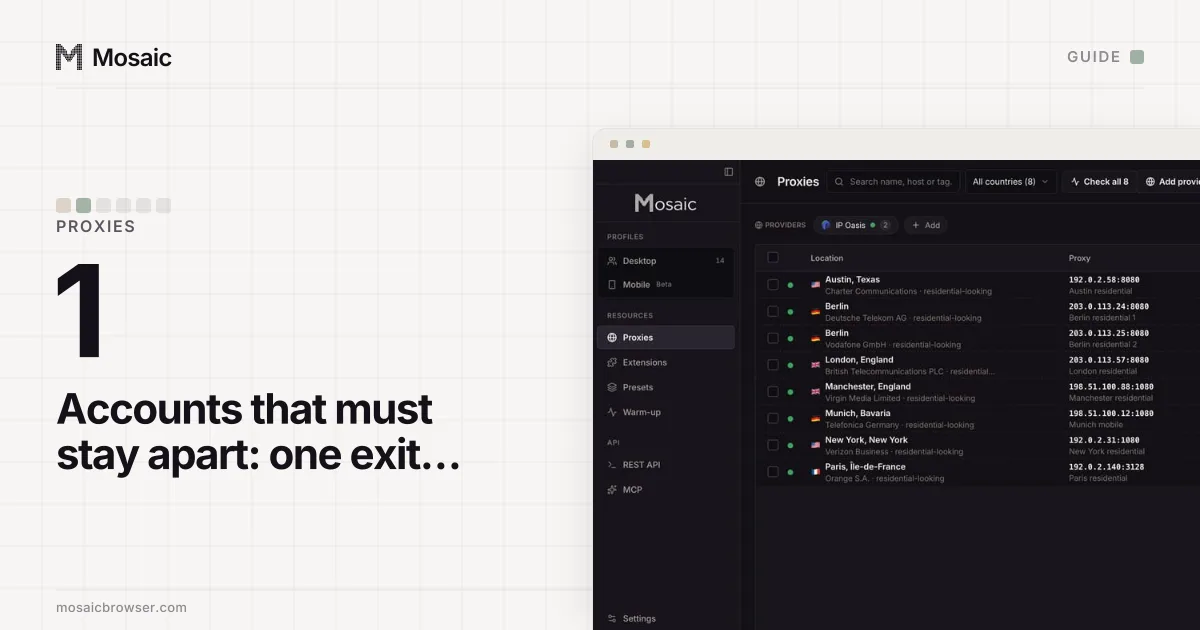
- The row under Proxies shows the exit's city, its ISP, and either datacentre or residential-looking.
- The exit score adds risk when the exit resolves to a datacentre range, by the database's hosting flag or by a hosting name in the ISP or reverse DNS. The note says why: "The exit resolves to a datacentre range. Consumer sites treat these as far more suspicious than residential addresses."
- A datacentre exit keeps the proxy's pill from reading Good, and the reason is listed: "The exit is a datacentre address, which consumer sites score as far riskier than a residential one." That is a warning, not a failure, because plenty of work runs through datacentre exits on purpose.
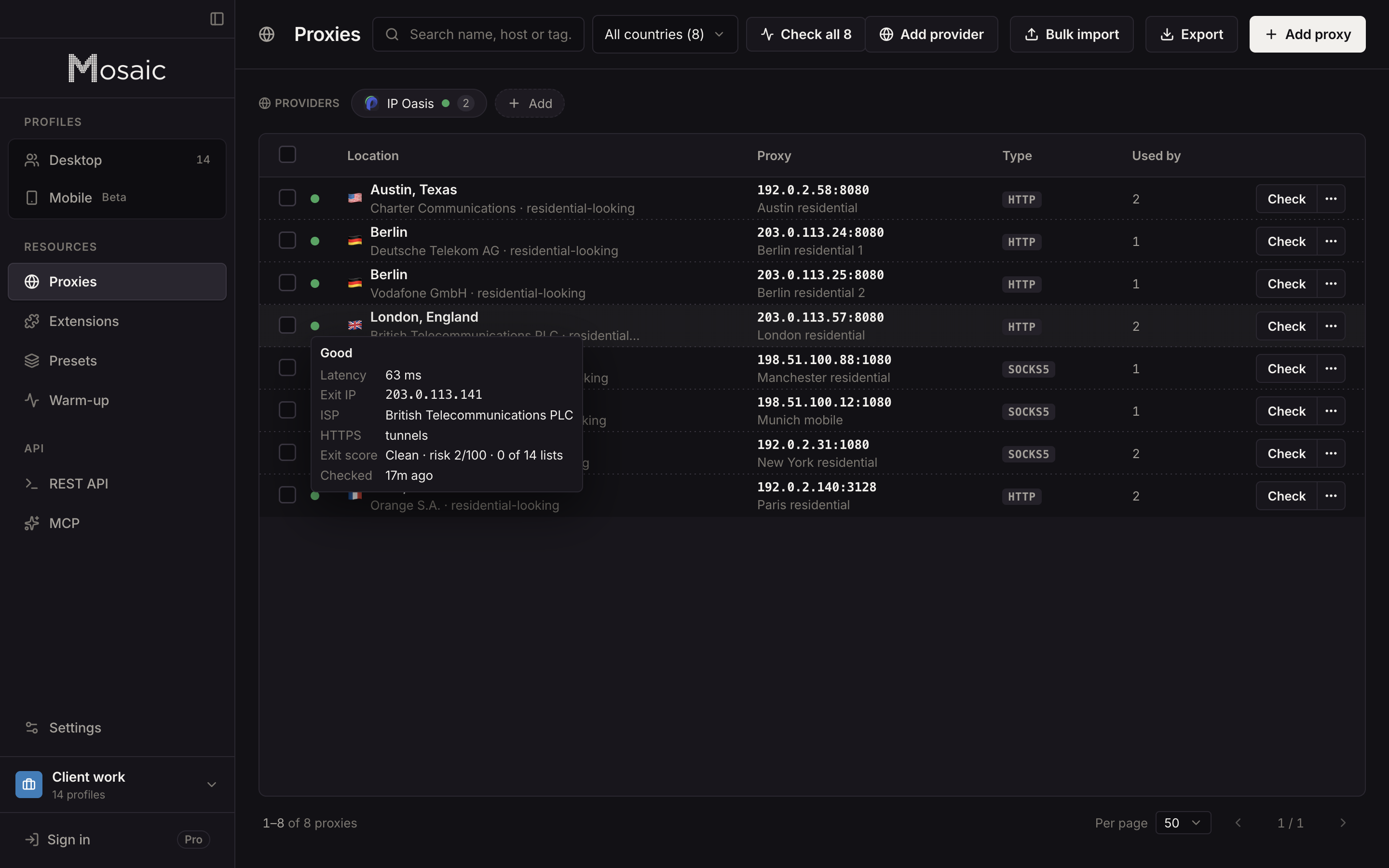
The check does not separate residential from mobile. ip-api has a mobile flag, but Mosaic reads only the hosting one, so its report says "Residential or mobile" rather than guess. Whether the proxy tunnels HTTPS and whether its exit rotates are read in the same pass (how to check a proxy before you use it lists all of it), and the residential proxy entry defines the home-connection kind on its own.
Sources
- ip-api: JSON endpoint documentation, read November 2, 2026
- RFC 6598: IANA-Reserved IPv4 Prefix for Shared Address Space, read November 2, 2026
- Google Account Help: How IP addresses work on Google, read November 2, 2026