Forum threads on how many accounts per proxy settle on numbers like three or five, and none of them cite a platform. We have not found a platform that publishes one, and a hard limit per IP would sit badly with every household and office that shares an address. The useful question is not how many, but whether these accounts are allowed to look related.
Each platform's own terms decide how many accounts you may run there; the legal side of multiple accounts is a separate question. Mosaic keeps accounts you are entitled to run apart; it does not change what a platform allows.
Why there is no safe number
An IP address is weak evidence on its own, because sharing one is normal. A home router puts a family behind one address. Mobile carriers go further: RFC 6598 reserves a whole block of address space so carriers can run carrier-grade NAT, which puts many subscribers behind a small pool of public addresses (RFC 6598, read 2 November 2026). Google's own help page warns that activity on a mobile network can show up from a location that is not yours (How IP addresses work on Google).
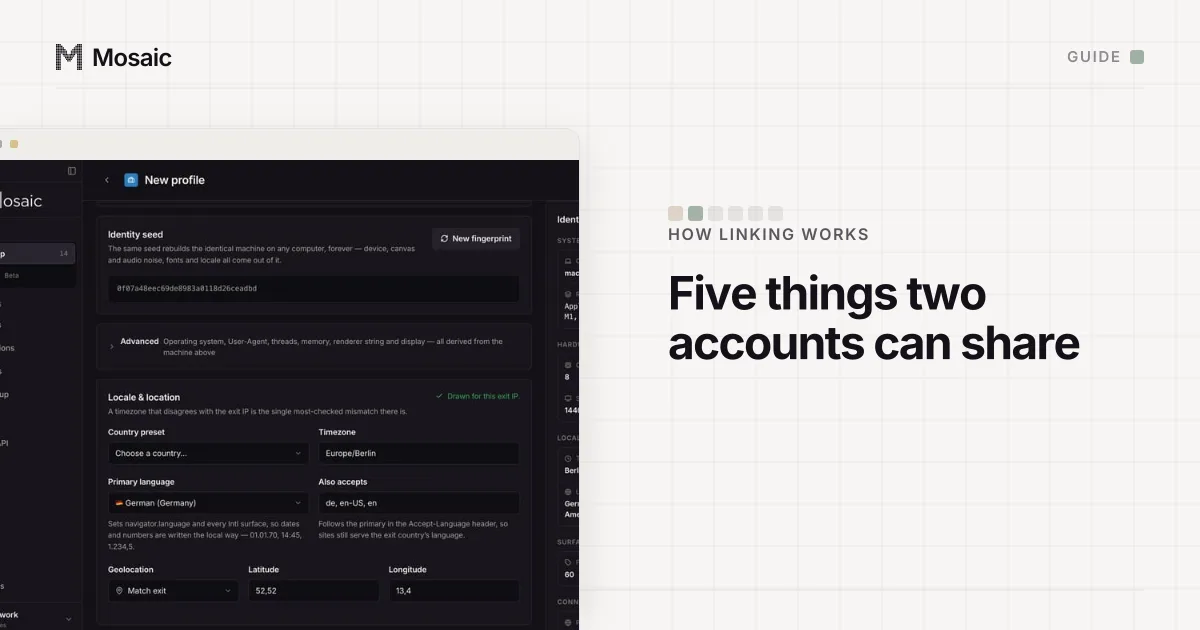
So a site that sees ten accounts on one address does not conclude much from the address. It concludes things from the address plus the same cookies, the same browser fingerprint, the same card or the same recovery phone. How websites detect multiple accounts goes through those signals one by one. A proxy can only change the first.
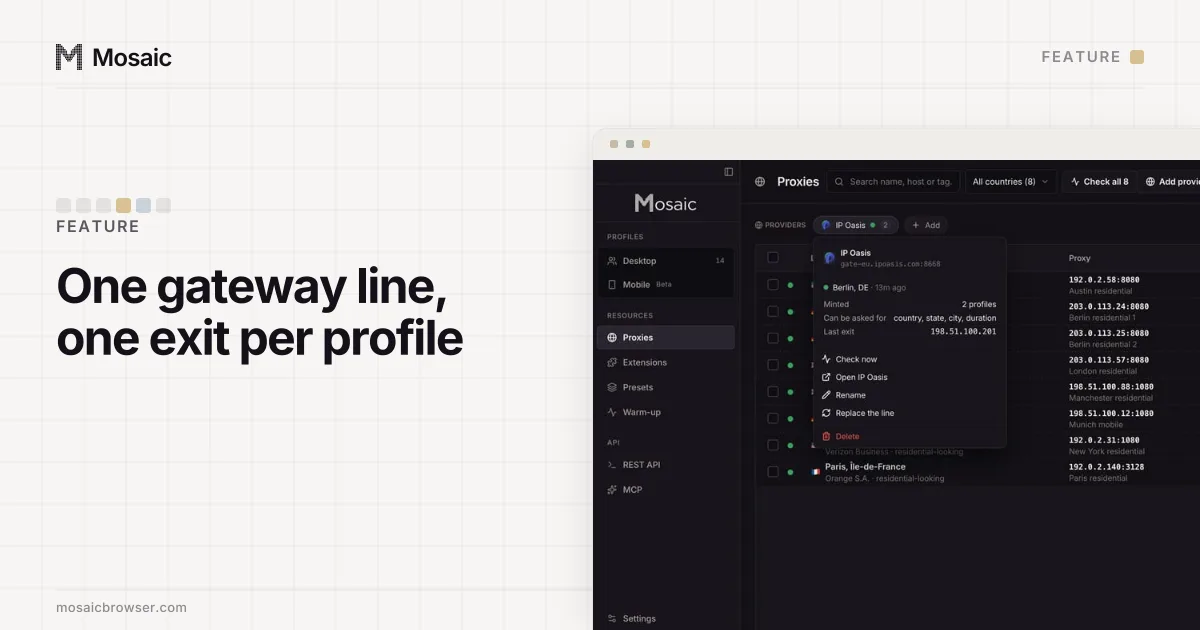
Paste one gateway line. Every profile mints its own exitIn Mosaic: Provider minting. One gateway line, a separate exit for every profile. Free holds 3 profiles. Pro is $49 a month for any number.
Mosaic is a desktop app
Email yourself the link and open it on your computer.
How it works: Provider minting
How many accounts per proxy, case by case
| Your situation | Accounts per exit | Why |
|---|---|---|
| Different clients' or businesses' accounts that must stay apart | 1 | a shared exit is one more link between accounts that are meant to be unrelated |
| Your own accounts on a platform that allows several | no proxy needed | they would come from your home address anyway; a proxy adds nothing |
| A household or small office with one account each | shared, as it is | that is what the address really is |
| Pages viewed without signing in, such as ad checks or price checks | many, rotating | nothing ties one page load to an account |
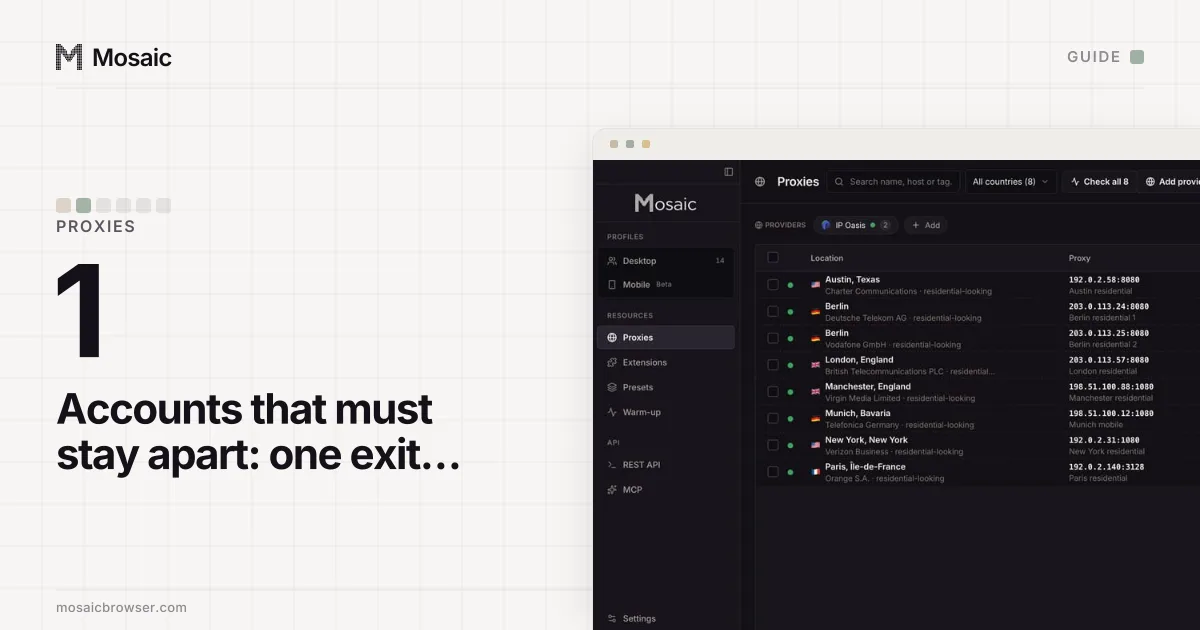
The first row is where people go wrong, and it is where the rule from one proxy per browser profile applies. With a residential seller, one exit means one session id, not one gateway line.
What the kind of address changes
A datacentre address is labelled as hosting in IP databases. A consumer site already treats it as unusual, so several accounts behind it read as more unusual still. A residential exit looks like a home, where two or three accounts are ordinary and forty are not. A mobile exit is shared by design, so it carries crowds well, but its location is coarse and it can change when the carrier reassigns addresses.
Rotating pools change the count in a way people miss. A rotating gateway gives one account many exits, which is the opposite problem: one account showing up from a new place on every connection. For anything signed in, the count that matters is one account per sticky session, and rotating vs sticky proxies explains how to ask a seller for one.
If you have fewer proxies than accounts
Buying one exit per account is not always possible on day one, and spreading the accounts thin is the wrong fix. Put the proxies on the accounts that must not be linked to each other, and leave your own accounts on your normal connection, where they would be anyway. Two clients' accounts on one exit is the combination to avoid; one client's account on your home address while you work for them is close to what an agency's office looks like.
With a residential seller the shortage is often not real. One gateway line gives a different exit for each session id you write into it, so one line can serve every profile you have.
Counting it in Mosaic
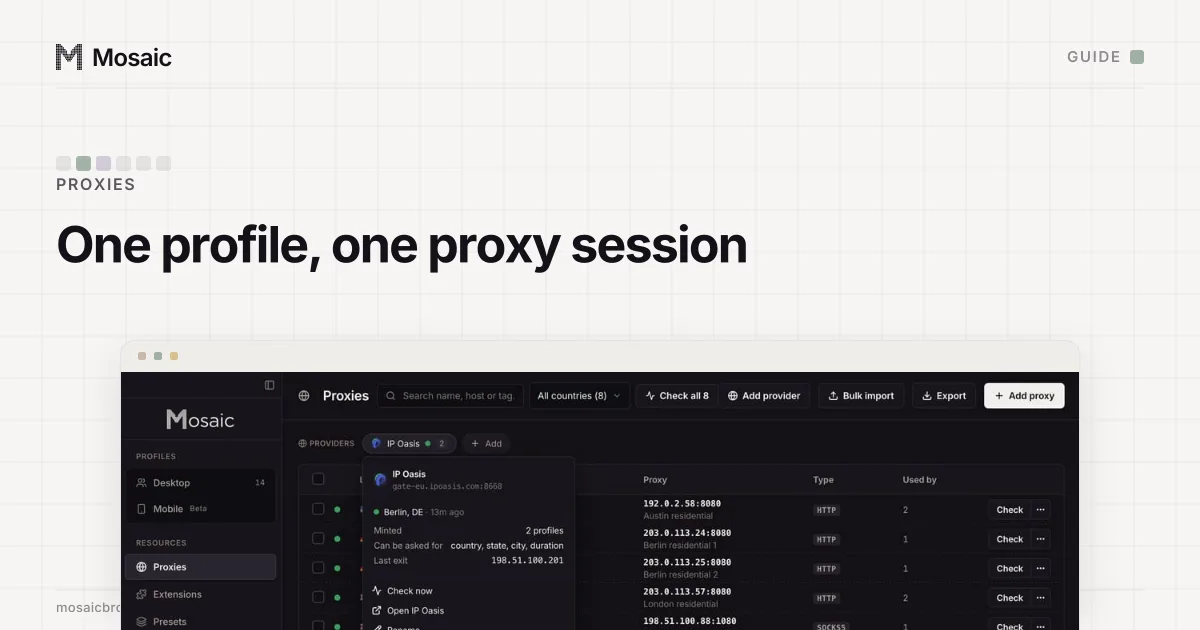
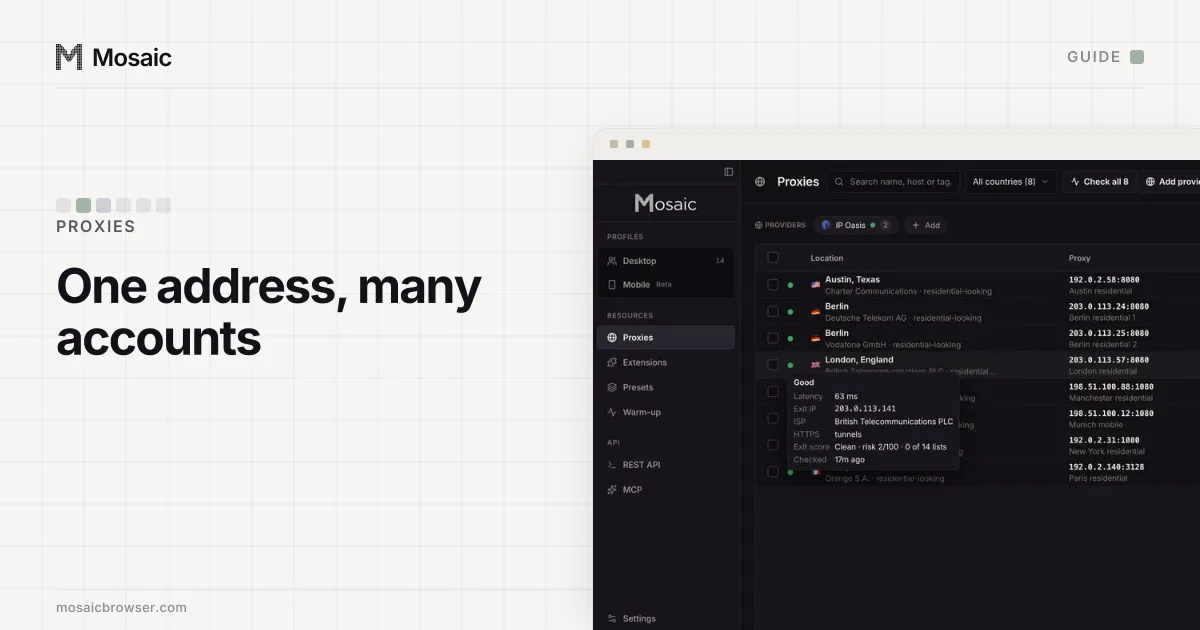
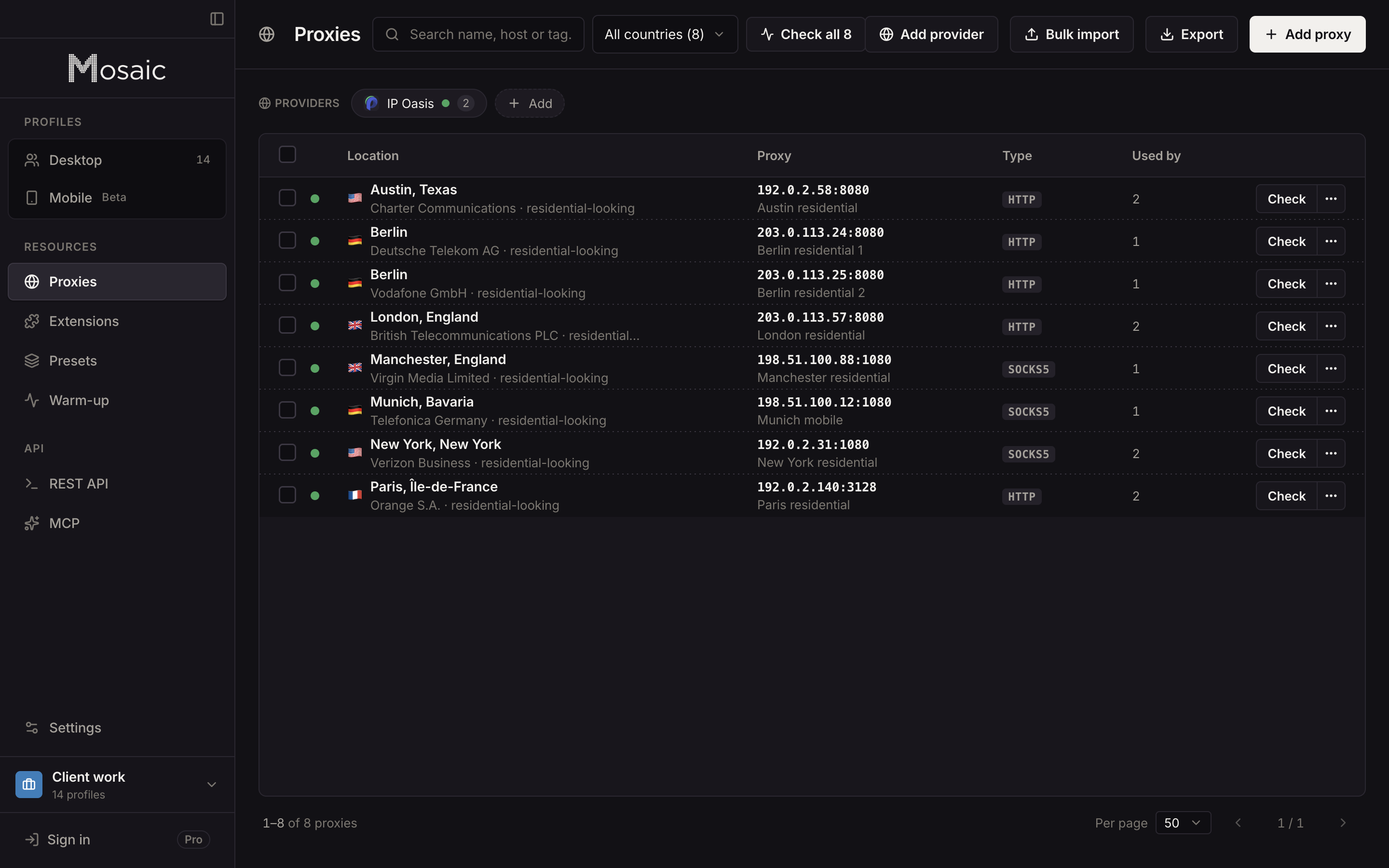
The Proxies screen has a Used by column, so a saved proxy shared by several profiles shows its count on the row. The safer route for accounts that must stay apart is a provider:
- Open Proxies › Add provider and paste one gateway line from your seller.
- Pick that provider as the profile's Connection › Source. Each profile mints its own session id, so the count per exit stays at one without any bookkeeping.
- Start the profile. Mosaic checks the proxy before it opens, and the check shows the exit's ISP and whether it looks residential or like a datacentre.
Which sellers Mosaic reads, and how minting works with each, is on the proxy providers page.
Sources
- RFC 6598: IANA-Reserved IPv4 Prefix for Shared Address Space, read November 2, 2026
- Google Account Help: How IP addresses work on Google, read November 2, 2026