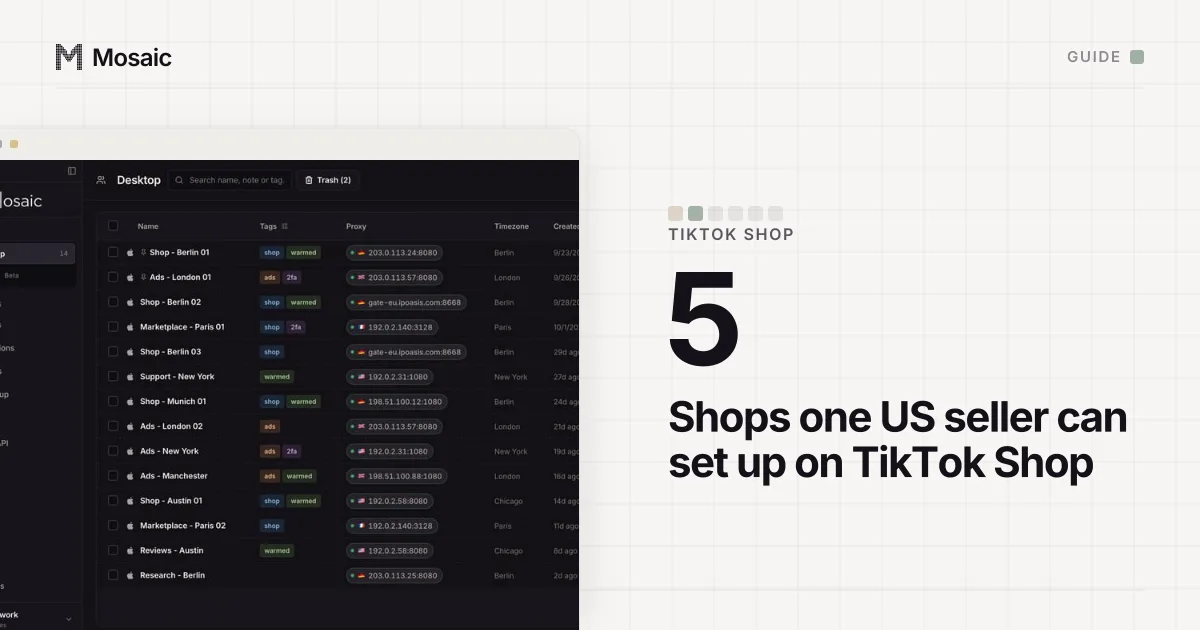
Yes, you can have more than one TikTok Shop account, and the US rules are short. The shop set-up guide in TikTok Shop's Seller University, which we read on 2 November 2026, says: "As a seller, you can set up to 5 shops, but only one shop at a time. You won't be able to register multiple shops simultaneously" (How to set up your TikTok Shop). Sellers in other countries register through their own regional Seller Center, which publishes its own rules.
Mosaic keeps accounts you are entitled to run apart; it does not change what a platform allows. On TikTok Shop that distinction matters more than usual, because the platform publishes how it connects shops and what it does with the connection.
What TikTok Shop asks of a second shop
Four rules from the US Seller University cover almost every question we see about a second shop.
- Up to 5 shops per seller, registered one after another.
- A fresh phone number and email for each. The registration guide says applicants "must use a phone number and email address not already used to open another shop" (What documents do I need to register).
- The same business checks every time: business verification, a W9 for tax, a warehouse address, and one Official TikTok account linked to each shop. A shop's Official Account can be changed at most 3 times.
- One email per store for staff too. The User Management guide says "one email address can only be added to one store", so a helper on two of your shops needs two addresses (How to use User Management).
Write the recipe once, then make forty profiles from itIn Mosaic: Presets and extensions. One recipe, forty profiles, forty exits. Free holds 3 profiles. Pro is $49 a month for any number.
Mosaic is a desktop app
Email yourself the link and open it on your computer.
How it works: Presets and extensions
TikTok Shop expects your shops to be connected
This is the part most answers skip. The Seller Enforcement Policy says TikTok Shop "may consider seller accounts to be connected where information, use, management, or operations show that the accounts are related". It lists contact details, payment information or bank accounts, the people with access, "devices, systems, tools, or other resources used to register, access, manage, or operate the accounts", and shared inventory or suppliers (Seller Enforcement Policy).
Five shops run by one person are connected by that definition, and that is fine. Being connected is not a violation. It decides what happens when one shop breaks a rule: TikTok Shop "reserves the right to take corresponding enforcement actions against its connected accounts", which may include suspending withdrawals from them.
TikTok Shop's own advice for multi-shop sellers points the same way. Its connected-accounts guide tells sellers to "be transparent about other shop records under your name" and to "be ready to explain legitimate multi-store operations if needed" (Understanding Connected Account Risks).
What you cannot do with several TikTok Shops
Opening a shop to carry on after another was restricted is the one TikTok Shop names outright. The enforcement policy covers "where another account is used to continue the same business or activity after enforcement has been taken", and the connected-accounts guide says: "Do not open another shop to continue business after a restricted account issue." We will not help with that, and a browser cannot change it: the signals TikTok Shop lists include your bank account and your inventory.
Different companies do not settle it either. The same guide warns that accounts under different legal entities "may still appear related" when the same team, devices, networks or warehouse run them. The wider picture, platform by platform, is in is it legal to have multiple accounts.
One business license, several shops
If you opened your shops under the same business license, US local sellers get a feature built for exactly this. In Seller Center, go to Account Settings, then User Management, and click Link seller account. The system lists the other sellers on your license, and once bound you "manage multiple stores on one platform". The owner account of the store you bind becomes a sub-account with the Main Administrator role, and unbinding is not self-service: it takes a request to customer service.
Shops on different licenses keep separate Seller Center logins. That is when running them side by side gets awkward.
Running more than one shop from one computer
The connected-accounts guide gives a recommendation for this as well: "Use separate devices, browsers, and network environments for different stores whenever possible, and avoid long-term sharing of the same computer or Wi‑Fi across multiple shops."
Two shops can live in two browsers. Past that, a browser profile per shop keeps each Seller Center session, its saved logins and its downloads to itself. A Chrome profile does that much for free; what it still shares with the profile next to it (screen, fonts, GPU, the internet address) is set out in how websites detect multiple accounts.
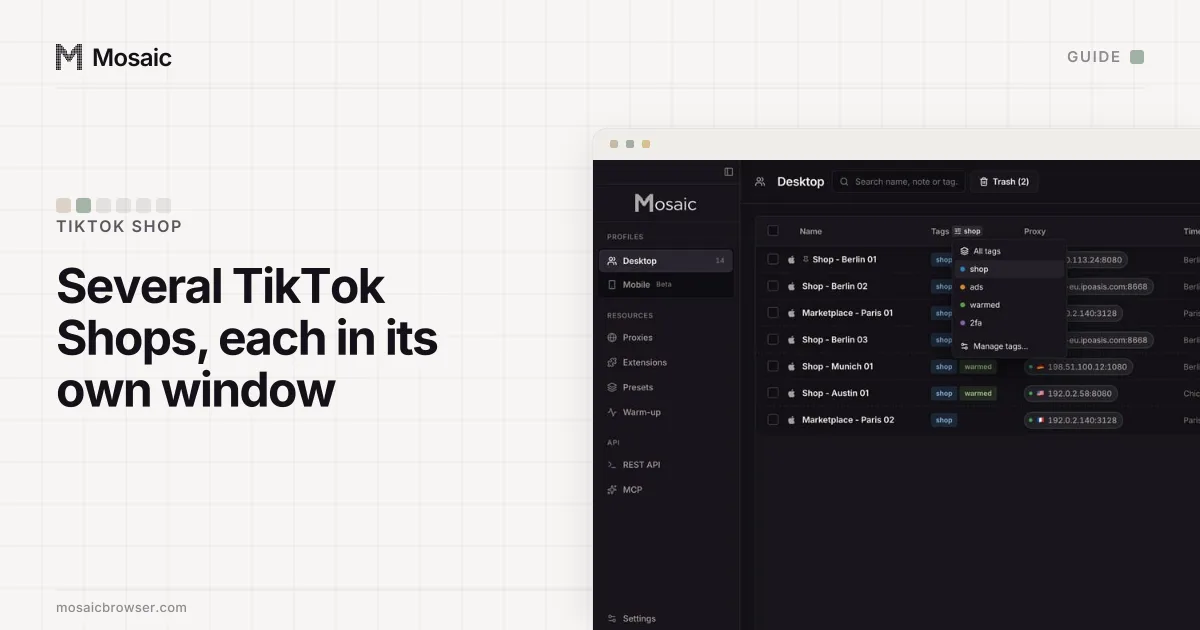
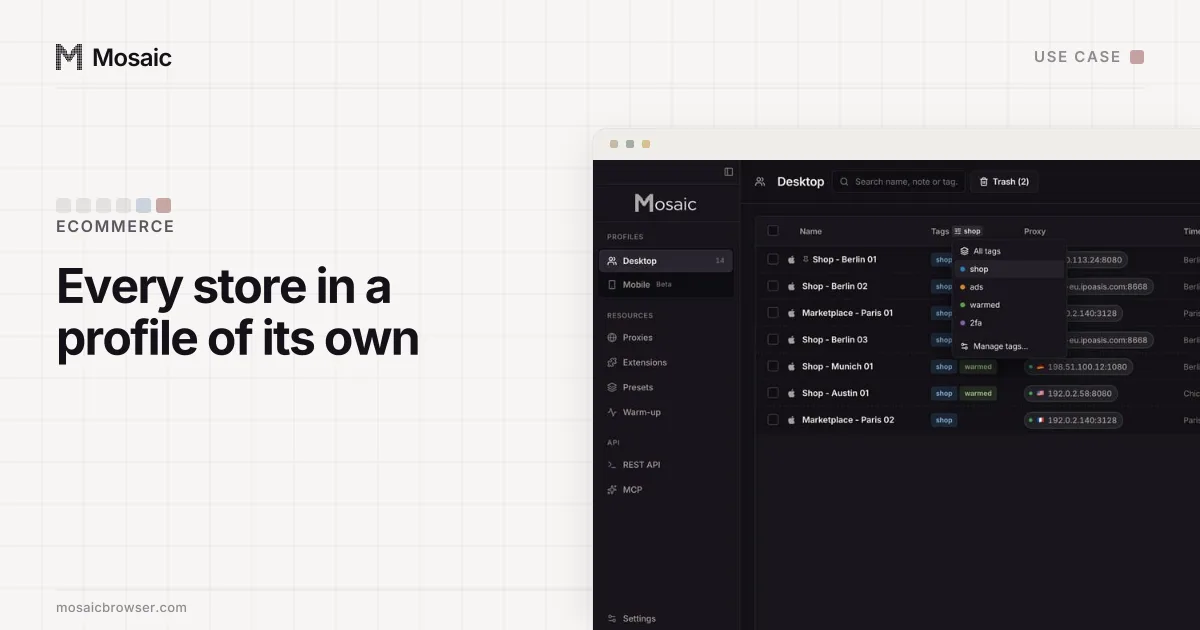
We built Mosaic for sellers past that point. Each shop gets a profile on Tesseract Chrome, our own Chromium, with its own cookies, its own fingerprint drawn from real hardware, and, if you attach one, its own proxy exit. Each profile saves downloads into its own folder, so one shop's shipping labels never print from another shop's batch.
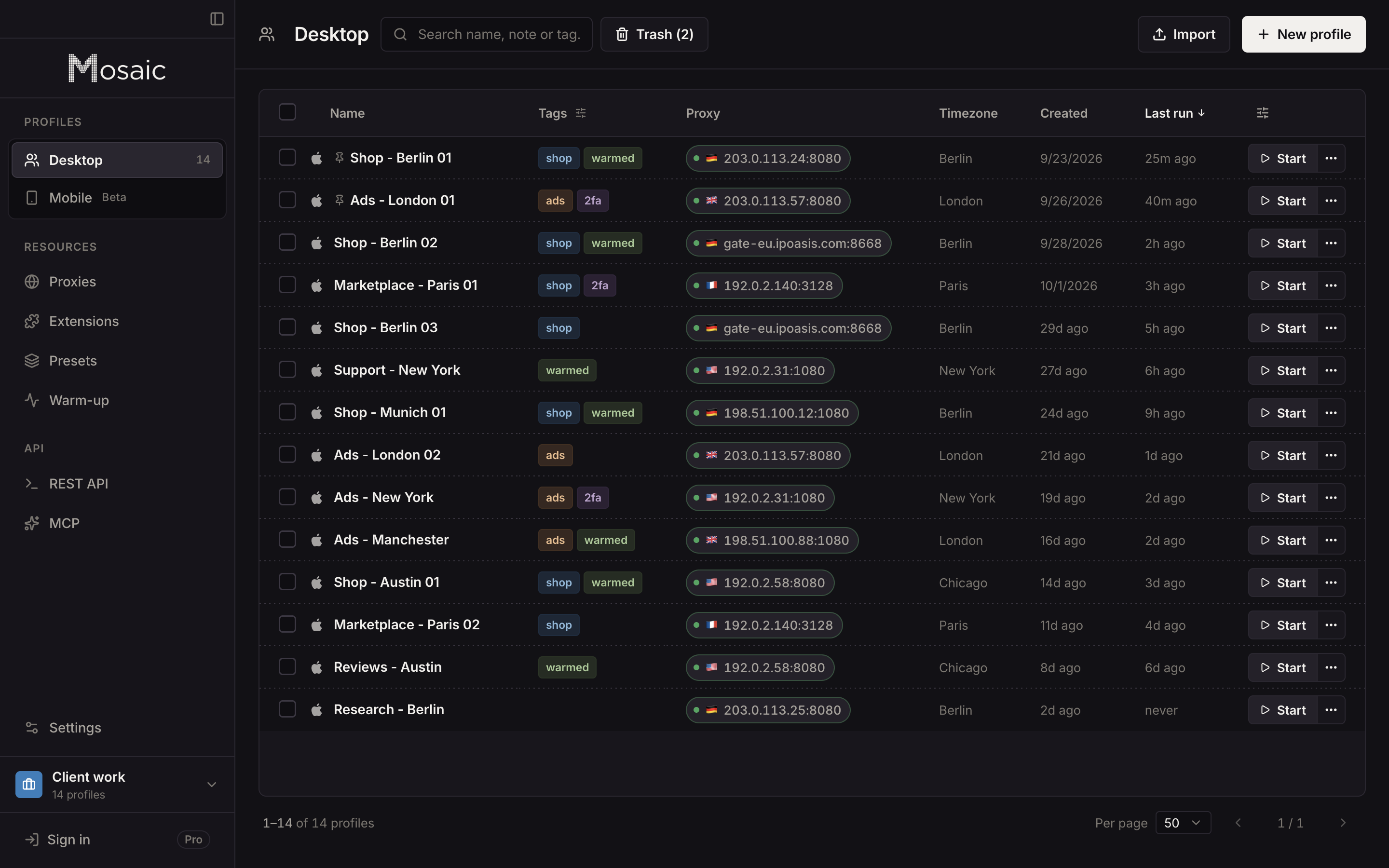
None of that hides whose shops they are. Your bank account, your team and your inventory still connect them, as they should. The day-to-day set-up, from naming profiles to storing each shop's login, is in how to manage multiple TikTok Shop accounts, and what TikTok Shop sellers do with Mosaic across marketplaces is on ecommerce. Free is 3 profiles and 10 profile creations; Pro is $49 a month with no per-profile pricing, on pricing.
Sources
- TikTok Shop Seller University (US): How to set up your TikTok Shop, read November 2, 2026
- TikTok Shop Seller University (US): What documents do I need to register as an Individual Seller or Sole Proprietorship?, read November 2, 2026
- TikTok Shop Seller University (US): Seller Enforcement Policy, read November 2, 2026
- TikTok Shop Seller University (US): Understanding Connected Account Risks Best Practices and Appeal FAQs, read November 2, 2026
- TikTok Shop Seller University (US): How to use User Management, read November 2, 2026