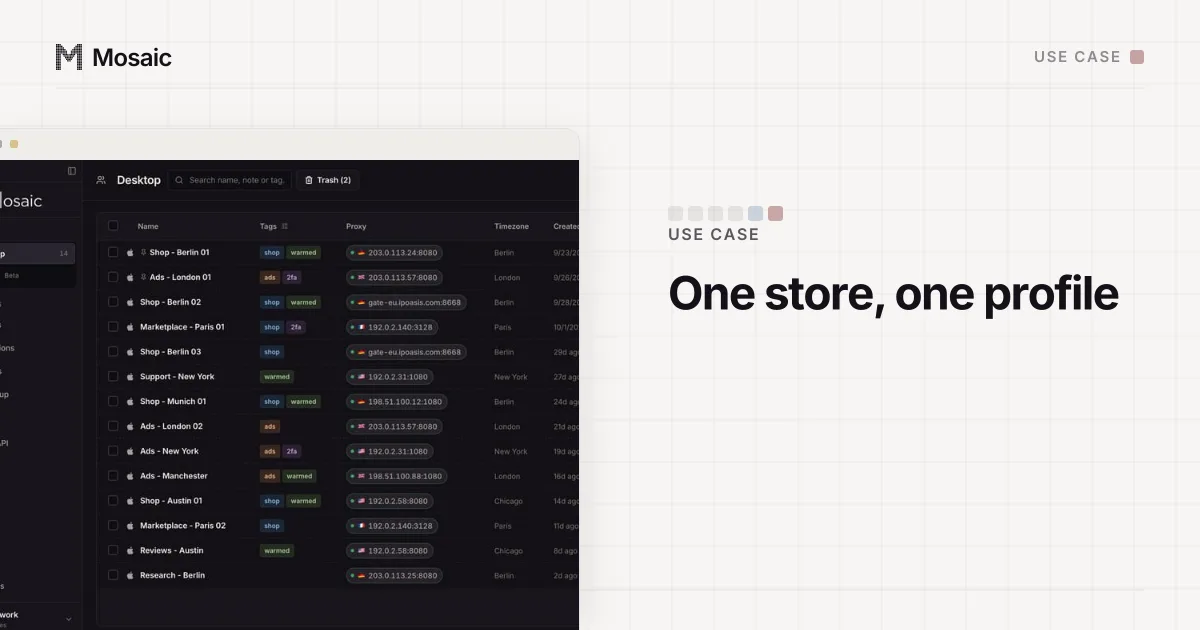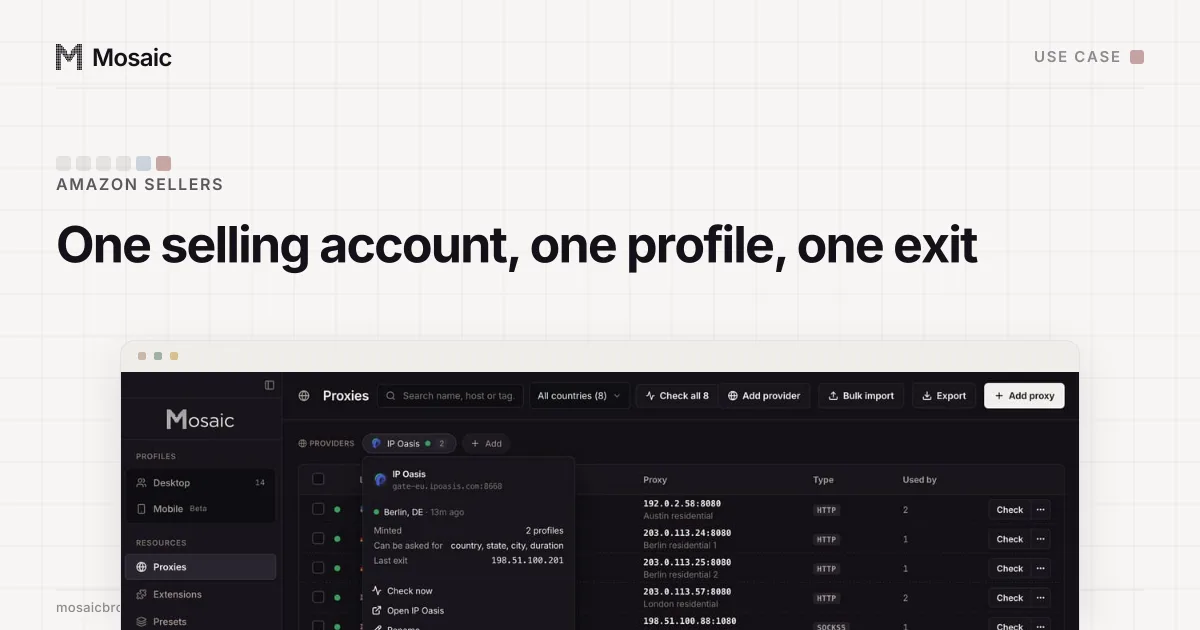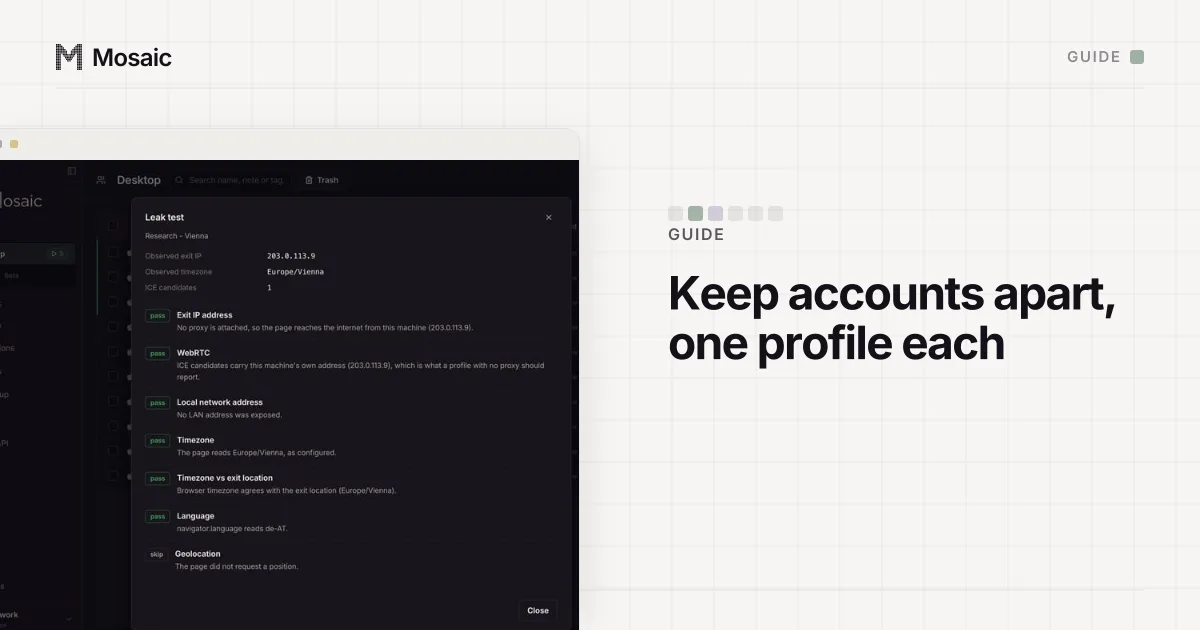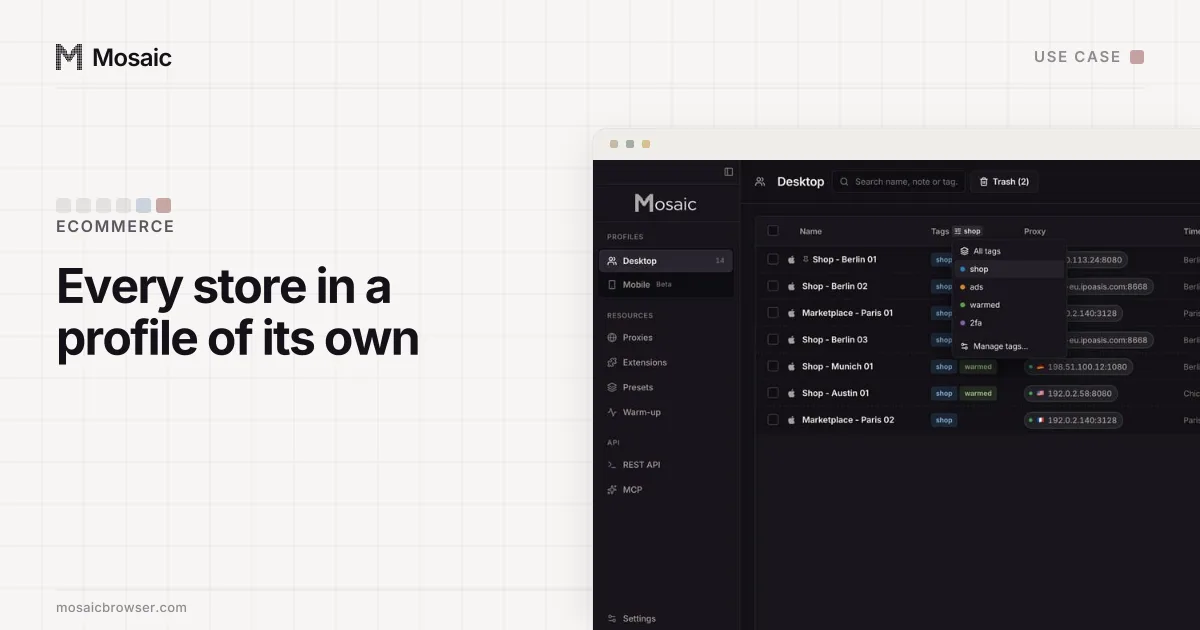
Ecommerce sellers end up with several browser sessions that must not touch: a store per marketplace, a store per region, a second brand that is its own company, the supplier portals behind them. An anti-detect browser keeps each of those in a profile with its own cookies, its own device fingerprint and its own exit address. Whether you need one depends on two things: what your marketplaces allow, and how many stores you actually work in.
What each marketplace allows
The rule decides whether a second account is a business decision or a problem. These are the marketplaces' own words, read on 2 November 2026.
| Marketplace | What it says about more than one account |
|---|---|
| Amazon | The Seller Code of Conduct says not to "operate more than one selling account on Amazon without a legitimate business need" |
| eBay | The multiple accounts policy says "Users may have multiple accounts on eBay", but not to register new ones to avoid restrictions or limits, and standards apply across all of them |
| TikTok Shop (US) | The seller setup guide says a seller can set up to 5 shops, one shop at a time |
Mosaic keeps the stores you are entitled to run apart; it does not change what a marketplace allows. If a marketplace has suspended a store, a new profile is not a way back, and we do not support using it as one.
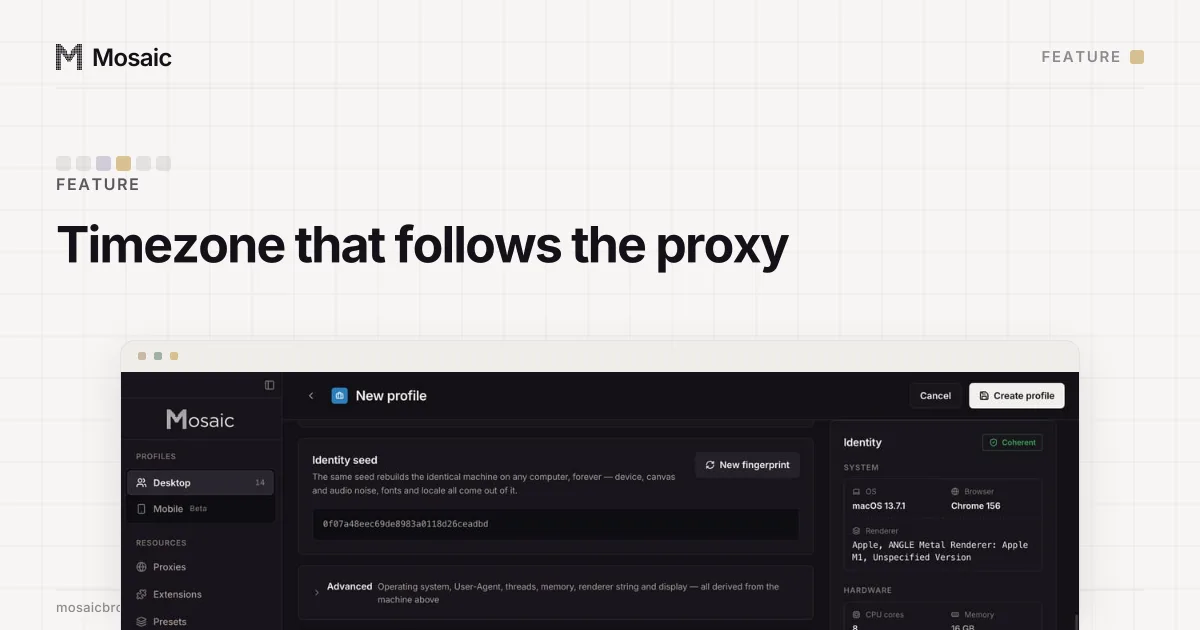
Timezone, language and location come from where the proxy comes outIn Mosaic: Matched to the exit. Timezone, language and location follow the proxy. Free holds 3 profiles. Pro is $49 a month for any number.
Mosaic is a desktop app
Email yourself the link and open it on your computer.
How it works: Matched to the exit
When you do not need one
A single store needs an ordinary browser. Two stores that you open once a week can live in two Chrome profiles, which split cookies and leave the fingerprint and address shared. An anti-detect browser earns its place when stores must not look like one device: separate companies, separate regions with their own exits, or an agency working in several clients' stores. How accounts get linked shows which layer each option leaves shared.
What to check in an anti-detect browser for ecommerce
Most of the pages ranking for this query are written by browser makers. These are the questions we would put to any of them, with our own answers beside them.
Does each store get its own exit, and does it stay put?
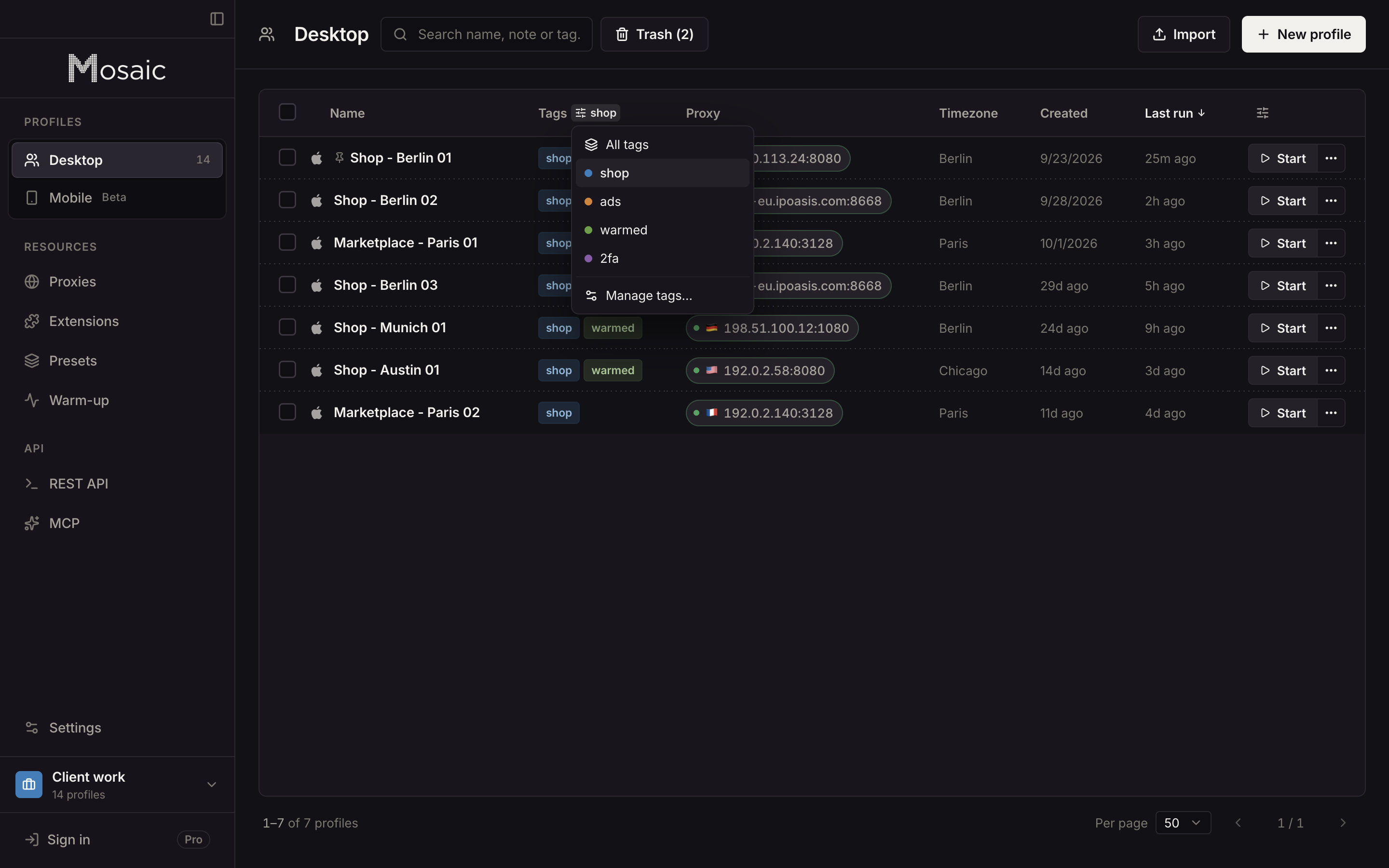
A store should come from the same country every day. In Mosaic, a provider mints a separate session for every profile, and a session you pin is never moved; if it dies, the launch stops and tells you.
Does the profile match the exit?
A store in Germany with a clock set to New York is the first mismatch a scanner reads. Mosaic measures each profile's exit and sets its timezone, language and geolocation from it before the page loads.
Is the proxy checked before the browser opens?
Mosaic will not open a profile behind a proxy that has not answered and tunnelled, so a dead proxy cannot send a page load from your home address.
Do store files stay with the store?
Invoices, reports and label PDFs save into each profile's own folder, kept out of Spotlight and deleted with the profile.
Where does the data live, and what does it cost at fifty stores?
Mosaic keeps profiles, cookies and proxies on your computer. Pro is $49 a month, one plan, with no per-profile pricing.
Moving stores from another browser
Sellers rarely start from nothing. Mosaic recognises exports from GoLogin, Dolphin Anty, AdsPower, Octo Browser and Multilogin by their shape and maps the name, notes, proxy, start pages, cookies where present, and the fingerprint fields that product recorded. Cookies come across only where the other product's export carried them.
Where Mosaic is not the right pick
No team seats, no cloud sync and no cloud phones. A profile lives on the computer that made it, so a shop with three staff on three laptops should use each marketplace's own user permissions. Mosaic sells no proxies; you bring a seller. The setup itself, store by store, is in Mosaic for e-commerce sellers, and Amazon specifics are in the Amazon sellers page.
Free covers 3 profiles and 10 profile creations; Pro has a 14-day free trial. Both are on the pricing page.
Sources
- Amazon Seller Central: Seller Code of Conduct, read November 2, 2026
- eBay Help: Multiple accounts policy, read November 2, 2026
- TikTok Shop Seller University: How to set up your TikTok Shop, read November 2, 2026