A Chrome profile is a folder of browser data: cookies, history, saved passwords, bookmarks, extensions and settings. Google describes profiles as a way to "keep your different accounts, like work and personal, separate" (Manage Chrome with multiple profiles, read 2 November 2026). They do that for anything stored in the folder. Most of a browser fingerprint is not stored in the folder. It is read from the computer, and every profile reads the same computer, which is why Chrome profiles do not have different fingerprints.
What stays the same in every Chrome profile
These are the values a page can read in any profile, without permission, and where each one comes from:
| Value | Read through | Comes from |
|---|---|---|
| Graphics card and driver | WebGL UNMASKED_RENDERER, WebGPU | the computer |
| Canvas and WebGL drawing output | toDataURL, getImageData | the GPU, driver and fonts |
| Screen size, colour depth, pixel ratio | screen, devicePixelRatio | the display |
| Installed fonts | text measurement | the operating system |
| CPU threads | navigator.hardwareConcurrency | the computer |
| Timezone | Intl.DateTimeFormat | the operating system clock |
| Dark mode, reduced motion, contrast | CSS media queries | the operating system |
| User-Agent and client hints | headers and navigator.userAgentData | the Chrome install |
| Public IP address | every request | the network |
None of those lives in the profile folder, so none of them changes when you switch profiles. Canvas fingerprinting, the most cited one, is a good example: a page draws hidden text and shapes and hashes the pixels. The result depends on the GPU, the driver and the font rendering, so two profiles on one Mac produce the same hash. More on how that hash is made is in our canvas fingerprinting entry.
The IP address is shared too. Chrome takes its proxy from, in order, managed policy, command-line flags, a proxy extension in the profile, or the system's network settings (Chromium's proxy notes, read 2 November 2026). With none of the first three, every profile uses the system setting, and every profile leaves from your connection.
Every profile is drawn from one real computer, not from separate listsIn Mosaic: Machines that exist. GPU, screen, CPU and fonts from one real device. Free holds 3 profiles. Pro is $49 a month for any number.
Mosaic is a desktop app
Email yourself the link and open it on your computer.
How it works: Machines that exist
What can differ between Chrome profiles
A few things are per profile:
- cookies,
localStorage, IndexedDB and cache, which is the part profiles were built for - extensions, some of which a page can detect
- the language list, if you set different languages in each profile's settings
- a proxy, if you install a proxy extension in that profile
So two profiles are two sets of cookies on one machine. To a site that only uses cookies, they are two visitors. To a site that reads the fingerprint, they are one visitor who signed in twice. The EFF's guide explains why that matters: a fingerprint is built from what the browser reports, not from what it stores, so clearing cookies does not change it (What Is Fingerprinting?, read 2 November 2026). A fresh profile is a tidier way of clearing cookies.
The values nobody thinks to check
When we built Mosaic we ran a test on our own profiles that is worth running on any setup: draw two profiles, read the same values in both, and flag every value that is identical between them and equal to the computer they run on. Those are values inherited from the machine rather than chosen.
That one comparison found six we had missed: dark mode, two accessibility settings, the display's colour gamut, the number of monitors and the scrollbar width. Several of them went out both as CSS media queries and as Sec-CH-Prefers-* request headers, so a site could read them before any script ran. The rare ones mattered most. If you turn on a setting few people use, every profile on your computer becomes unusual and identical, which makes them easier to group, not harder.
Chrome profiles inherit every one of those six, by design. They are settings of the computer, and a profile is not a computer.
How to check whether your Chrome profiles have different fingerprints
- Open a fingerprint test page in Chrome profile 1, such as the ones listed in how to check your browser fingerprint.
- Open the same page in profile 2.
- Compare the GPU renderer, screen, fonts, timezone, canvas hash and IP row by row.
On one computer with no extensions changing anything, expect them to match. That match is the answer to the question.
When Chrome profiles are enough
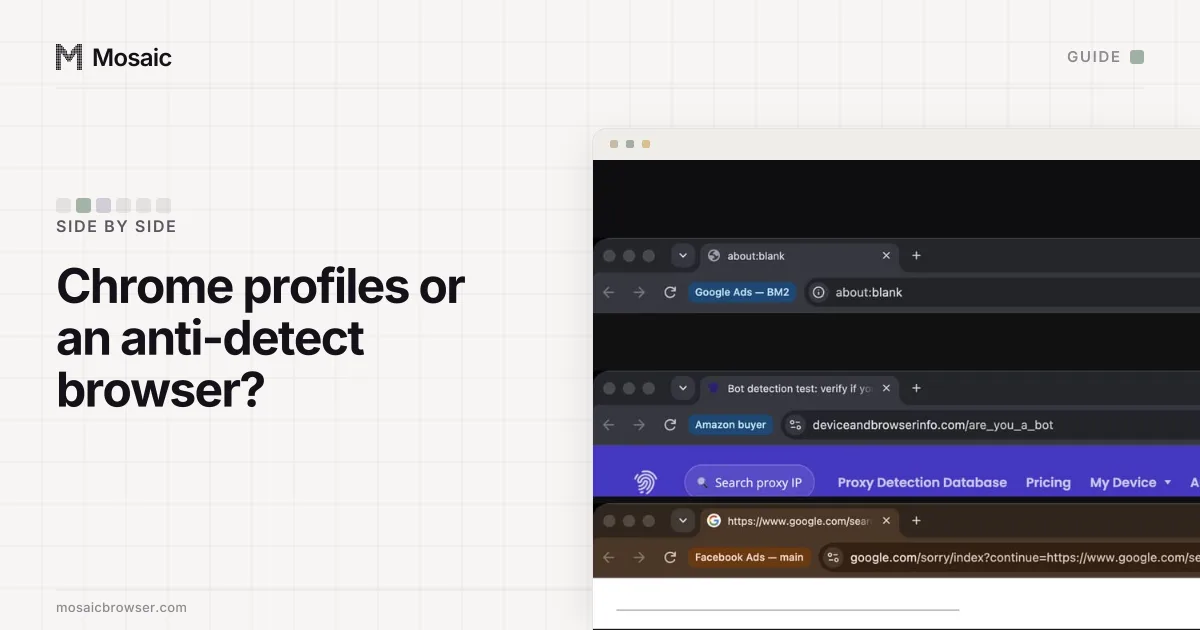
For your own work and personal accounts, profiles are the right tool, and they are free. Nobody expects your two Gmail accounts to come from two computers. They fall short when the accounts belong to different people or businesses that should not appear as one machine, such as client accounts at an agency, because the shared fingerprint and IP join them. Chrome profiles vs an anti-detect browser compares the two side by side.
How Mosaic profiles differ
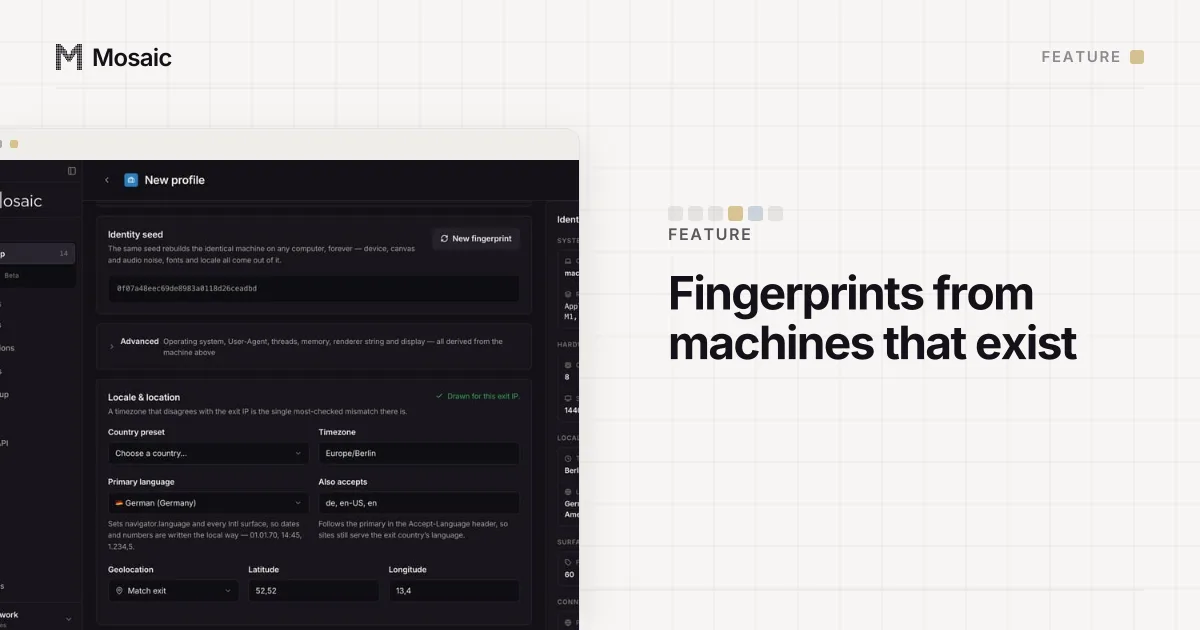
A Mosaic profile carries its own fingerprint as well as its own cookies. Screen, CPU threads, memory and fonts are drawn together from records of real hardware and changed inside our own Chromium, in C++, so the page and its workers read the same values. On a Mac the graphics chip stays your own, because detectors catch a renamed chip by how it draws; the machine drawn around it is one that really ships that chip. Dark mode is switched on for about 30% of profiles, roughly the share real traffic shows, and the other inherited values are drawn per profile too. A profile can claim any desktop OS or Android, but macOS matches best on a Mac, because fonts and font rendering come from the real computer and no switch reaches them. Each profile also has its own proxy, so the IP stops being shared as well.
Sources
- Google Chrome Help: Manage Chrome with multiple profiles, read November 2, 2026
- EFF Surveillance Self-Defense: What Is Fingerprinting?, read November 2, 2026
- Chromium: Proxy support in Chrome (net/docs/proxy.md), read November 2, 2026