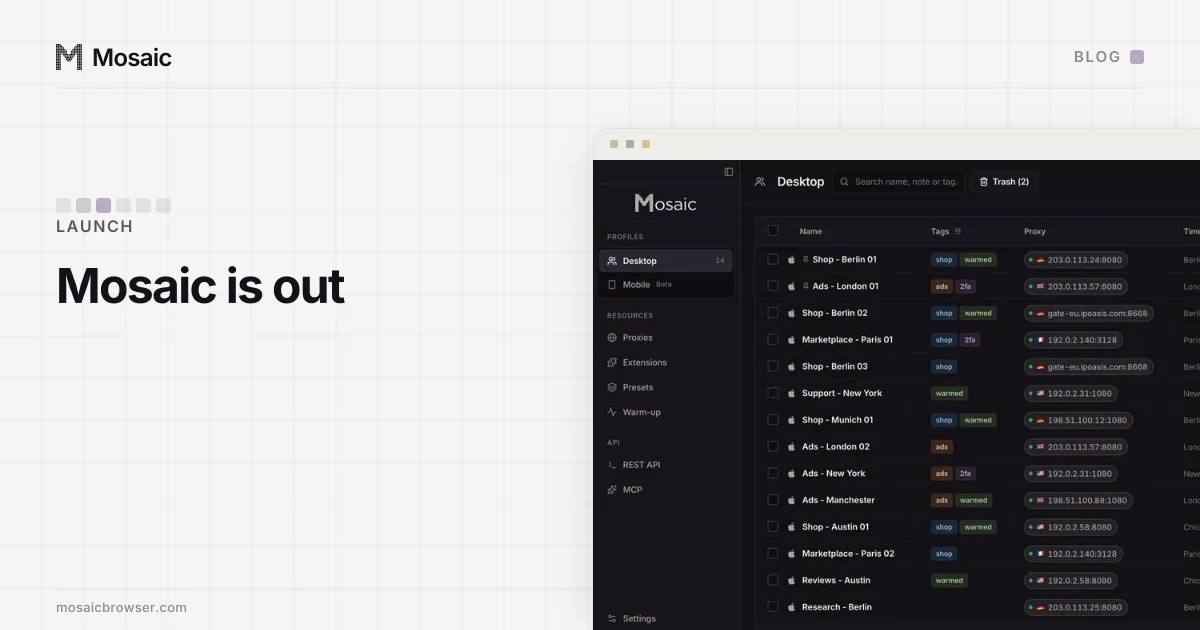
Mosaic is a desktop app for macOS and Windows that keeps many browser identities apart. Each one is a profile: a fingerprint, a proxy and a cookie jar that agree with each other. You start a profile and get a real browser window on your desk, with its own history, its own exit address and its own idea of what computer it is running on.
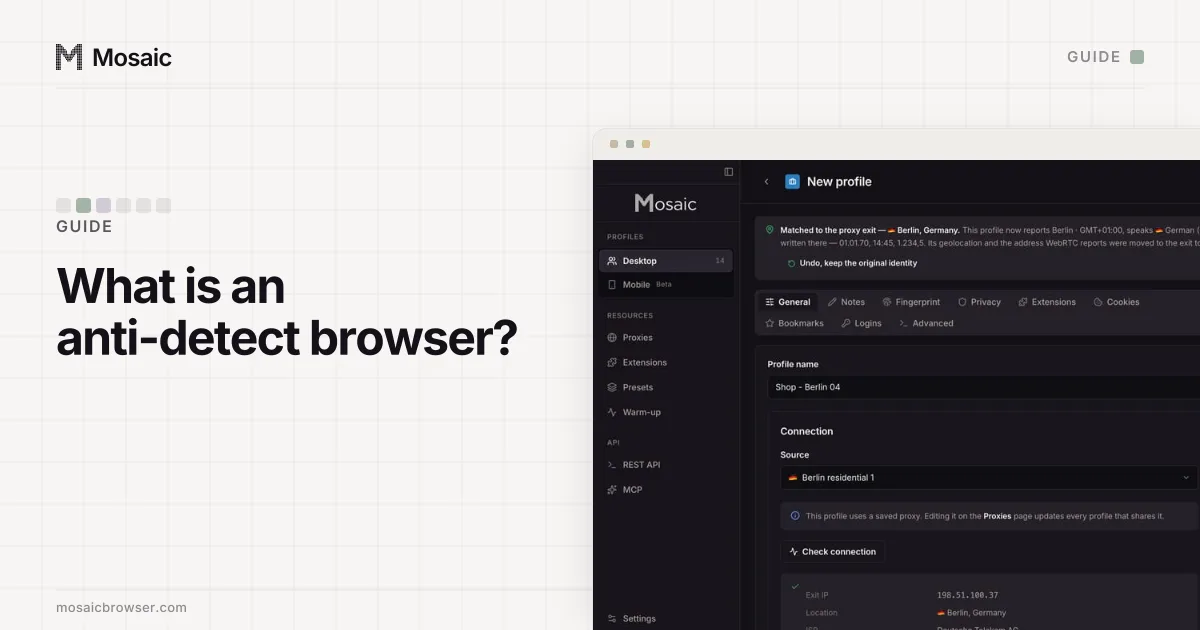
That is the category everyone calls an anti-detect browser. If the term is new to you, what an anti-detect browser is covers it from zero. This post is about the three decisions that make Mosaic different from the others, and about the price.
The browser is our own Chromium
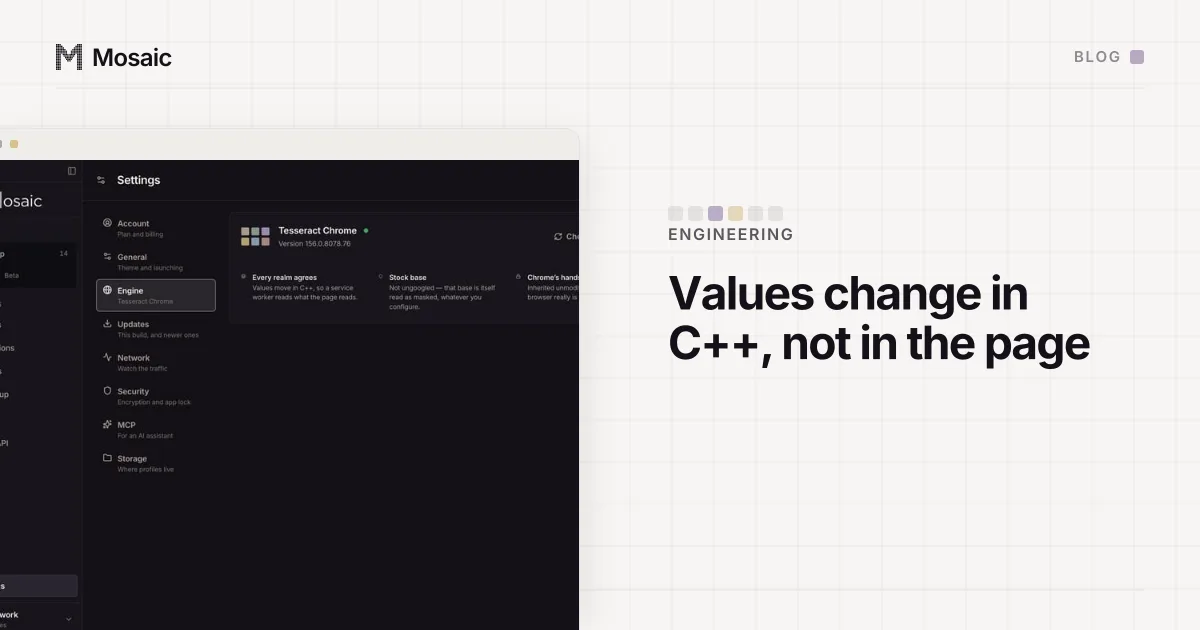
Mosaic does not drive the copy of Chrome you already have, and it does not inject a script into pages to tell them a different story. It ships its own engine, called Tesseract Chrome: stock Chromium source with more than sixty patches applied, built by us.
The patches change values in C++, inside the engine. So the page, every iframe and every worker read the same GPU, the same screen and the same timezone, because there is only one place the answer comes from. A script injected into a page has to win that argument in every realm separately, and a consistency scanner exists to find the realm where it lost. Why we built our own Chromium has the long version, with the measurements that pushed us there.
Every profile is drawn from one real computer, not from separate listsIn Mosaic: Machines that exist. GPU, screen, CPU and fonts from one real device. Free holds 3 profiles. Pro is $49 a month for any number.
Mosaic is a desktop app
Email yourself the link and open it on your computer.
How it works: Machines that exist
Profiles are drawn from machines that exist
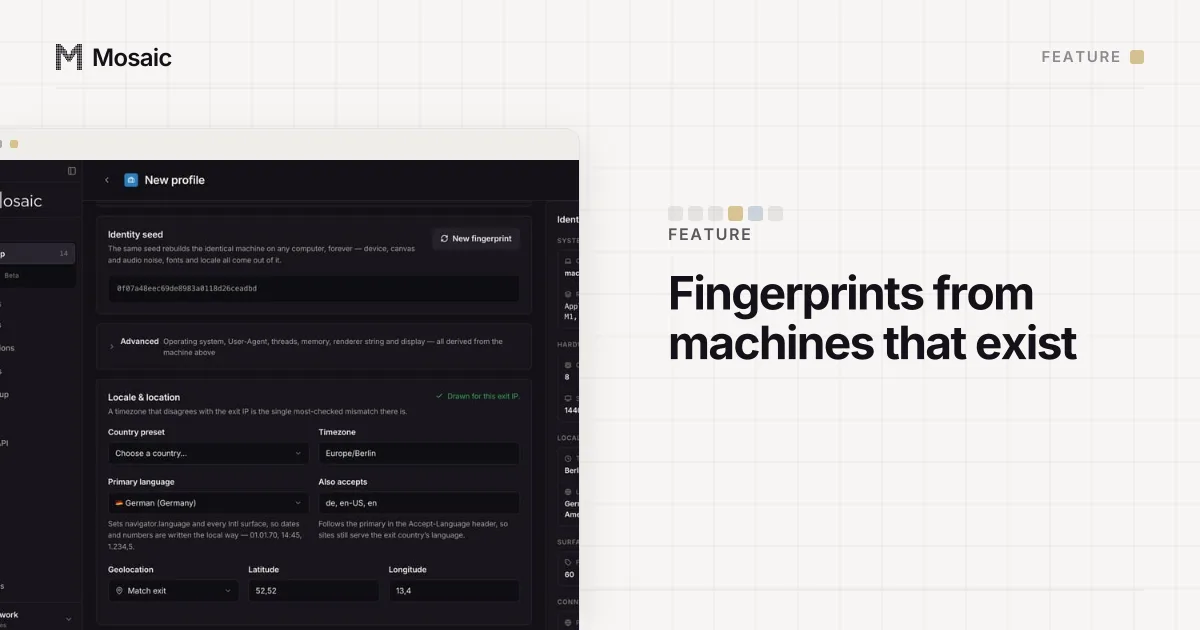
A fingerprint is not a bag of independent fields. An Apple M3 Max next to a 13-inch MacBook Air panel is a combination nobody can buy, and a site with a table of real hardware reads it instantly. So Mosaic draws a whole device at once: the GPU as its driver names it, the thread counts that model ships with, the memory, the panels. Then it chooses within that one machine. Incoherent combinations are not filtered out afterwards; they cannot be built in the first place.
The profile is then matched to its proxy. Timezone, language and location follow the exit the profile browses through, and Mosaic measures that exit rather than trusting the country in a proxy's name. A profile that claims Berlin while its traffic leaves from Ohio fails the first comparison any scanner makes. Machines that exist shows how a profile is put together.
Everything stays on your computer
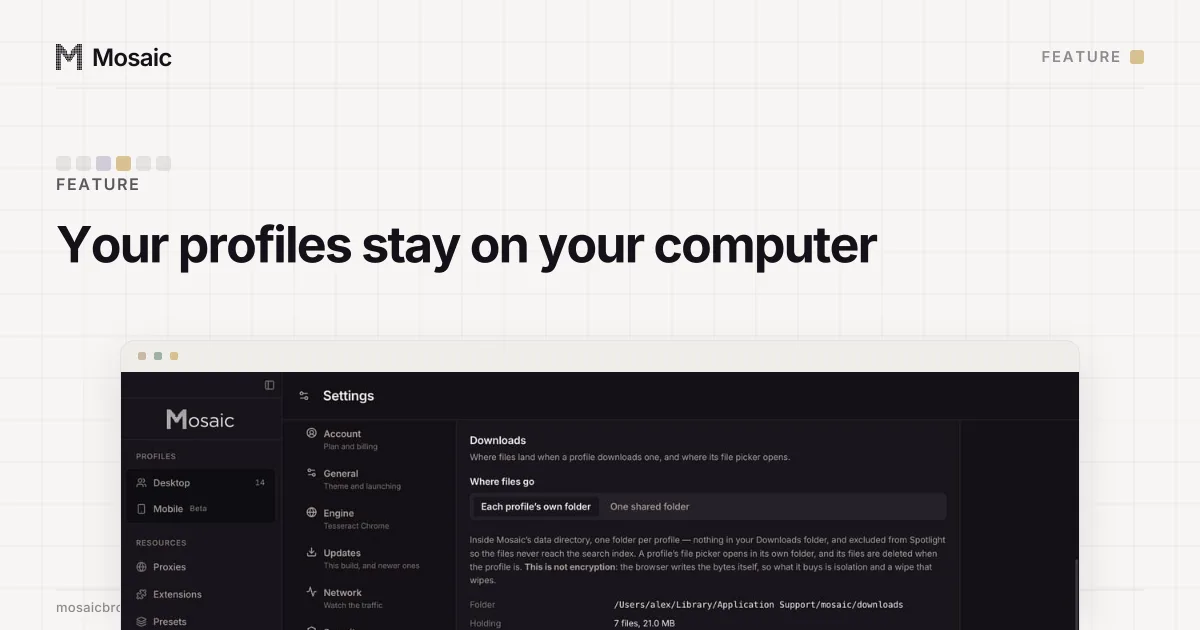
Profiles, cookies, proxies and logins live in a folder on your disk. There is no sync server holding your accounts, and no team dashboard in somebody else's cloud. Our server knows your plan and when a profile opens, by an id, and never what is in it.
This has a cost and we would rather say it up front. You cannot open the same profile from a second computer, and there are no shared team workspaces. If you need those, a cloud product will suit you better. If what worries you is a vendor holding the cookie jars for every account you run, local first explains what we do instead. The store and cookie jars are encrypted on disk, an app lock means nothing decrypts without your password, the library is snapshotted daily, and the trash keeps deleted profiles for 30 days.
One plan, no per-profile pricing
There are two plans. Free is 3 profiles and 10 profile creations, with the full browser and every fingerprint feature. Nothing about the engine is held back on Free.
Pro is $49 a month, with a 14-day free trial. It removes every limit: unlimited profiles, unlimited projects, and the two automation surfaces, a local REST API and an MCP server for AI assistants. There are no tiers by profile count, because a profile costs us nothing to give you. It runs on your machine, on your CPU, and is stored on your disk. Charging per profile would be charging for a number. The pricing page has the details.
What it is for
Mosaic is for running accounts you are allowed to run: a seller with a shop per marketplace, an agency with each client's ad account in its own browser, a social media team keeping brand pages apart, a QA engineer who needs a clean browser that reports Tokyo time and a Japanese exit. Using it to get around a ban or to fake identities is not something we will help with.
It is also a young product. We do not have teams, cloud phones or iOS profiles, and we are not going to pretend otherwise on a comparison table. What we do have is an engine we can patch and rebuild in minutes when a site finds something new, and a habit of measuring before we claim anything.
Getting it
Mosaic is built for macOS and Windows. The download page says what is available and for which system, and questions and corrections go to hello@mosaicbrowser.com.