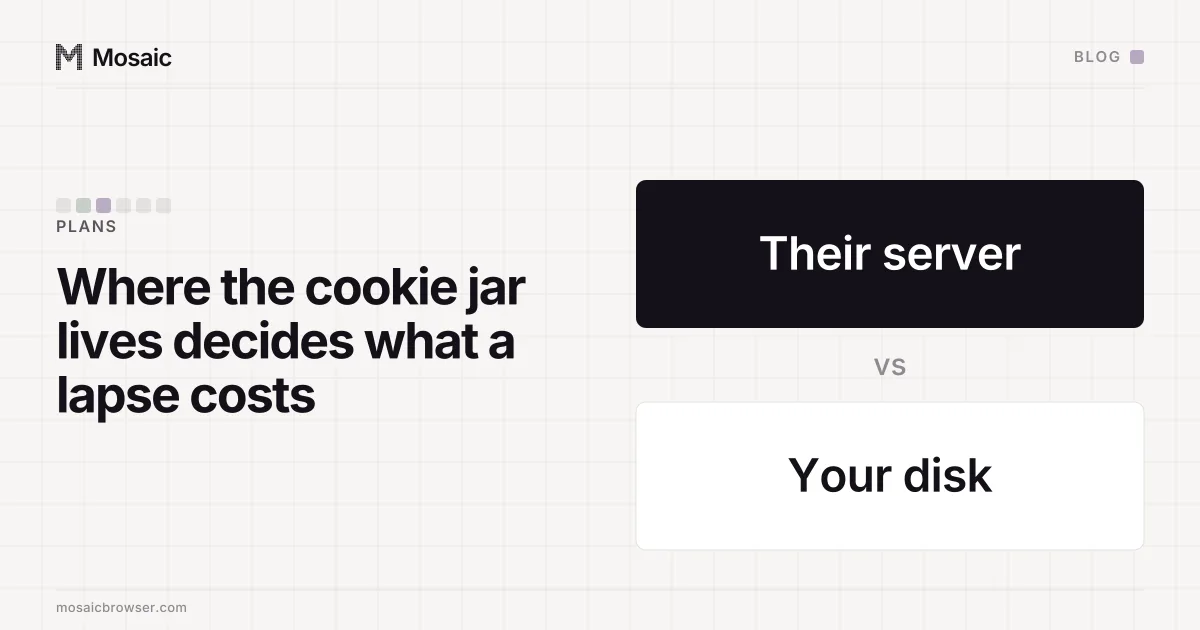
When an anti-detect browser subscription expires, what happens to the profiles depends on where they are stored. If the vendor keeps them on its servers, the cookie jars are in its hands and its retention terms decide how long they exist. If the profiles live on your computer, the files stay on your disk and the lapse changes only what the app allows. Find out which kind you have before the renewal date.
Two places a profile can live
A profile in this kind of browser is several things kept together: a cookie jar with your signed-in sessions, a fingerprint, a proxy and the browser's own storage. That bundle has to sit somewhere, and products split into two camps.
In the first, the profile is stored with the vendor. That is what makes opening the same profile on a second computer, or handing it to a colleague, work: the copy that matters is on their side, and your machine downloads it to launch. In the second, the profile is a folder on your own disk, and the vendor never holds the cookie jar.
Neither arrangement is a trick. They are different trade-offs, and the bill for each one arrives on a different day. With a cloud copy you pay in dependence: the day you stop paying, the cookie jars are on a server you no longer have a contract with. With a local copy you pay in custody: the vendor cannot lose your profiles, and it cannot restore them either.
Make 500 profiles in one go, then work on all of them at onceIn Mosaic: Bulk actions. 500 profiles per batch; start, edit and type into many. Free holds 3 profiles. Pro is $49 a month for any number.
Mosaic is a desktop app
Email yourself the link and open it on your computer.
What a lapse costs with a cloud copy
Here a lapsed subscription is a question about someone else's records. The usual pattern is a read-only or locked state for a period, and then deletion, but the length of that period, whether you can still export during it and whether a downgrade counts as a lapse are all in each vendor's own terms and help pages. Read them before you need them, and read the date on them, because they change.
The part people tend to miss is that the expensive thing to lose is not the fingerprint. A fingerprint can be drawn again. The cookie jar cannot: it holds sessions that took sign-ins, two-factor codes and sometimes weeks of ordinary use to build. If the only copy is on a server that will delete it, the lapse costs every one of those sign-ins.
What a lapse costs with a local copy
When the profile is a folder on your disk, ending the subscription does not reach it. The files are still where they were the day before. What changes is the software's side: which plan you are on, how many profiles it will open, which features stay on.
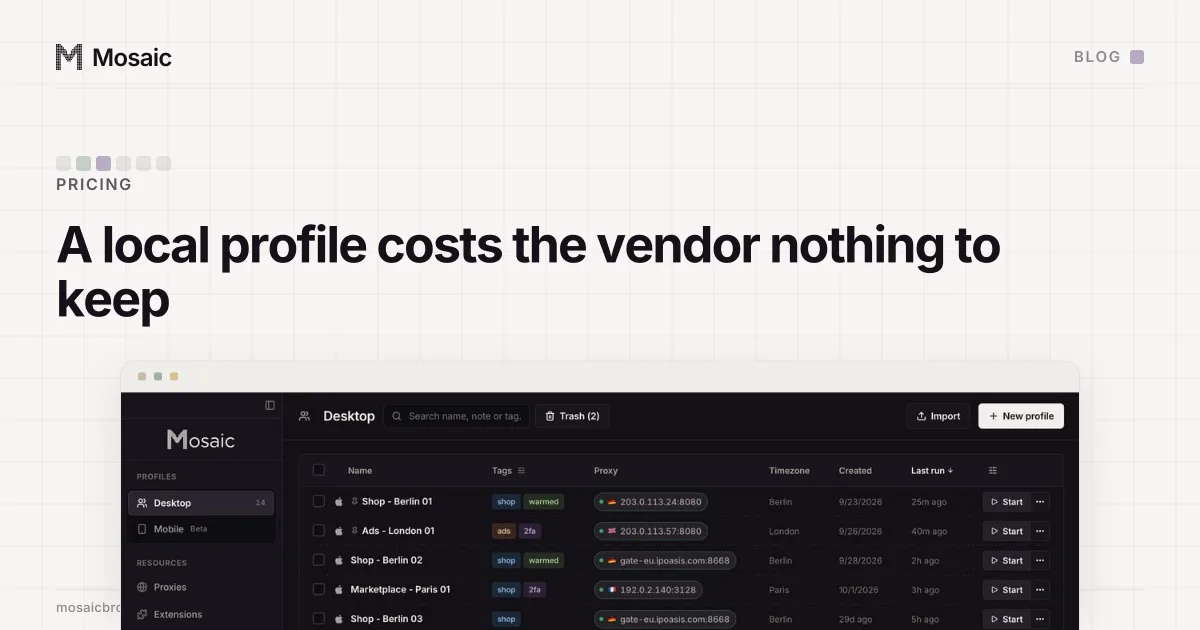
That is how Mosaic is built. Profiles, cookies and proxies stay on your computer, and Mosaic has no cloud copy of your profiles. If a Pro subscription ends, nothing in the library is deleted and the account is on the free plan. The free plan has every engine feature, and it is limited by how many profiles it holds and makes, and by the two automation surfaces, the REST API and MCP; the exact numbers are on the pricing page, which reads them from the same file the app enforces them from. Exporting is not a Pro feature, so cookie jars can be exported on either plan.
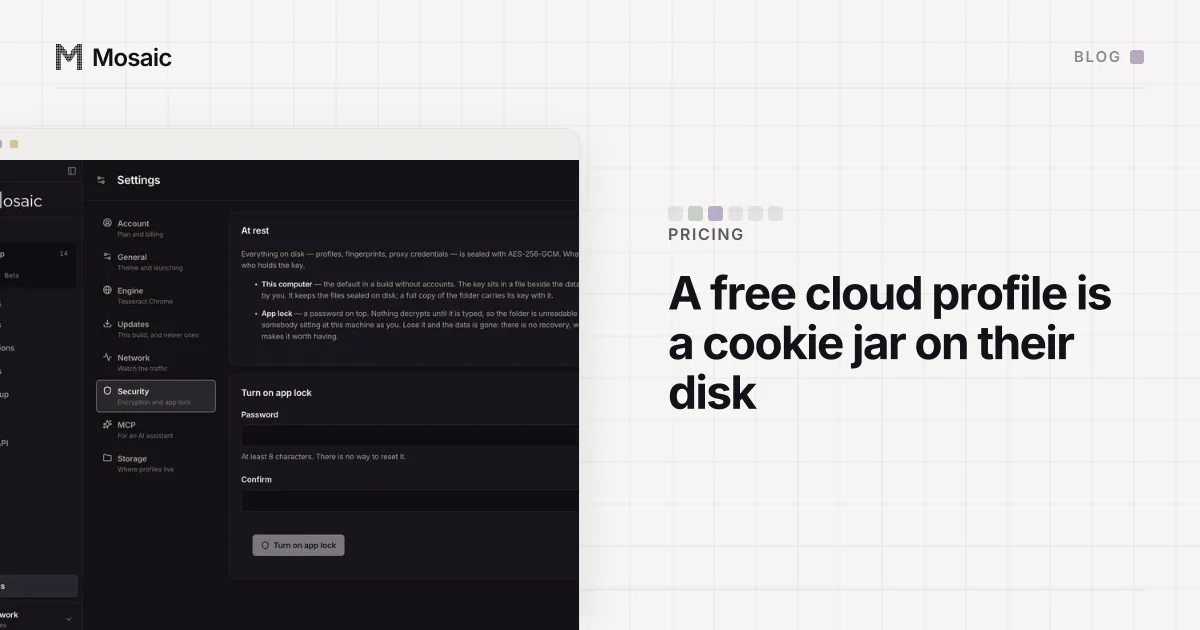
Custody is the cost. The store and cookie jars are encrypted on disk, and Mosaic keeps daily backups of the library for 7 days by default, but those backups are on the same computer. A disk that fails takes them with it unless you copy them somewhere else.
Before an anti-detect browser subscription expires, save the profiles
Do these while the subscription is still active, because some of them may not be possible after:
- Export each cookie jar in a format other software reads. In Mosaic, the Export current button on a profile's Cookies tab fills the box above it with the jar as JSON, ready to save to a file. While Pro is active, the same jar is also at
GET /profiles/:id/cookiesover the local API. - Write down which proxy each profile used. A session arriving from a new address is one of the things a site notices.
- If you keep whole profiles, export them while they are stopped. Mosaic refuses to export a running profile, because a live browser has its databases open and the archive would catch a half-written session.
- Store the exports like passwords. A cookie jar is a set of signed-in sessions, and anyone holding the file can use them.
How much a profile should cost in the first place, and why so many products price by profile count, is in why anti-detect browsers cost what they cost. The same export-then-retire order for a client whose contract is ending is in what to do with a client's browser profile when the contract ends, and pricing by open browsers rather than stored profiles is in paying per open browser instead of per profile.