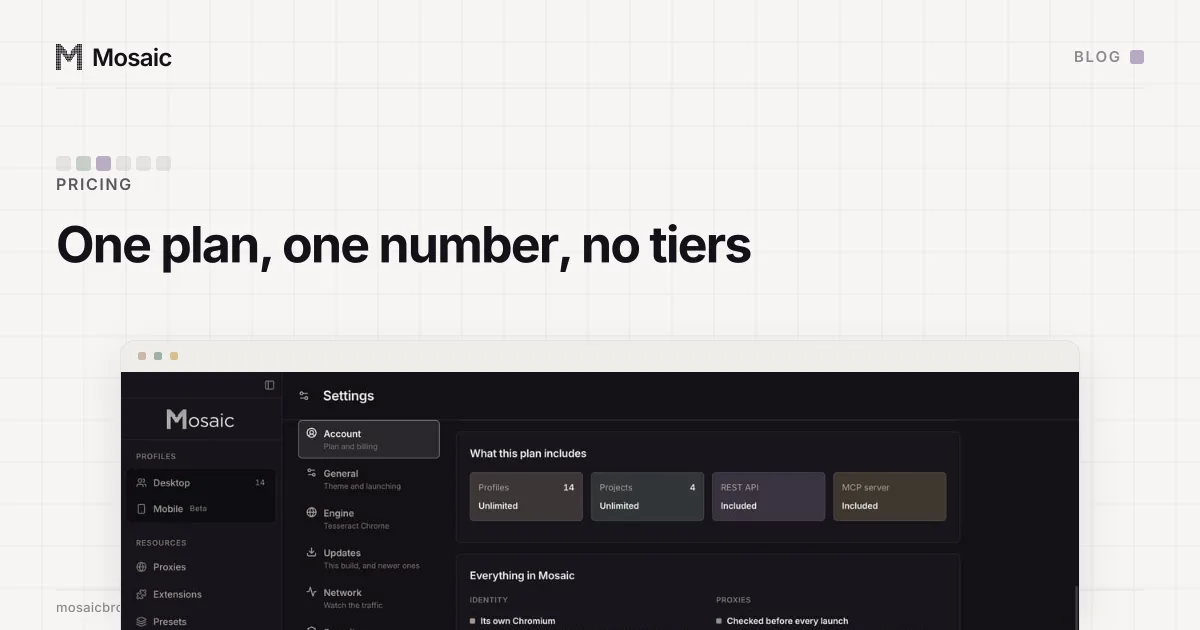
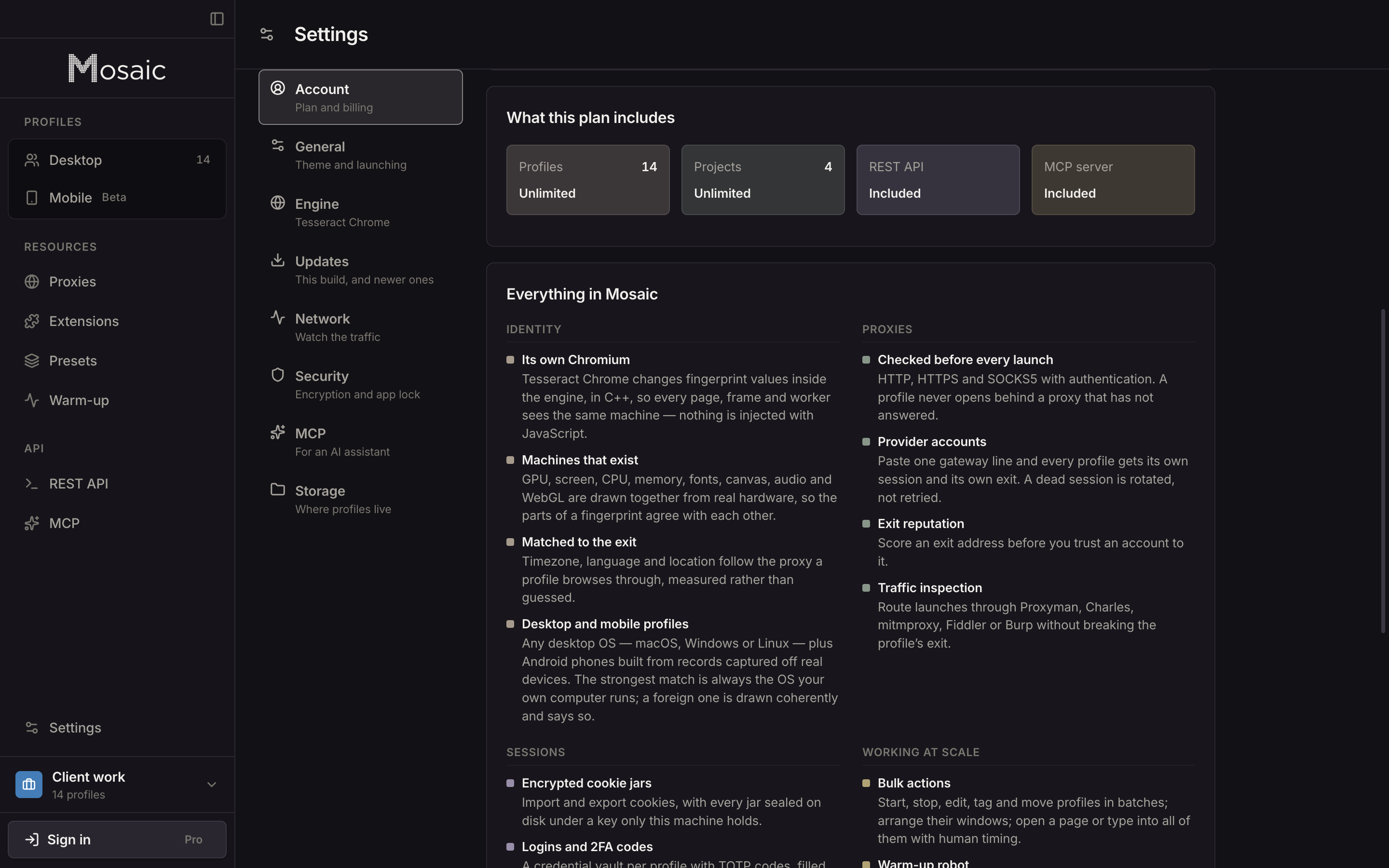
Anti-detect browser pricing per profile means you buy a count: a plan holds a set number of profiles, and the next step up costs more. Mosaic Pro does not work that way. It is $49 a month, one plan, everything unlimited, and the 1,000th profile costs the same as the first. Here is why we wrote the price like that.
What anti-detect browser pricing per profile pays for
A per-profile plan has a table behind it. Each row is a number of profiles and a monthly price, and when your work grows past a row you move to the next one. For a product that keeps your profiles on its own servers, that table follows the costs. Every stored profile is disk and traffic the vendor pays for, so charging per profile is charging for something real.
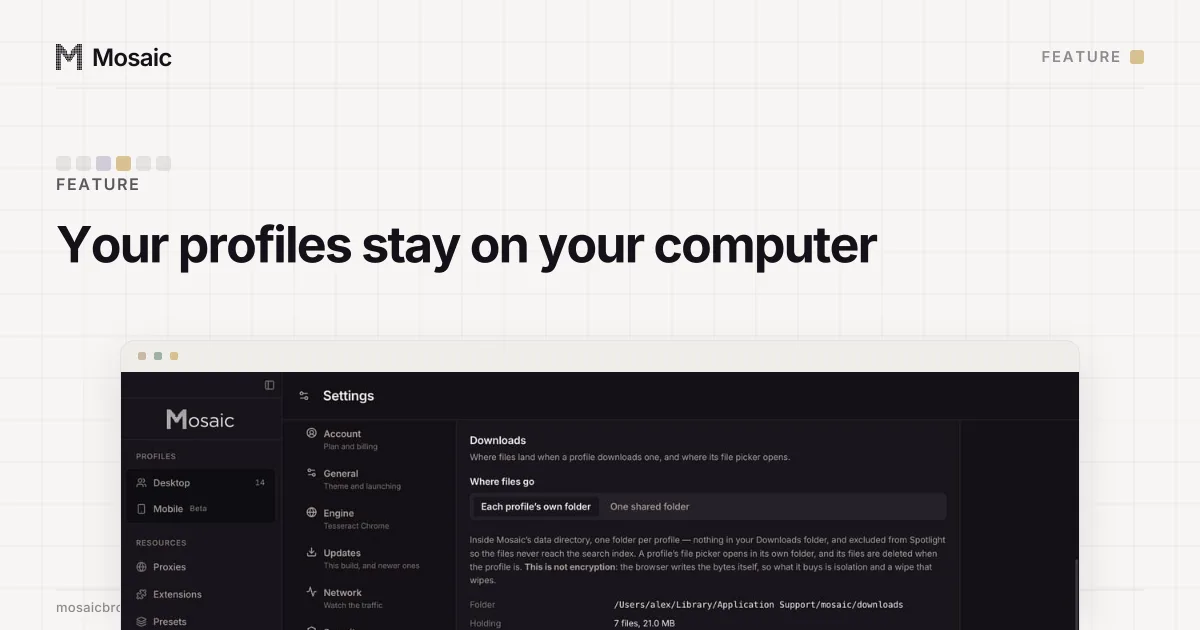
Mosaic keeps nothing of the kind. A profile is a folder on your computer and a browser process on your CPU. Its cookies, its proxy and its fingerprint stay there, and Mosaic has no cloud copy of your profiles. So we asked what a profile costs us, and the answer was nothing at all.
The comment in the code
The plan file in the app, src/shared/plans.ts, carries the reason next to the price. The one paid plan is a fixed price with no tiers, because the things a tier would meter (profiles, projects, API calls) cost this product nothing to give away: everything runs on the customer's own machine.
That sentence decided the shape of the whole file. The limits table has two rows, free and pro, and Pro's profile, project and creation limits are all null, which the file defines as unlimited. We used null rather than Infinity on purpose. The limits cross JSON three times, between the window, the local API and the account server, and JSON.stringify(Infinity) comes out as null anyway. A value that changes on the way would be a second description of one limit.
Your profiles, cookies and proxies stay on your computerIn Mosaic: Local first. Profiles, cookies and proxies stay on your computer. Free holds 3 profiles. Pro is $49 a month for any number.
Mosaic is a desktop app
Email yourself the link and open it on your computer.
One number, from the button to the card
A single price only helps if it is the same number everywhere. The price lives once, as PRO_PRICE, in cents: amount: 4900, in US dollars, every month. The pricing panel in the window reads it. The account server that sells Pro reads it too.
Payment goes through Stripe, and a Stripe Price is a separate object that could drift from our file. So the account server checks the configured Price against PRO_PRICE before it takes anyone to checkout. If the two disagree, it does not fail and it does not charge the stale figure. It checks out at the amount in plans.ts, on the same Stripe product, and writes to its log that the Price needs replacing. The number you see on the button is the number on your card statement.
What Free is, and where the line sits
A flat Pro price still needs a free plan with an edge, so people can try the browser before paying. Free: 3 profiles and 10 profile creations. It runs the same engine and the same fingerprints drawn from real hardware as Pro, with the same proxy check before every launch. The difference between the plans is limits and the two automation surfaces, the local REST API and the MCP server, never a crippled browser.
We put the line there because those are the things a person with five accounts does not need and a person with five hundred does. A weaker fingerprint on Free would have been a different kind of line, and a dishonest one: it would teach people the product is weak.
What one price does not cover
One price is not the lowest price for every buyer, and we are not claiming it is. If you only ever run a few accounts, Free may be all you need, and a small per-profile tier somewhere else could cost less than $49 a month.
The price also does not include proxies. Mosaic sells none. You bring a seller, paste one gateway line as a provider, and every profile mints its own session from it. That bill goes to your proxy seller.
Why we think it is the honest shape
A local product is software you run, so we charge for the software. Profiles, projects and API calls happen on your machine, at your cost in disk and CPU, and putting a meter on them would mean charging rent on things you already own. Local first lists what lives on your computer and what our account server knows.
Try Pro free for 14 days; the trial takes a card, and if you cancel before day 14 you pay nothing. The plans are on the pricing page.