To test affiliate link redirects by country, you have to click the link from each country. The tracker decides on the server, from the visitor's IP address, so an exit in that country is the minimum. A real visitor's browser also carries a timezone and a language, and the landing page at the end of the chain may read both. Only a browser whose exit, language and timezone agree on one country sees the page a visitor there gets.
How an offer decides where to send a click
An affiliate link rarely points at the merchant. It points at the network's tracking domain, and the chain usually runs like this:
- The tracker receives the click and records it, with your publisher ID and any sub-ID.
- It looks up the country of the IP address the request came from.
- It checks the offer's allowed countries. A click from an accepted country goes to that country's landing page. One from elsewhere goes to a fallback: another offer, a generic page, or a "not available in your region" page.
- It answers with an HTTP redirect, and sometimes the next hop is a second tracker, the advertiser's own, which runs its own lookup.
That lookup happens before your browser has run a line of JavaScript, so nothing in the browser can influence it except the address. The landing page is where the browser starts to count. A page built for several markets often picks its language from navigator.language or the Accept-Language header, and some read the timezone to decide which prices or which legal text to show.
Paste one gateway line. Every profile mints its own exitIn Mosaic: Provider minting. One gateway line, a separate exit for every profile. Free holds 3 profiles. Pro is $49 a month for any number.
Mosaic is a desktop app
Email yourself the link and open it on your computer.
How it works: Provider minting
What curl tells you, and what it misses
The fastest first look is from the command line, through a proxy in the country you want to test:
curl -sIL -x http://user:pass@gateway:port 'https://track.example/click?id=123' | grep -i '^location'
That prints every HTTP redirect the servers send, in order, so you can see the tracker hand the click on and where it lands. It is worth doing for each country, because a chain that ends at the same URL everywhere is often an offer whose country rules were never set.
It misses two things. Many chains include a page that redirects with a meta refresh or a script, and curl stops there. And curl sends no browser language and has no timezone at all, so a landing page that reads them sees a visitor no country produces.
How to test affiliate link redirects by country: three profiles
The test that matches a real visitor is a browser per country. Take three: Germany, the United Kingdom and the United States. Each profile needs an exit in its country, a language a person there would plausibly have, and that country's local time. If any one of the three points elsewhere, you are testing a mixture.
The mismatches are easy to make by hand. A VPN moves the IP and leaves the timezone where you are. A browser set to German that browses from a US exit is a visitor a US offer may treat oddly. And a residential exit can move between sessions, which is why the setting worth fixing is the country rather than the address (pinning the country, not the address, has the reasoning).
Run the same link in all three and record, per country, every URL in the chain and the page you end on. The difference between the three columns is the offer's geo setup, written out.
Doing it in Mosaic
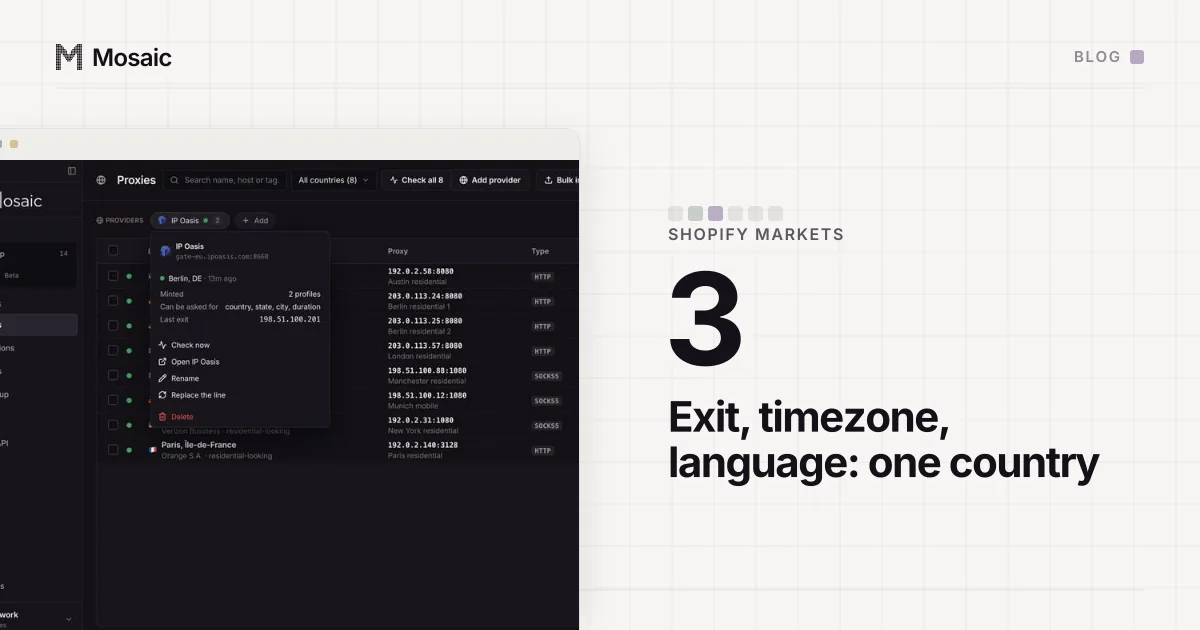
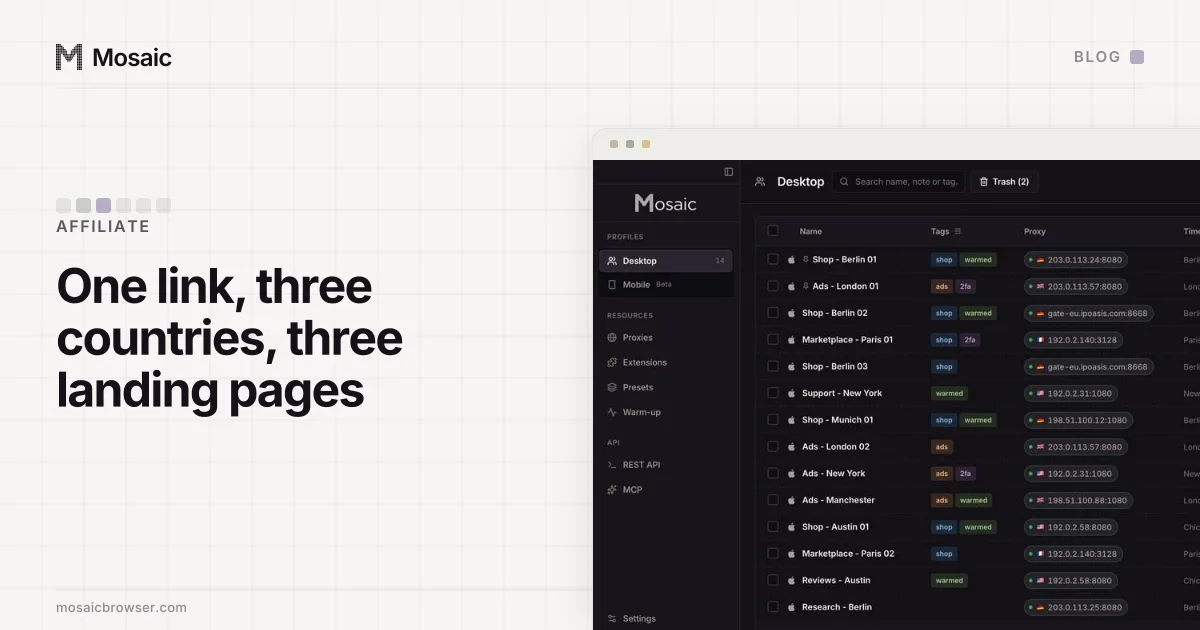
A Mosaic profile carries its own exit, fingerprint and cookie jar. Save your proxy seller's gateway line once as a provider, then make one profile per country and pick the country for each. Every profile mints its own session, and Mosaic checks the proxy before the browser opens. The profile's timezone, language and geolocation are set from the exit it measured, so the German profile reads German time without you setting it.
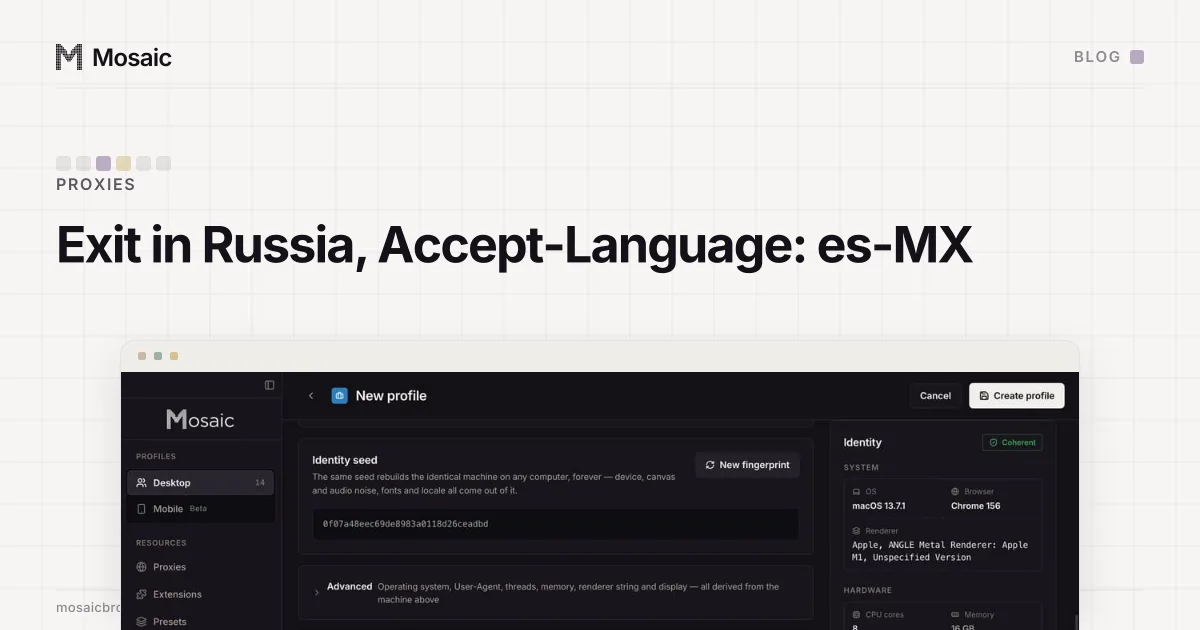
One thing it deliberately leaves alone. The language follows the exit only on a profile that has never run; on one with history, a language that disagrees with the exit is reported and kept, because the site has been hearing it all along (the profile that kept speaking Mexican Spanish is how we got there). For a geo test, a new profile per country is the clean start.
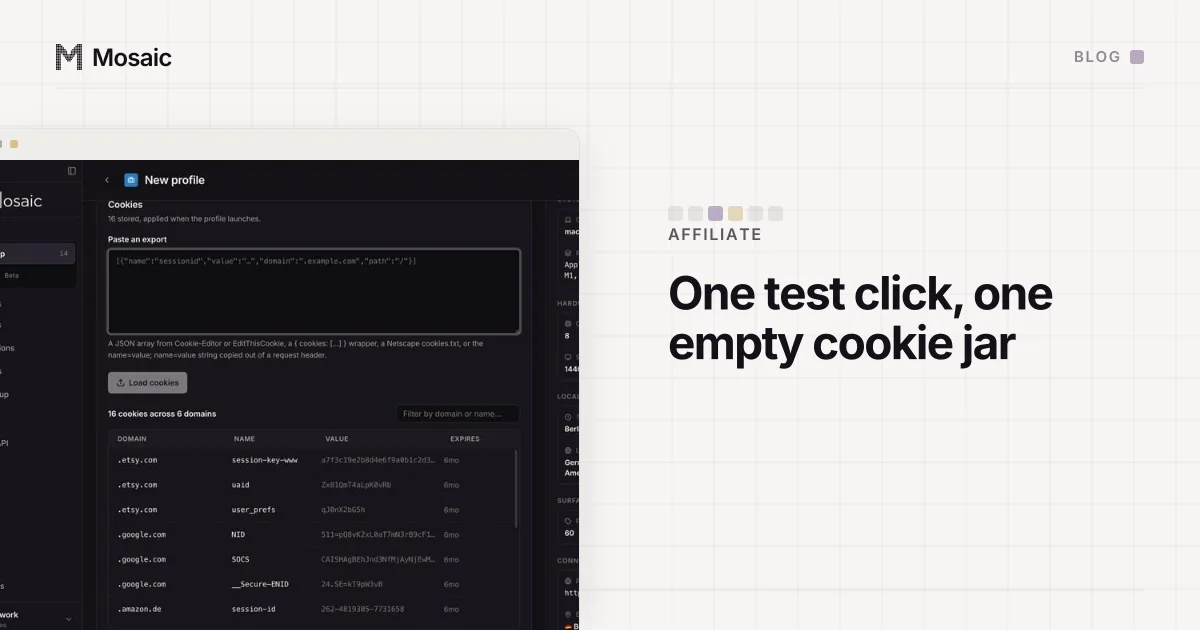
Start each profile, paste the link, and open the browser's developer tools on the Network tab with "Preserve log" ticked before you click. Every hop then stays in the list, including the script redirects curl could not follow. For a run that should start from nothing, test in a profile whose jar is empty, since an earlier click's cookie can change which page a tracker serves (testing affiliate link tracking with a clean jar covers clearing it).
Keep it to your own links
This is a check that your links send each country where your programme says they will. Read the programme's terms on test clicks, and do not buy through your own link to test it. Showing a reviewer one page and visitors another is cloaking, which networks prohibit and we will not help with. The same three-profile setup also suits a merchant checking its own storefront by country, which the Shopify Markets test walks through, and an agency checking client campaigns, as in the ad-account setup.