We make Mosaic. We tried to be fair; corrections to hello@mosaicbrowser.com.
Nearly every anti-detect browser has a free plan now, so the best free anti-detect browser is the one whose limit you can live with. They are free in different ways. One gives unlimited profiles and caps launches. One gives 5 profiles that live only in its cloud. One expires after two months. We read ten other vendors' free plans on their own pricing pages on 2 November 2026, added ours, and put the limit that will stop you in its own column, because that is the number to choose by.
The best free anti-detect browser plans, side by side
| Profiles on Free | The limit that bites | Where profiles live | |
|---|---|---|---|
| Donut Browser | Unlimited, local | Paid plans add cloud backups and sync | Your disk |
| ixBrowser | Unlimited | 10 creations and 100 opens a day; 2 seats | See vendor |
| Nstbrowser | 500 | 30 launches a day | See vendor |
| Kameleo | Unlimited local, 100 cloud | 2 browsers at once; 300 minutes of browser time | Local and cloud |
| Multilogin | 5 | Cloud only | Its cloud |
| Undetectable.io | 5 cloud | 50 profile creations a month | Its cloud |
| Mosaic | 3 | 10 profile creations in total; no REST API or MCP | Your disk |
| Incogniton | 10, then 3 | 10 for the first two months, 3 after | See vendor |
| GoLogin | 3 | No profile sharing | See vendor |
| Dolphin{anty} | Up to 3 | No API access | Cloud and local sync |
| AdsPower | 2 | 7-day trial of paid features | See vendor |
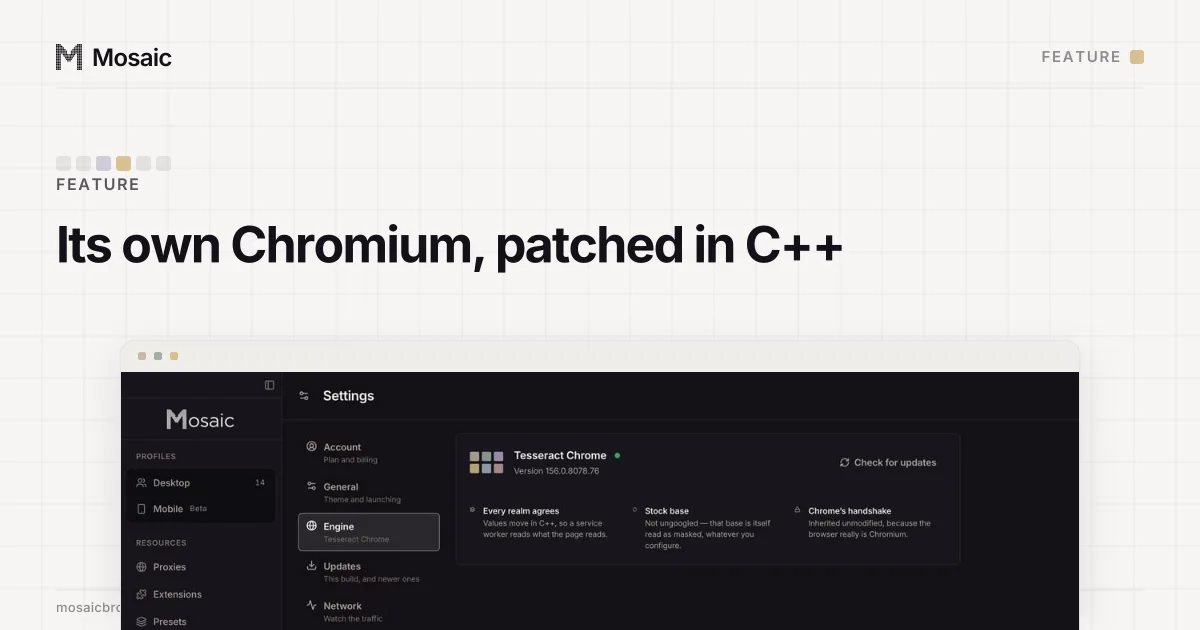
The fingerprint is changed inside the engine, not painted on topIn Mosaic: Its own Chromium. Tesseract Chrome: values changed in C++, not JavaScript. Free holds 3 profiles. Pro is $49 a month for any number.
Mosaic is a desktop app
Email yourself the link and open it on your computer.
How it works: Its own Chromium
What each free plan is good for
Donut Browser
The most generous free tier on paper: unlimited local profiles, proxy and WireGuard support, a profile management API and no account required. The app is open source under AGPL-3.0, and runs on macOS, Windows and Linux. Paid plans start at $29 a month for cloud backups. If you want free and local and you are comfortable with a young open-source project, start here.
ixBrowser
Unlimited profiles on every plan, including Free. The meter is daily: 10 new profiles and 100 profile opens a day, with 2 team seats. A slow, steady library fits inside that; a big build on day one does not.
Nstbrowser
500 profiles on Free, capped at 30 standard profile launches a day, with 3 team members. Its pricing page leans towards scraping and automation, with paid plans from $29.90 a month.
Kameleo
Free has unlimited local storage and 100 cloud profiles, but only 2 browsers running at once and 300 minutes of browser time. It is built for developers who run automation, and the free plan is a fair way to test its API before paying for concurrency.
Multilogin
5 profiles with no time limit and no card required, but they are cloud profiles only. You also get 200 MB of premium proxy traffic and 30 cloud-phone minutes, once. A good way to try the product; not a place to keep accounts long-term.
Undetectable.io
5 cloud profiles at a time, with a monthly limit of 50 profile creations, and 10 browser configurations. Its FAQ notes that local profiles are a paid-plan feature.
Incogniton
10 profiles for the first two months, then 3, with no card. A generous start that shrinks.
GoLogin, Dolphin{anty} and AdsPower
Small free plans meant as trials: 3 profiles on GoLogin, up to 3 on Dolphin{anty} without API access, 2 on AdsPower plus a 7-day trial of the paid features. Each is enough to see whether the product suits you, and not much more.
Mosaic's free plan
Free is 3 profiles and 10 profile creations. The creation count does not reset: make and delete twenty profiles and you have used it. What it does include is everything a profile does. The difference between Free and Pro is limits and automation, never a weaker browser.
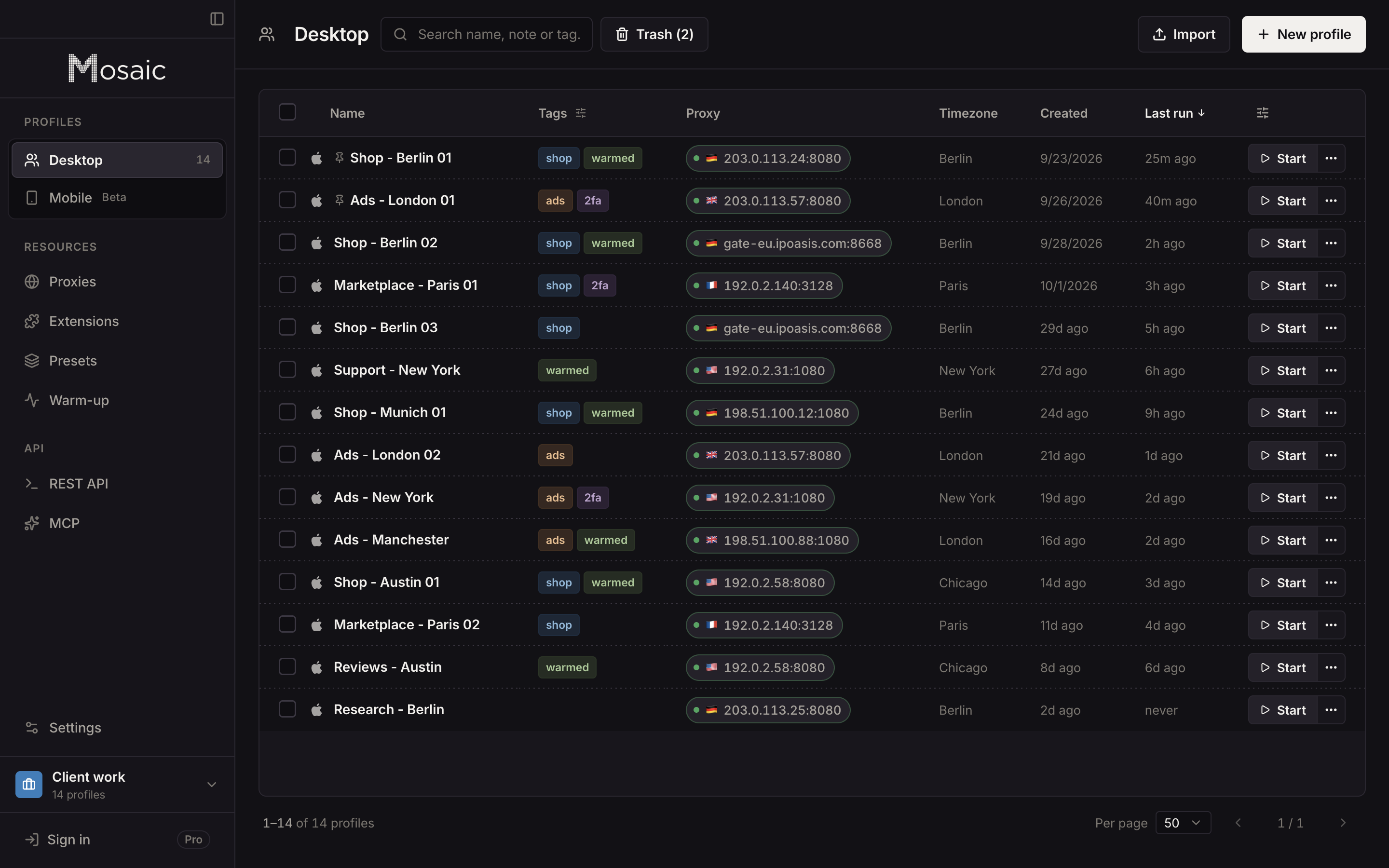
A free account downloads Tesseract Chrome, our own Chromium, the same engine Pro runs: fingerprint values changed in C++ inside the browser, hardware drawn from records of real machines, timezone and language matched to the proxy's measured exit. Proxy checks before every launch, cookie import and export, the credential vault with TOTP codes, the warm-up robot and the detection tests are all on Free. Profiles, cookies and proxies stay on your computer. What Free does not have is the REST API and the MCP server, and opening a profile on Free needs a connection to our server.
When five is not enough, Pro is $49 a month, one plan, everything unlimited, and you can try it free for 14 days. It does not charge per profile, which is the subject of anti-detect browsers with unlimited profiles.
How to choose a free plan
Decide what you are testing for. If it is the browser itself, any of these will do, and five profiles is plenty: make two, put each behind its own proxy, and check both against public detectors before trusting an account to either. If it is a small library you want to keep for months, the cloud-only and expiring plans are the wrong fit, and Donut Browser, Kameleo's local profiles or Mosaic's 3 are closer. If it is a large library on no budget, ixBrowser and Nstbrowser have the counts, with daily caps.
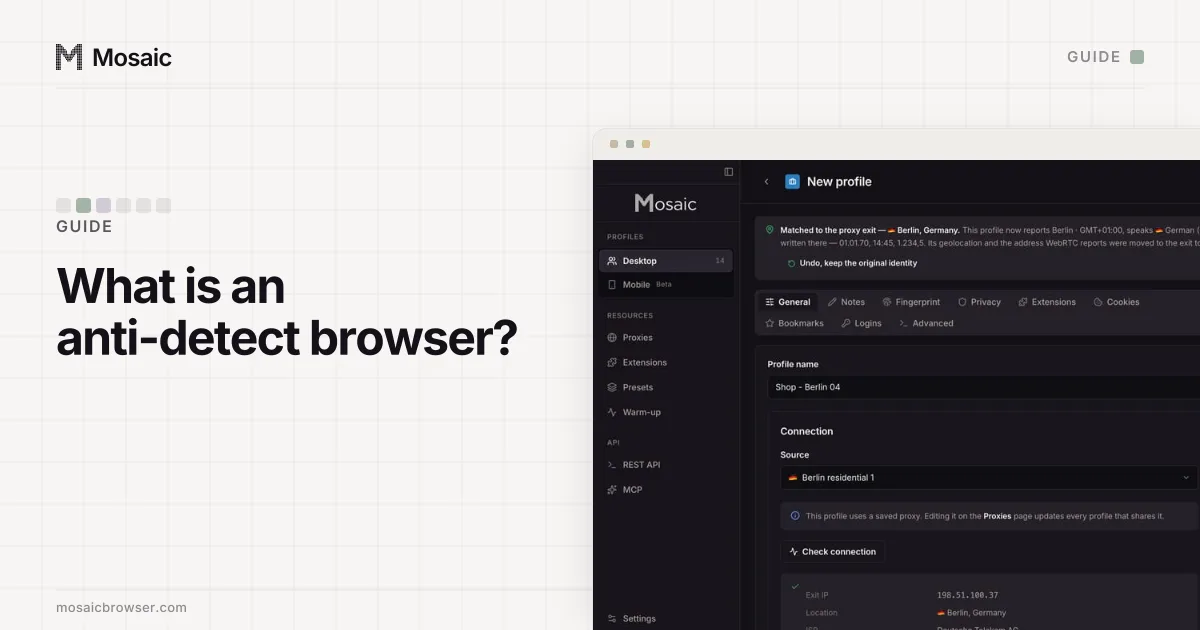
Whatever you pick, a free browser does not make a free setup. Each account still needs its own exit, and proxy traffic is the cost that grows. If the category itself is new, what an anti-detect browser is covers how they work. The paid field is compared in the best anti-detect browsers, and Mosaic's plans are on the pricing page.
Sources
- Donut Browser pricing, read November 2, 2026
- Nstbrowser pricing, read November 2, 2026
- ixBrowser pricing, read November 2, 2026
- Kameleo pricing, read November 2, 2026
- Multilogin pricing, read November 2, 2026
- Undetectable.io pricing, read November 2, 2026
- Incogniton pricing, read November 2, 2026
- GoLogin pricing, read November 2, 2026
- Dolphin{anty} pricing, read November 2, 2026
- AdsPower pricing, read November 2, 2026