We make Mosaic, the local-first anti-detect browser; Geonode is a proxy seller you bring your own account to. This page is the setup, not a review of Geonode's network.
A Geonode account is a username, a password and a gateway host. Mosaic read Geonode's gateway line from a real account, so the parts of the line, including where the options sit and what a session id looks like, are read straight from what you paste.
Geonode rotates on port 9000 and holds a sticky exit on 10000, and the US pool answers on its own gateway host; Mosaic reads all of that from the line.
Connect Geonode to Mosaic
- In Geonode's dashboard, copy the gateway line for the pool you want, with your username and password in it.
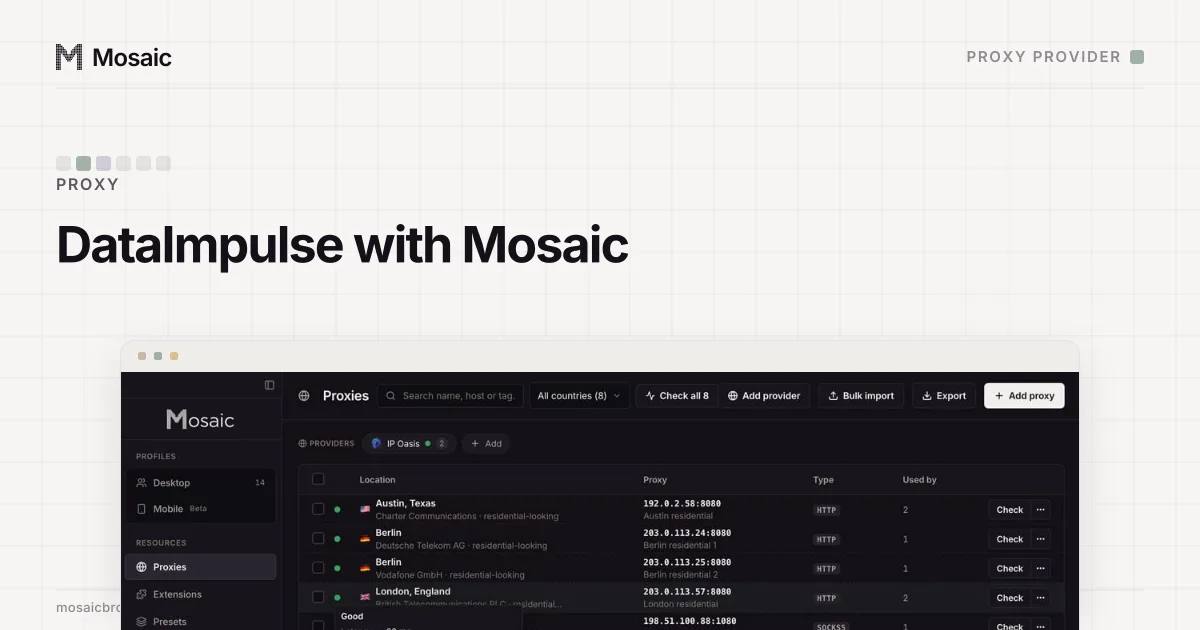
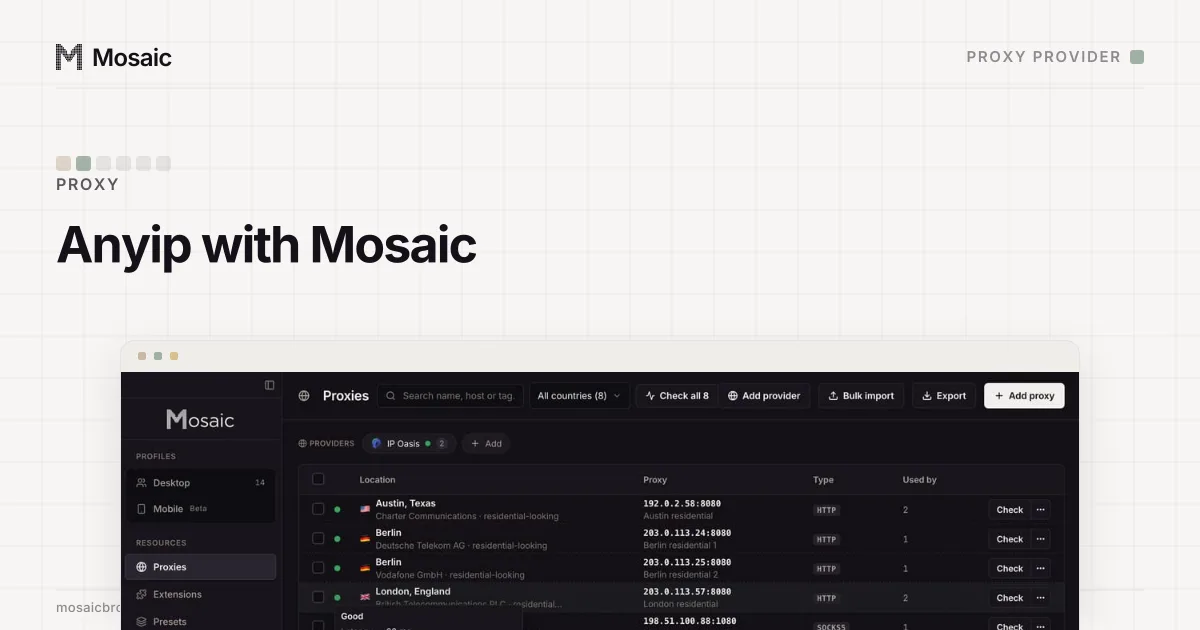
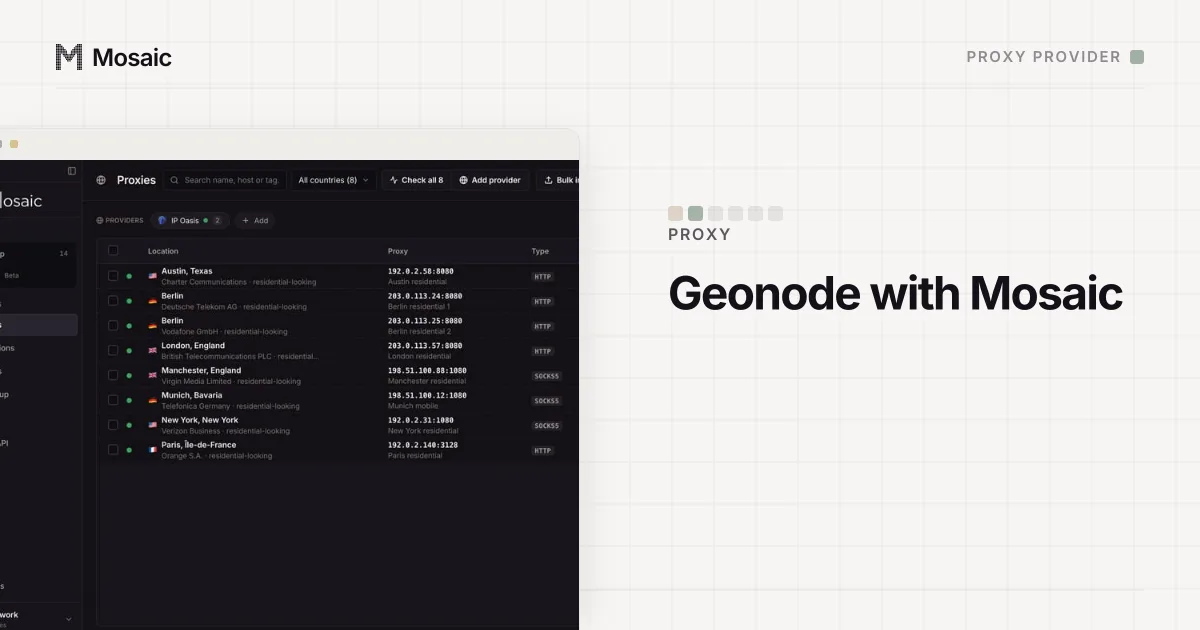
- In Mosaic, open a profile's proxy field, or the Proxies screen, and paste the line. Mosaic detects it as Geonode and saves it as a provider you can reuse.
- Create profiles from the provider. Each one mints its own Geonode session, so each profile browses from a different exit.
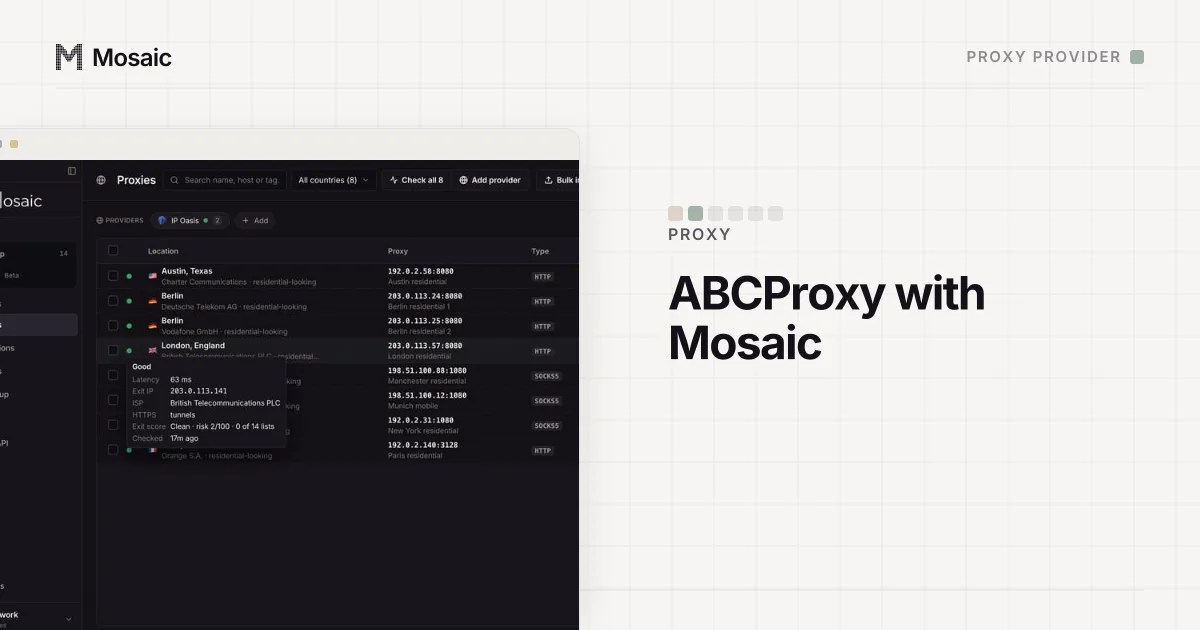
- Press Start. Mosaic checks the proxy before every launch and will not open the browser until Geonode has answered and tunnelled, so a dead proxy never leaks your own address.
Geonode carries a session id Mosaic recognises, so each profile mints its own session and holds its own exit. A Geonode session that answers but reaches nothing is swapped for a fresh one rather than retried, because a residential session that is dead stays dead for every attempt on the same token.
Paste one gateway line. Every profile mints its own exitIn Mosaic: Provider minting. One gateway line, a separate exit for every profile. Free holds 3 profiles. Pro is $49 a month for any number.
Mosaic is a desktop app
Email yourself the link and open it on your computer.
How it works: Provider minting
What you can set per profile with Geonode
Geonode's line carries the exit country, a state or region, a city, a sticky session id and how long a session holds, so those are what Mosaic lets you choose per profile. Pick country, state and city in Geonode's own words, and the exit matches. A pick Geonode has no word for is refused by name, because a token a gateway silently ignores would put the profile somewhere else without telling you. The words Mosaic does not recognise still survive, because the line is copied rather than rebuilt, so an option Geonode added that Mosaic has never seen still reaches the exit.
What Mosaic does with the Geonode exit
Once a Geonode proxy is checked, Mosaic reads the public address and city it comes out at and matches the profile to it: the timezone, the languages and the geolocation are set from the exit, not from the proxy's label. Mosaic also stops WebRTC from going around the Geonode proxy, so a page cannot read your real address that way. The authentication runs through a local relay, so a Geonode login works over HTTP, HTTPS and SOCKS5, including SOCKS5 with a username and password, which Chrome cannot log in to on its own.
The honest limits
Mosaic does not sell proxies or proxy traffic; the Geonode bill is between you and Geonode. Mosaic read Geonode's format from a real line, but a proxy pool still changes under you, which is why every Geonode proxy is checked again before each launch. Whether to run several accounts on Geonode exits is the platform's rule, not ours: Mosaic keeps accounts you are entitled to run apart, and does not change what a site allows.
If you are still choosing a seller, the proxies worth using with an anti-detect browser sets out what to look for, and rotating against sticky sessions explains which kind each job wants. Mosaic Pro is $49 a month for any number of profiles, with the first 14 days free, and Free holds 3 profiles.