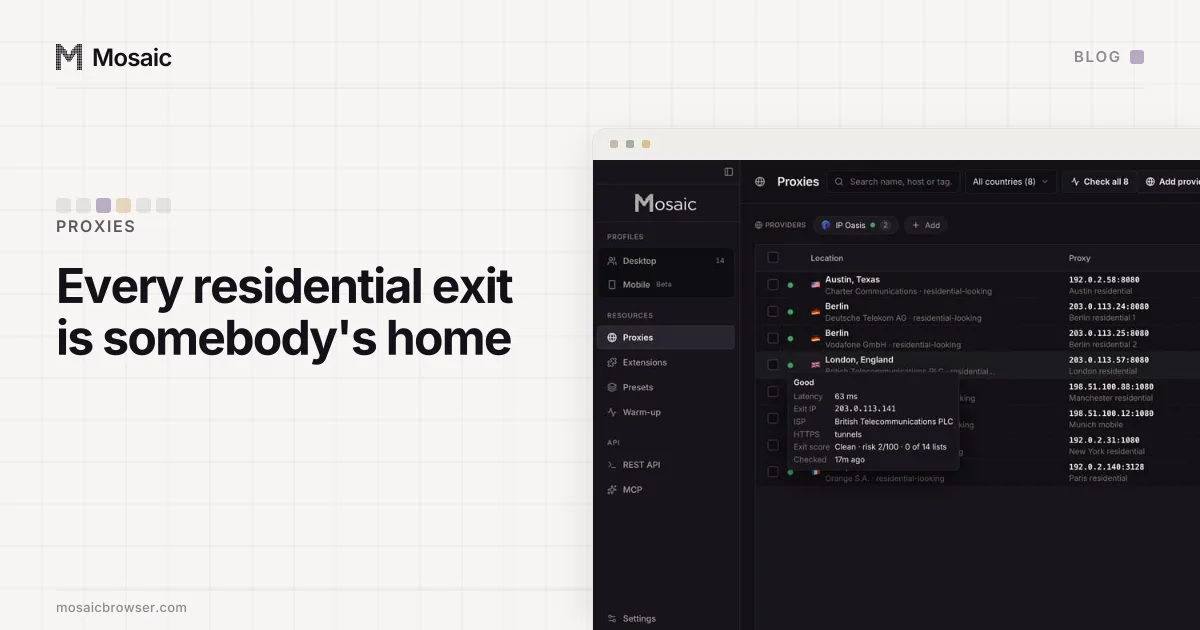
Residential proxies are ethical when the person whose connection you are renting agreed to it knowingly, can stop, and does not end up paying for what you do with it. Every residential exit is a real household's internet line. Somebody is watching television on it while your request leaves through it. So the ethics come down to how that household came to be in the pool, which a buyer can ask about.
Where the exits come from
A residential proxy seller does not own the addresses it sells. It borrows them, from software running on ordinary people's phones, computers, routers and televisions. That software reaches devices in a few ways:
- An app whose whole purpose is sharing bandwidth, usually for a small payment or credit. The person installed it to do exactly this.
- A free app, game or browser extension carrying a seller's software development kit. The app asks to use the device's connection, and in return the user gets the app free or without adverts.
- Software that never asked in any way a person would notice, and devices enrolled by malware. Some proxy pools have been built from infected devices, and those are the plain wrong end of this list.
Consent across that range is not one thing. At one end it is a full-screen prompt that says, in words a person reads, that other people's traffic will pass through their connection. At the other end it is a clause deep in a licence agreement for a flashlight app, accepted by a tap nobody remembers. Both can be called opt-in. Only one of them is an agreement in any sense a person would recognise.
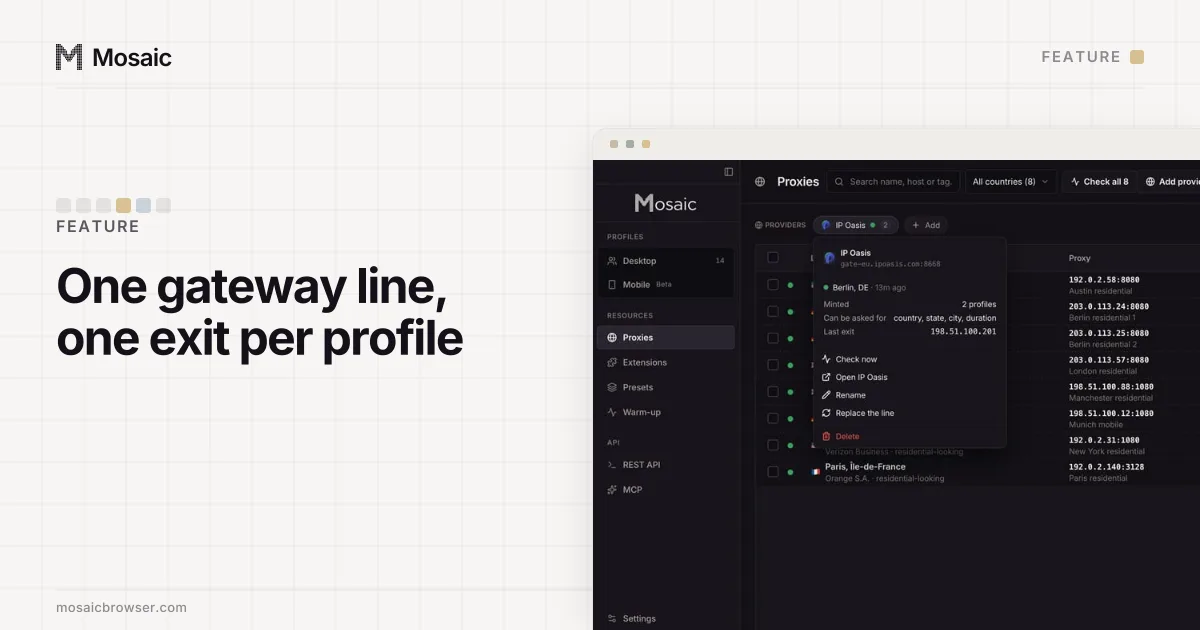
Paste one gateway line. Every profile mints its own exitIn Mosaic: Provider minting. One gateway line, a separate exit for every profile. Free holds 3 profiles. Pro is $49 a month for any number.
Mosaic is a desktop app
Email yourself the link and open it on your computer.
How it works: Provider minting
Are residential proxies ethical? Look at what the household carries
The household keeps using the connection while it is rented out, so the costs land on them.
Bandwidth is the obvious one, and on a metered or mobile plan it is money. Reputation is the less obvious one. Sites rate addresses by what comes from them, and an address that carries a lot of other people's automated traffic starts meeting more captchas and blocks, for everybody behind it. Companies that sell IP intelligence, Spur and IPinfo among them, track which addresses act as proxy exits, and a home address can end up flagged that way. And when someone uses the exit for abuse, the complaint goes to the address it came from, which is the household's.
None of that is visible from the buyer's side. You see a gateway, a username and a country.
Questions worth asking a seller
A seller that sources its pool carefully can usually answer these. Silence on them is an answer of its own.
- How are your exits sourced? Your own app, an SDK in other people's apps, or partners you buy from?
- What exactly does a person see before their device joins? Can you show the screen?
- Can they leave, and how easily? Is it a setting, or an uninstall?
- What do they get in return: money, a free app, or nothing they would name?
- Do you limit use of their device, for example only on Wi-Fi, only while charging, or with a bandwidth cap?
- Who may buy from you, and what traffic do you refuse? A seller that checks its buyers protects its households from the worst traffic.
- What happens when an abuse report arrives for one of your exits?
Write the answers down next to the date. They are the closest thing a buyer has to an audit.
When a residential exit is not needed
A household's line is the right tool only when the job needs an address that looks like a home. Plenty of work does not. Checking what a page looks like from another country, testing your own app or site, or reading public pages at a polite rate often works through a datacenter proxy. ISP proxies, also sold as static residential, use addresses registered to an internet provider but hosted on servers, so no household is involved. Using a residential exit where a datacenter one would do is cost passed to somebody who never sees the bill.
Where Mosaic stands
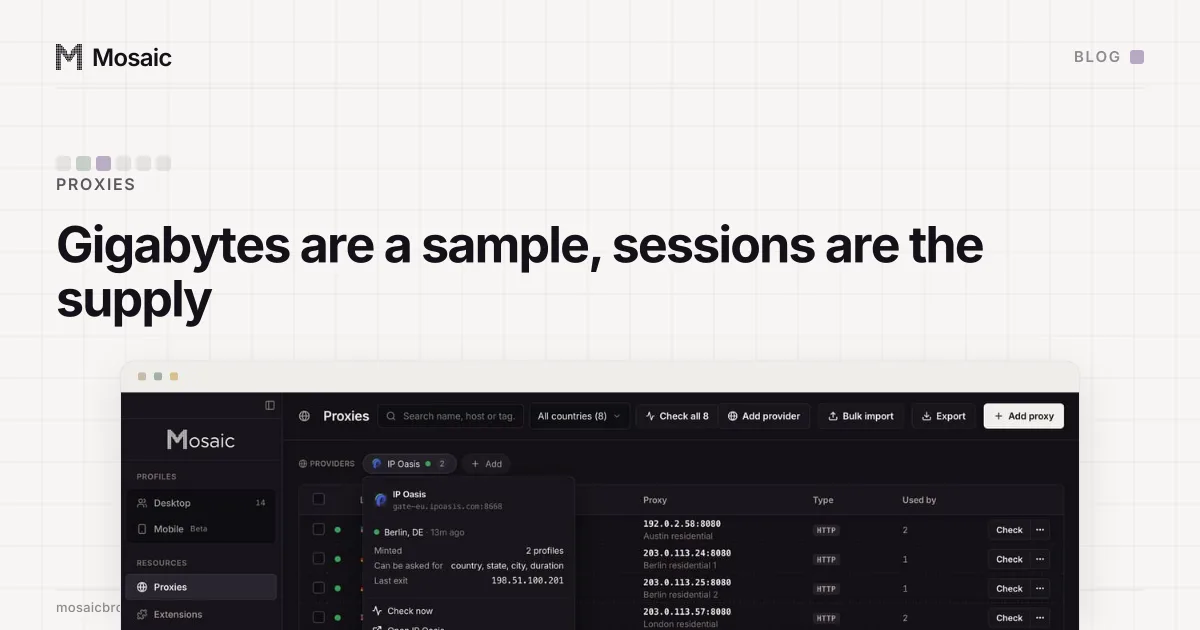
Mosaic does not sell proxy traffic, and no plan bundles any. You bring your own proxy or save a seller's gateway line as a provider, and each profile mints its own session from it. That means we do not choose your seller, and we do not vouch for any seller's sourcing. The questions above are yours to ask. Why anti-detect plans that do bundle traffic tend to include only a sample is in the post on bundled proxy traffic.
What the seller can see of your traffic once you are connected, hostnames and byte counts over HTTPS, is a separate question and is in what a proxy provider can and cannot see. The mechanics of the exits themselves, sticky and rotating sessions included, are in the residential proxy entry.