Proxy cost per account comes down to the unit on the invoice. On a per-GB residential plan, one profile costs whatever it downloads. On a per-IP plan, it costs one address a month. On a per-port mobile plan, it costs a port, used or idle. We priced all three below at $4, $3 and $50, round figures we made up so the division is easy to follow; swap in your seller's own numbers and the method still holds.
The three ways sellers bill
Per GB is residential: a gateway hostname, a username with a session token in it, and a pool of home connections behind that. The meter counts bytes through the gateway. A sticky session holds one exit until its minutes run out or the household goes offline, and then the next session is somewhere else. (The wholesale reasons a residential gigabyte costs what it does are in why residential proxies cost what they cost per GB.)
Per IP is what sellers call ISP or static residential. You get a list of host:port:user:pass lines, one per address, billed monthly. The address on the first of the month is the address on the thirtieth, and the traffic is usually included or capped high enough not to matter.
Per port is mobile. The port leads to a modem or phone on a carrier network, and the address behind it changes when the carrier or a rotate link says so. Sending 1 GB through it costs the same as sending 50.
The example prices
To keep the arithmetic honest we picked round numbers and labelled them. They are not quotes.
| Plan | Example price |
|---|---|
| Residential, per GB | $4 per GB |
| ISP, per IP | $3 per IP per month |
| Mobile, per port | $50 per port per month |
Traffic is the other input, and it is a guess. We have no measured monthly figure for a profile, so the table assumes 0.5 GB for a light one (sign in, read a seller dashboard, sign out) and 3 GB for a heavy one (an image feed, some autoplay video). Both are assumptions, not readings. Whatever the real number is, a browser profile pulls every font, script and image the page names, which a scraper asking only for the HTML does not.
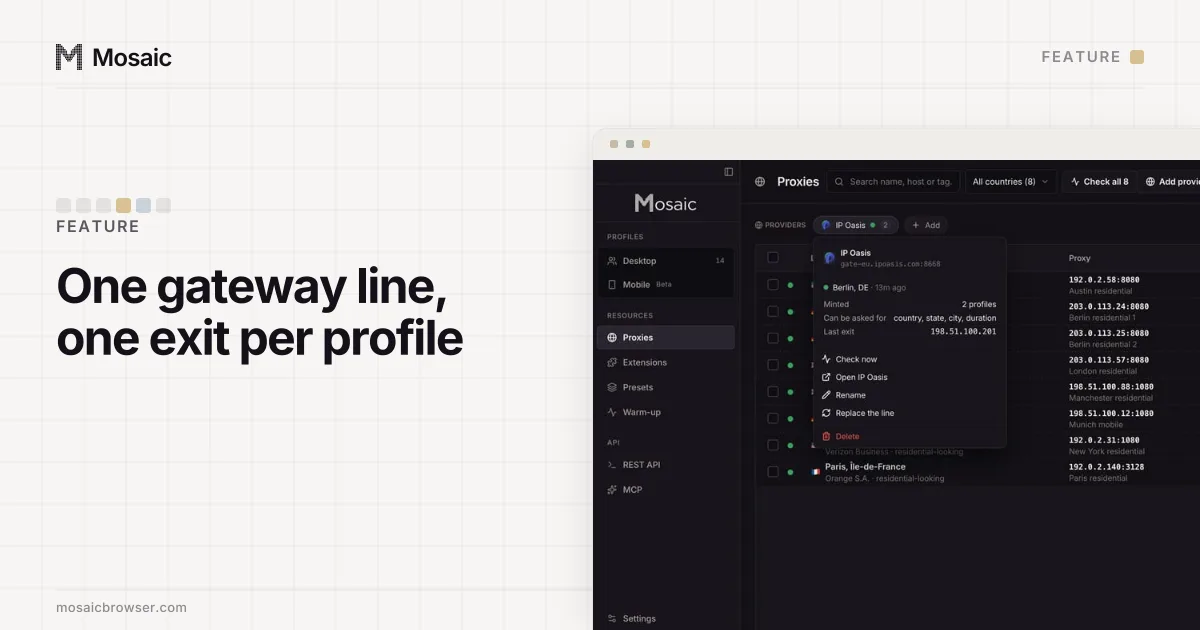
Paste one gateway line. Every profile mints its own exitIn Mosaic: Provider minting. One gateway line, a separate exit for every profile. Free holds 3 profiles. Pro is $49 a month for any number.
Mosaic is a desktop app
Email yourself the link and open it on your computer.
How it works: Provider minting
Per profile, at one, ten and a hundred
Every row gives each profile its own exit, because profiles that share an exit share an address in the site's logs.
| Plan | 1 profile | 10 profiles | 100 profiles |
|---|---|---|---|
| Residential, light (0.5 GB each) | $2 | $20 | $200 |
| Residential, heavy (3 GB each) | $12 | $120 | $1,200 |
| ISP, any traffic within the cap | $3 | $30 | $300 |
| Mobile, one port per profile | $50 | $500 | $5,000 |
Two things fall out of it.
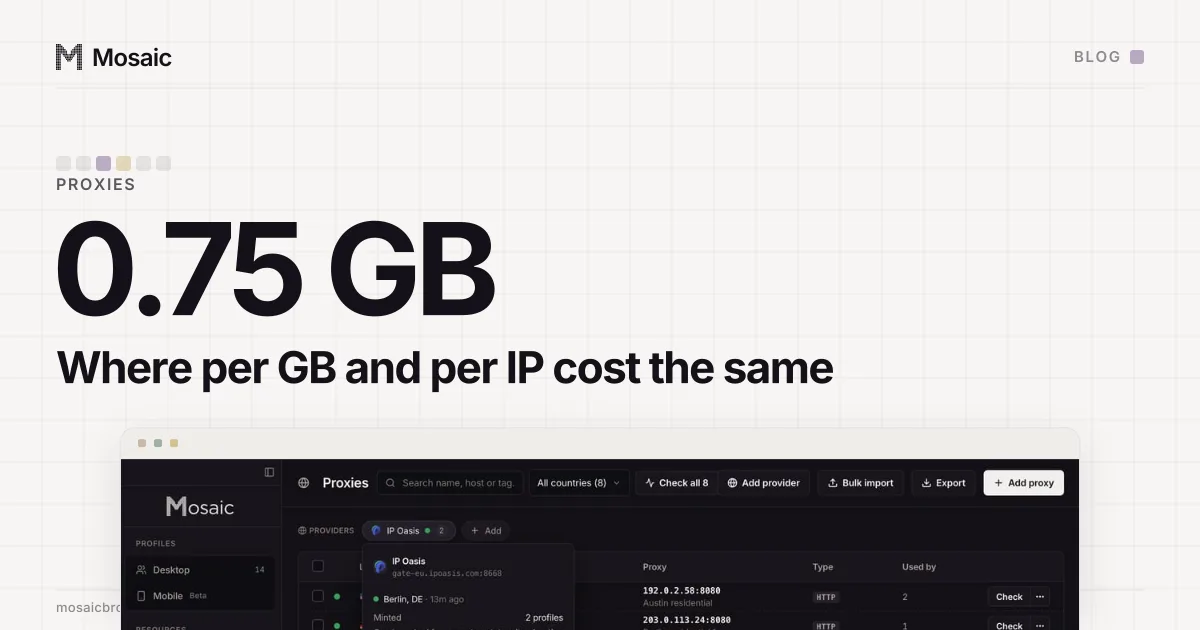
The per-GB and per-IP lines cross at a traffic figure you can work out from two prices. Divide the monthly price of one IP by the price of one gigabyte: $3 divided by $4 is 0.75 GB. A profile that uses less than 0.75 GB a month is cheaper on residential traffic; one that uses more is cheaper on its own ISP address. With your seller's real prices the crossing point moves, and the sum is the same.
Mobile is a different kind of cost. At one port per profile it is the most expensive line by a wide margin, and the only way to make it cheap is to put several profiles behind one port, which gives them one exit at a time. That works for a short check from a carrier network. For accounts that have to stay apart, it undoes the reason for having separate profiles.
Long-lived accounts and bursts want different plans
A seller account you keep for a year should sign in from the same address most mornings. A login from Leeds on Monday and Lisbon on Thursday is the sort of thing a risk team writes a rule about. The ISP line gives you that sameness for $3 whatever happens. A sticky residential session gives it only until the session expires, and the session after it lands on another household. Past 0.75 GB a month, the account you keep is cheaper on its own address as well as steadier.
Short jobs flip the sum. Say you look at one checkout page from ten countries, once, at roughly 50 MB a session. That is 500 MB, so $2 at $4 per GB. Ten ISP addresses in ten countries would be $30 for a month you used for an afternoon.
You can have both on one machine. Mosaic does not care how many sellers you use, so the accounts you keep can sit on ISP lines and the tests can mint from a per-GB pool.
What the sum leaves out
Three things the table cannot show.
- Dead sessions. A residential session that reaches nothing tends to stay dead on every retry with the same token; in our own measurement one session returned four 504s in a row while fresh ones returned 200. Its bytes are close to zero, so the bill never shows it. What it costs is the launch. Mosaic spends a failure on a new session rather than another attempt on the dead one, up to three attempts, and only for sessions it minted itself.
- Minimums. A plan with a monthly minimum makes the first profile pay all of it, which wrecks the one-profile column.
- Reputation. A $3 address that sits on a blocklist is worth less than nothing to the account behind it. Mosaic scores an exit's reputation before you trust an account to it, and you should read that score before paying for a second month.
Where Mosaic sits in the bill
Mosaic sells no proxy traffic. Every dollar in the tables goes to your seller, and the totals are the same with or without us. Paste one gateway line into Proxies › Add provider and Mosaic keeps it as a provider template: each profile mints its own session id from it, so forty profiles get forty exits from a single paste.
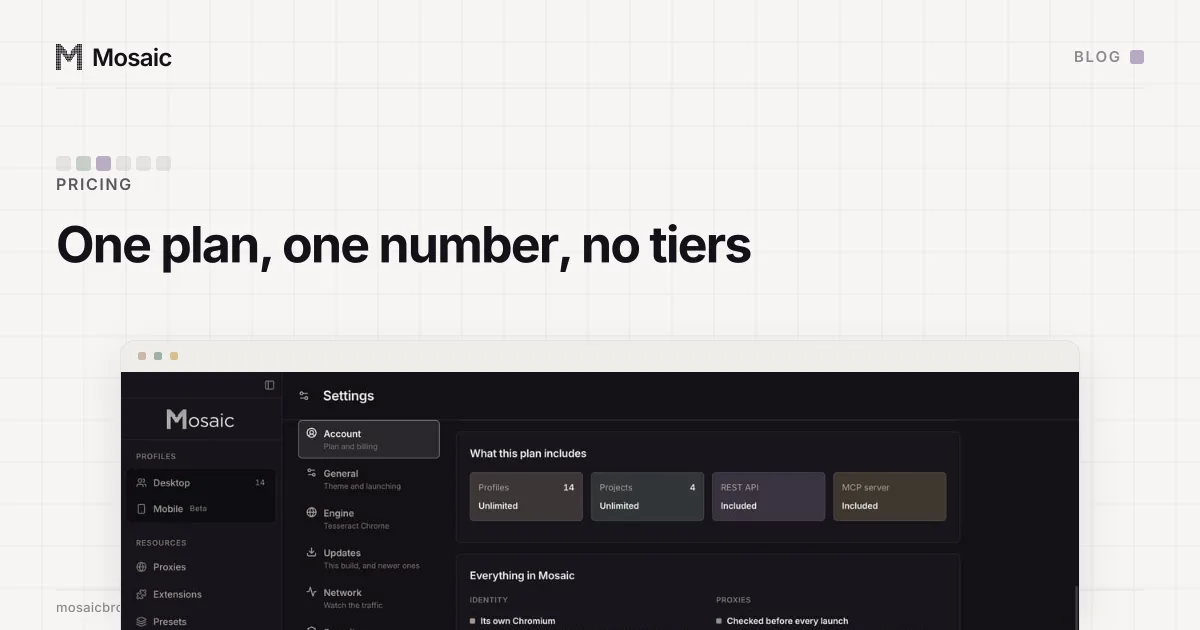
What Mosaic costs is separate and does not grow with the library: Pro is $49 a month, one plan, everything unlimited, so at a hundred profiles it works out to 49 cents a profile. At that size the proxy is the bigger line by far, which is the right way round. Why Mosaic Pro is one price explains why profiles cost us nothing to give away.