Yes: residential proxy providers often sell the same IP addresses, and the reasons are structural rather than accidental. Some of the overlap is one device enrolled in several networks. Some of it is resale, and some is a set of brands that share one operator underneath. The practical upshot is that changing seller changes your bill and your dashboard, and it may not change the households your traffic leaves from.
How one home IP ends up in several pools
A residential exit is a device on a consumer connection that has agreed, or been made, to relay traffic. There is no registry of which network a device belongs to, and nothing stops it belonging to several.
The most common way in is an SDK. Proxy networks pay app developers to put their code inside free apps, and a phone or a TV box running two such apps is in two networks. Each network sees a fresh exit with a home ISP's name on it. Neither has any reason to tell its customers the other exists.
The second way is wholesale. Building a pool of devices is expensive, so plenty of smaller brands buy access to a larger one and put their own name, prices and dashboard on top. Their customers and the upstream seller's customers then draw from the same addresses, sometimes through gateways that look nothing alike.
The third is common ownership. Google's Threat Intelligence Group, working with partners, moved against IPIDEA, a residential proxy network, and its write-up tied a whole list of proxy and VPN brands to the same operators. A buyer who moved from one of those brands to another changed logos, not networks. We covered where that network's devices came from in when the residential exit is somebody's infected router.
There is also a fourth case that looks like sharing and isn't. Home addresses are dynamic. An ISP can hand yesterday's address in one seller's pool to a different customer today, who happens to run a different seller's app. Anyone who compares two pools over a long window will count some of this as sharing, so overlap is only meaningful when both pools are sampled at the same time.
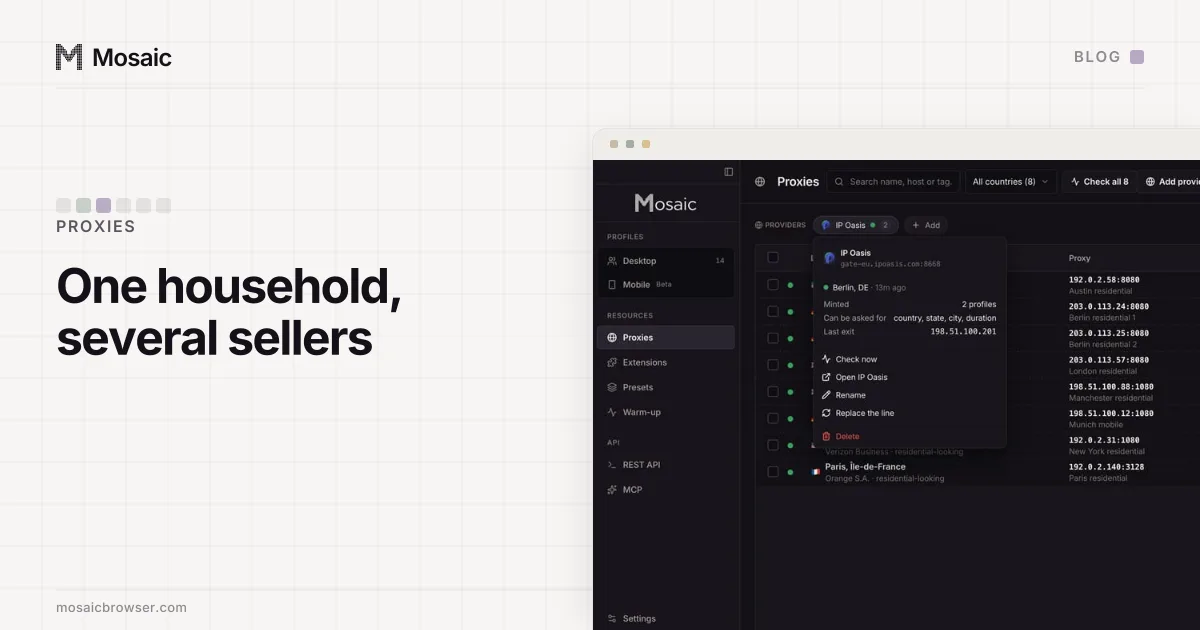
Paste one gateway line. Every profile mints its own exitIn Mosaic: Provider minting. One gateway line, a separate exit for every profile. Free holds 3 profiles. Pro is $49 a month for any number.
Mosaic is a desktop app
Email yourself the link and open it on your computer.
How it works: Provider minting
What a shared IP means for the account you log in to
A site does not know which seller you bought from. It knows the address, and whatever it has recorded about that address: logins from other accounts, abuse reports, a listing on a public blocklist, a score from an IP intelligence vendor. All of that follows the address from seller to seller.
So an exit can arrive with a history you did not give it. If a stranger on another provider used the same household's connection to sign in to the same site last week, the site has two accounts on one address, and yours is one of them. Switching to another provider after a bad experience with one is the move people make, and an overlapping pool is why it sometimes changes nothing. We met one in Wichita: a residential exit that two detectors in our catalogue would not serve a page to, three rounds running, while the same machine with no proxy loaded both (the residential IP several detectors already knew).
It also limits what a rotating gateway can promise. Every request on a rotating port draws again from the pool, and a reputation score is a score for one draw, as we explained in scoring a rotating proxy scores one draw from the pool.
What you can check from the buyer's side
You cannot see which other sellers carry your exit. What you can see is the address itself.
Look it up before you trust an account to it. Public DNS blocklists record what an address has been seen doing, and a geo lookup's network type says whether it sits in a consumer ISP's range or a hosting company's. Mosaic's exit reputation check does both, along with a reverse DNS lookup, because hosting providers often name themselves in the PTR record. It reads the exit the profile is actually leaving from, whoever sold it.
Keep one profile on one exit. Most of the harm of a shared pool comes from accounts meeting on one address, and the one place you control that is your own side. In Mosaic you paste one gateway line from your seller as a provider, and every profile mints its own session from it, so two of your profiles never leave from the same session by accident (provider accounts: one gateway line, one exit per profile). That holds within one provider. It cannot stop a household you reach through one seller also being in another seller's pool, and we don't claim it does.
Ask the seller how devices join its pool, and whether it builds its own or buys from someone. The answer proves nothing on its own. A seller that cannot say where its devices come from, though, cannot tell you who else is selling them either. What sets a home exit apart from a datacentre one in the first place is in our residential proxy entry.