Residential proxy prices are quoted per gigabyte, and the rate moves: with the size of the plan you commit to, with the seller, and with the market as a whole, which has moved in both directions over the years. For anyone running browser profiles, the rate is only half of the sum. The other half is how many gigabytes one profile uses in a month, and that number belongs to you, not to any price survey.
How residential proxy prices are quoted
The shape is close to the same across sellers, even where the figures differ. There is a pay-as-you-go rate for traffic bought without a plan, usually the highest. There are monthly plans that include an allowance of gigabytes at a lower effective rate, which falls further as the allowance grows. And on many plans, traffic you did not use by the end of the period is gone.
That last detail changes the sum more than the headline rate does. A plan sized for the busiest month wastes the difference every quiet month. A plan sized for the quiet month pays the pay-as-you-go rate for the overflow. Neither is visible in a comparison table that prints one price per GB.
Why the gigabyte is the unit at all, and what it pays for on somebody else's home connection, is in why residential proxies cost what they cost.
The sum per profile
Budgeting per profile is one multiplication with three inputs:
cost per profile per month = GB per profile per month x your effective rate
effective rate             = plan price / GB you actually used
To keep the arithmetic easy, take a made-up rate of $5 a GB. A profile that uses 400 MB a month costs $2. Forty of them cost $80. If the same profiles start autoplaying video and use 2 GB each, the forty cost $400, and the rate never changed.
That is why a price rise and a habit change land on the bill the same way. The rate is the number people watch, and the gigabytes per profile are usually the number that moves more.
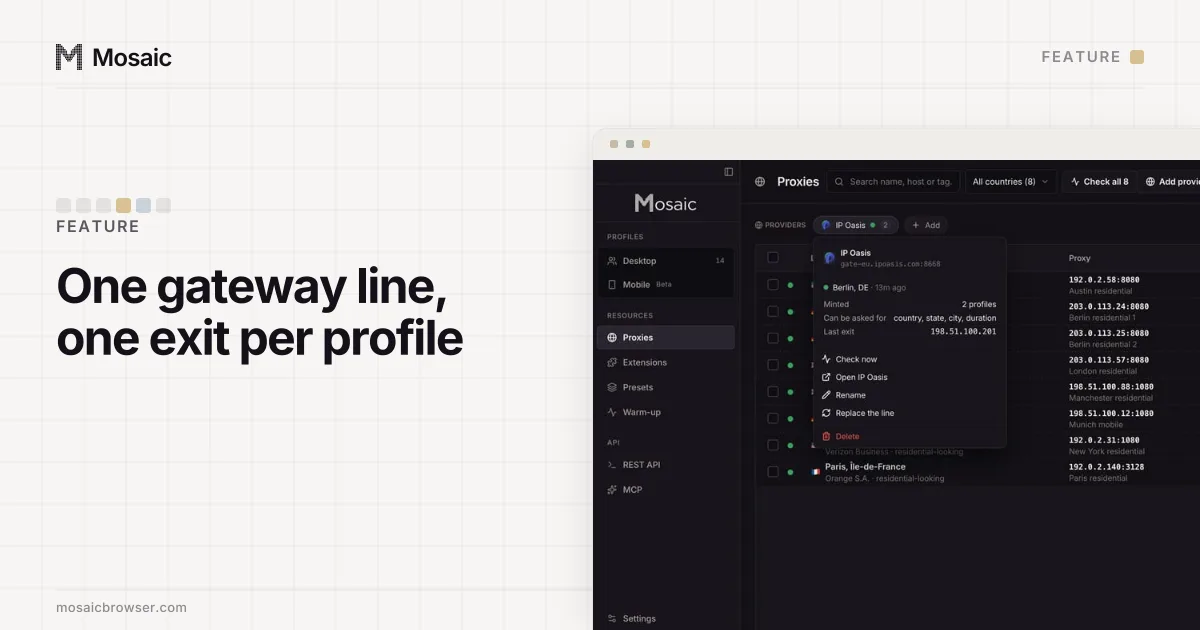
Paste one gateway line. Every profile mints its own exitIn Mosaic: Provider minting. One gateway line, a separate exit for every profile. Free holds 3 profiles. Pro is $49 a month for any number.
Mosaic is a desktop app
Email yourself the link and open it on your computer.
How it works: Provider minting
What uses the gigabytes in a browser profile
A real browser downloads everything a page asks for: images, fonts, scripts, ads, and video if the page plays it. That is why a profile costs more per page than a script fetching the same HTML would, and why two profiles on one plan can differ by a factor of ten.
In Mosaic a few things spend traffic that people do not always count:
- Warm-up. The robot browses a profile in its own browser, through that profile's own proxy, so the history and cookies it builds are paid for in the same gigabytes as the real work.
- Start pages. A profile that opens five dashboards on every launch loads five dashboards on every launch.
- The proxy check. A profile does not open until its proxy has answered and tunnelled, so every launch begins with a few small probe requests: where it exits, whether it tunnels, which resolver it uses. They are small next to one page with images, but they are not zero.
A dead session is the opposite case. On a sticky residential gateway a session that reaches nothing stays dead for every retry on the same token, and it uses almost no traffic, because nothing loads. It costs time instead. Mosaic asks the seller for a different session rather than retrying the dead one three times; rotate, don't retry has the forty-session run where the twenty-ninth was dead.
Measure one profile before you budget forty
The honest way to get the gigabytes-per-profile figure is to measure it. Run one profile alone on the provider for a few working days, doing exactly the job it is for, and read the usage in the seller's dashboard before and after. Divide by the days. That is your number, for that kind of work, and it is worth more than any figure in a blog post, this one included.
Then do the same for each kind of profile you run, because a profile that answers customer messages and a profile that reviews video ads are different budgets.
Where the per-profile cost goes when the rate rises
When the rate goes up, there are fewer levers than it seems, and the useful ones are about which profiles need a residential exit at all.
- A profile meant to browse from your own place does not need a proxy. With no proxy, a Mosaic profile matches this computer's own location, which is the truthful answer for your own business accounts.
- A profile that must look like it is somewhere else does need an exit there, and pinning the country rather than the address keeps it consistent without paying for a dedicated IP.
- Warm-up plans and start pages are yours to trim, and both are measured in the same gigabytes.
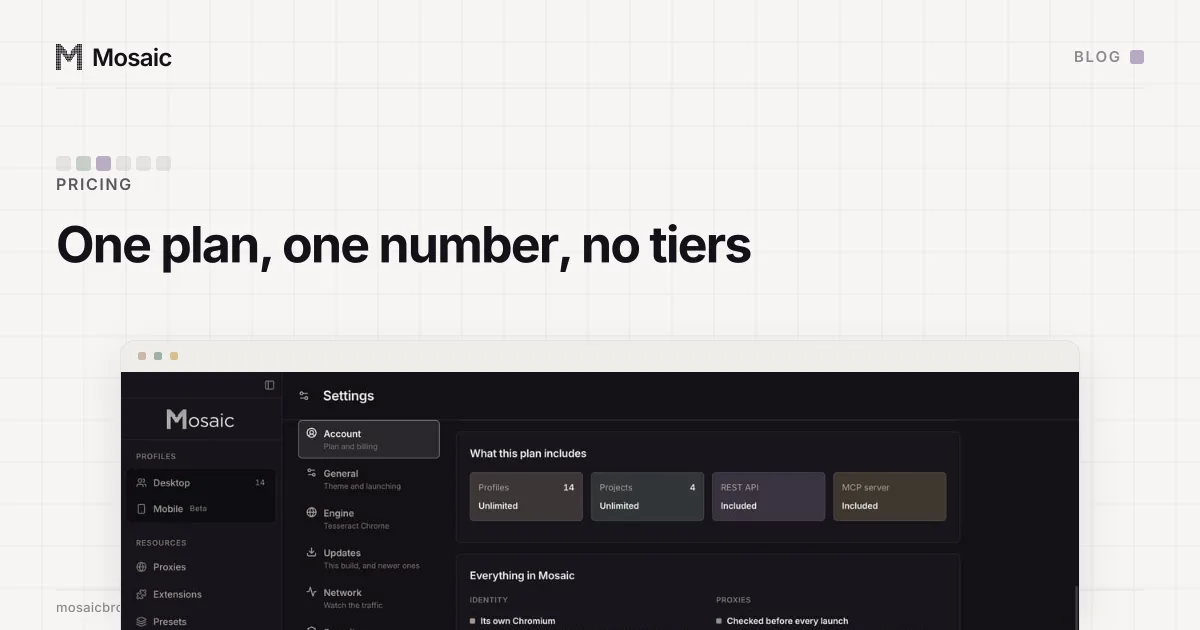
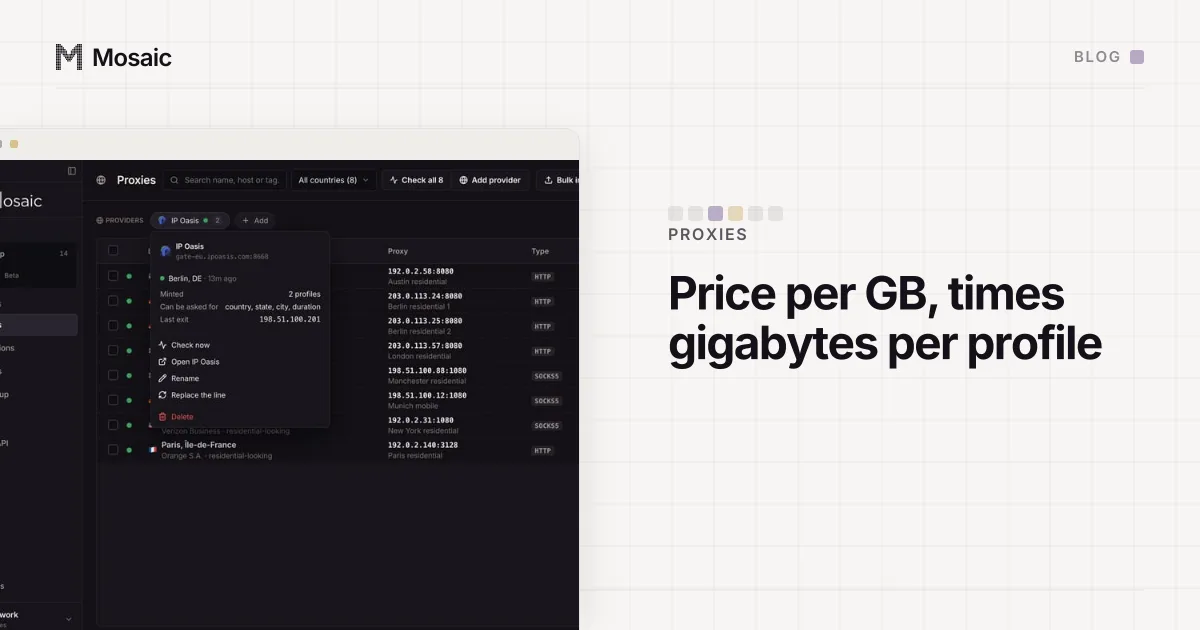
Mosaic's own share of the sum does not grow with the profile count. Pro is $49 a month whether you run ten profiles or a thousand, which at a hundred profiles is 49 cents each (why we chose one price). Mosaic sells no proxy traffic, so the proxy bill is the part that scales, and you keep the choice of seller. Paste one gateway line as a provider and every profile mints its own session from it.