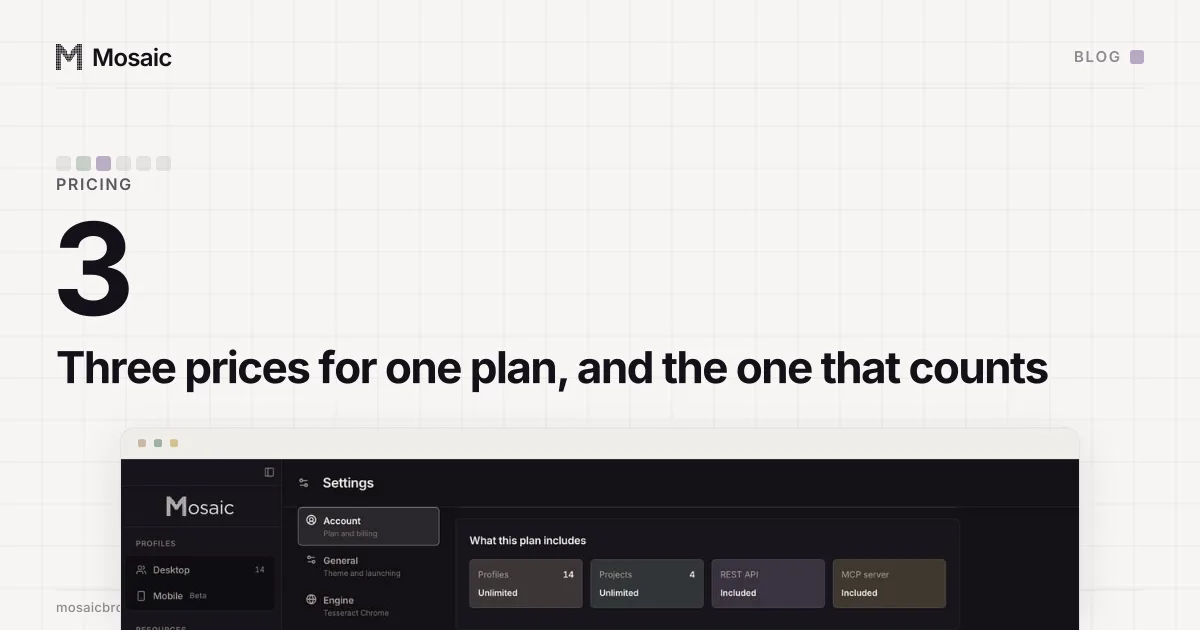
If you are on an old GoLogin pricing plan, what you pay is set by your own account's subscription, not by GoLogin's public pricing page. The public page lists what a new account can buy today. Reviews add a third set of numbers. Some quote the public page on the day they were written, and some quote plans that only older accounts still hold. So three honest sources can name three prices for what sounds like one plan, and only the vendor can say which applies to you.
This is not peculiar to GoLogin. It happens to any subscription product that changes its plans while people are still paying for the old ones, and anti-detect browsers do change theirs.
What an old pricing plan is, at GoLogin or anywhere
When a vendor changes its prices or its tiers, it has to decide what happens to people already paying. There are three usual answers:
- Keep the old price for as long as the subscription renews unchanged. This is grandfathering in the strict sense.
- Keep the old price until a date, then move everyone to the new plans, with notice.
- Move everyone at their next renewal.
Under the first two, the old plan still exists inside the billing system even though nobody new can buy it. It still has its name, its limits and its price, and it is invisible on the public page. A review written by someone on that plan, or written before the change, describes a plan you cannot sign up for.
Make 500 profiles in one go, then work on all of them at onceIn Mosaic: Bulk actions. 500 profiles per batch; start, edit and type into many. Free holds 3 profiles. Pro is $49 a month for any number.
Mosaic is a desktop app
Email yourself the link and open it on your computer.
Why review prices disagree with the pricing page
Most of the disagreement has ordinary causes, and only one of them is a legacy plan.
- The review is older than the current page. Pricing pages change, and a review stays up for years after it was written.
- Monthly and yearly prices get mixed up. "Per month, billed yearly" is a lower number than the monthly price, and a review that drops the "billed yearly" is quoting a price you only get by prepaying.
- Tiers are a slider. Many anti-detect browsers price by profile count, so "the Professional plan" can mean several prices depending on how many profiles the slider is set to.
- A promo or affiliate discount is folded in. The code's first-payment price gets reported as the plan's price.
- The reviewer is on a legacy plan, or describes one that existing accounts kept.
A legacy plan is the hardest of these to spot from outside, because the review can be accurate. It is accurate about a plan you can no longer buy.
Which price counts
For a new account, the vendor's own pricing page on the day you buy. Note the date you read it, because the page will change. For an existing account, your own billing page, plus whatever the vendor tells you in writing about how long your price holds.
A review is useful for what the plans include and how the product behaves. It is the weakest source there is for what you will be charged. If a review's figure disagrees with the vendor's page, the vendor's page wins, every time, and the gap is a reason to check the date on the review.
What to check before you change an old plan
A grandfathered price usually holds only while nothing changes. Before you touch the subscription, find out from the vendor:
- whether moving up or down a tier puts you on current pricing;
- whether pausing or cancelling ends the old price for good, so that coming back means paying the current one;
- whether adding seats or profiles to an old plan is still possible, and at which price;
- what happens to your profiles if the subscription lapses, especially where they are stored on the vendor's servers.
The last point matters more than the price. Where the profiles live decides what an ended subscription costs you, and the two cases, cloud and local, are in what happens to your profiles when the subscription ends.
How to compare without the legacy noise
Compare current list prices at the profile count you expect to need in a year, read from each vendor's own page with the date. The sum for that, and why a first-month code tells you almost nothing, is in the price at month thirteen. Whether a yearly prepayment is worth it, and the break-even month at each discount, is in yearly discounts, read in full. Why tools that store profiles in the cloud price by profile count in the first place is in why anti-detect browsers cost so much.
Mosaic keeps profiles on your computer, so Pro is one plan with no per-profile tiers, and there is no ladder of old and new tiers to compare. Pro is $49 a month and the thousandth profile costs the same as the first. The current figure is always the one on the pricing page.