Multi-accounting is a neutral word for something people do every day. A social media manager signs in to eight clients' Instagram accounts. A seller runs two Etsy shops for two product lines. A QA tester needs ten users to test one app. The word picked up a bad reputation from the other uses (ban evasion, fake reviews, bonus abuse), and platforms write their rules with both kinds in mind.
What the platforms allow
There is no general rule, only each platform's own. Three examples, all read on 2 November 2026, show how far apart they are.
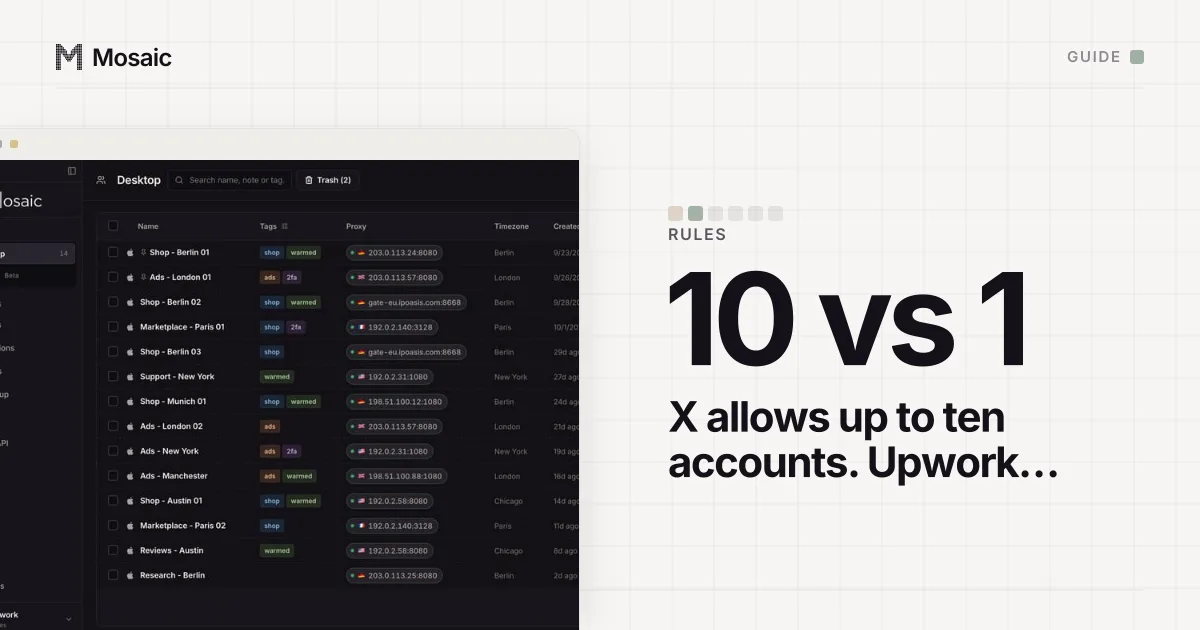
Reddit's help centre says you are welcome to create multiple accounts, and forbids using them to vote on the same posts or to get round a community or site-wide ban (Reddit Help). Amazon allows a second Seller Central account only with a legitimate business need, such as separate brands run as separate businesses, and only while every account is in good standing (Amazon seller code of conduct). LinkedIn's User Agreement says you will only have one account, in your real name.
So "is multi-accounting allowed" has no answer until you name the platform. Our guide on whether it is legal to have multiple accounts separates the two questions people mix up: whether something breaks a law, and whether it breaks a contract with the platform. Mosaic keeps accounts you are entitled to run apart; it does not change what a platform allows.
Make 500 profiles in one go, then work on all of them at onceIn Mosaic: Bulk actions. 500 profiles per batch; start, edit and type into many. Free holds 3 profiles. Pro is $49 a month for any number.
Mosaic is a desktop app
Email yourself the link and open it on your computer.
How platforms connect accounts
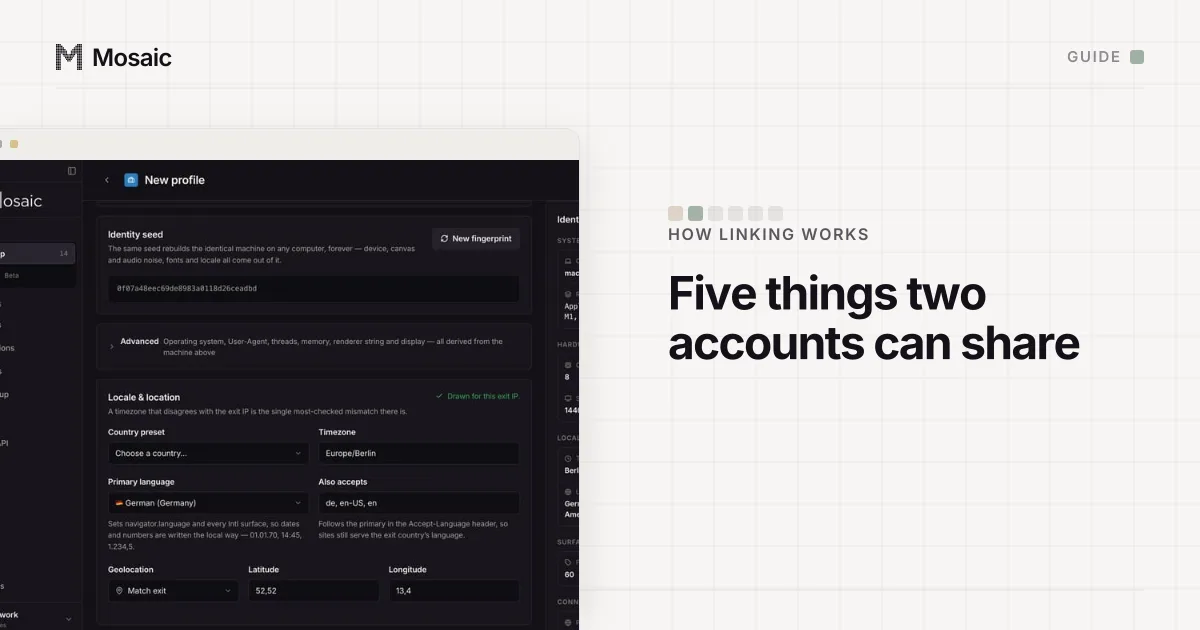
A platform that limits accounts has to notice when two belong together, and it does that by comparing traces. Cookies and local storage are the first: two accounts signed in to from one browser share a jar. The browser fingerprint is the second, since every profile in an ordinary browser reports the same GPU, fonts and screen. The IP address is the third, and the one people think of first. Then come payment cards, phone numbers and behaviour, which no browser setting changes.
Separating only one of these does little. Clearing cookies leaves the fingerprint. A VPN changes the address and leaves the cookies and the fingerprint. The five kinds of signal, and how they add up, are in how websites detect multiple accounts.
Multi-accounting within the rules
Where a platform allows several accounts, it often has its own tool for them first: Meta Business portfolios for client pages, Google Ads manager accounts, Amazon's user permissions for staff (set and edit user permissions). Use those before anything else, because they are how the platform expects agencies and teams to work.
When the accounts have to be separate logins, each one needs a browser of its own: its own cookies, its own fingerprint and its own exit. Chrome profiles separate the cookies and share the rest. An anti-detect browser separates all three. The by-hand options and where each stops working are compared in managing multiple accounts on one computer.
How Mosaic handles it
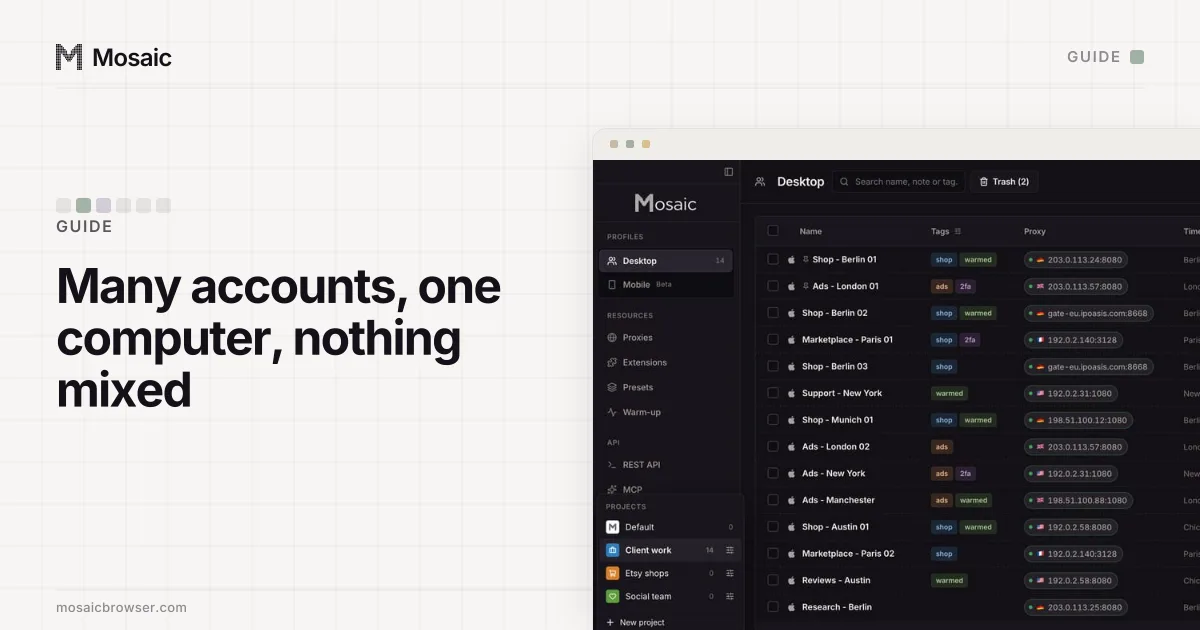
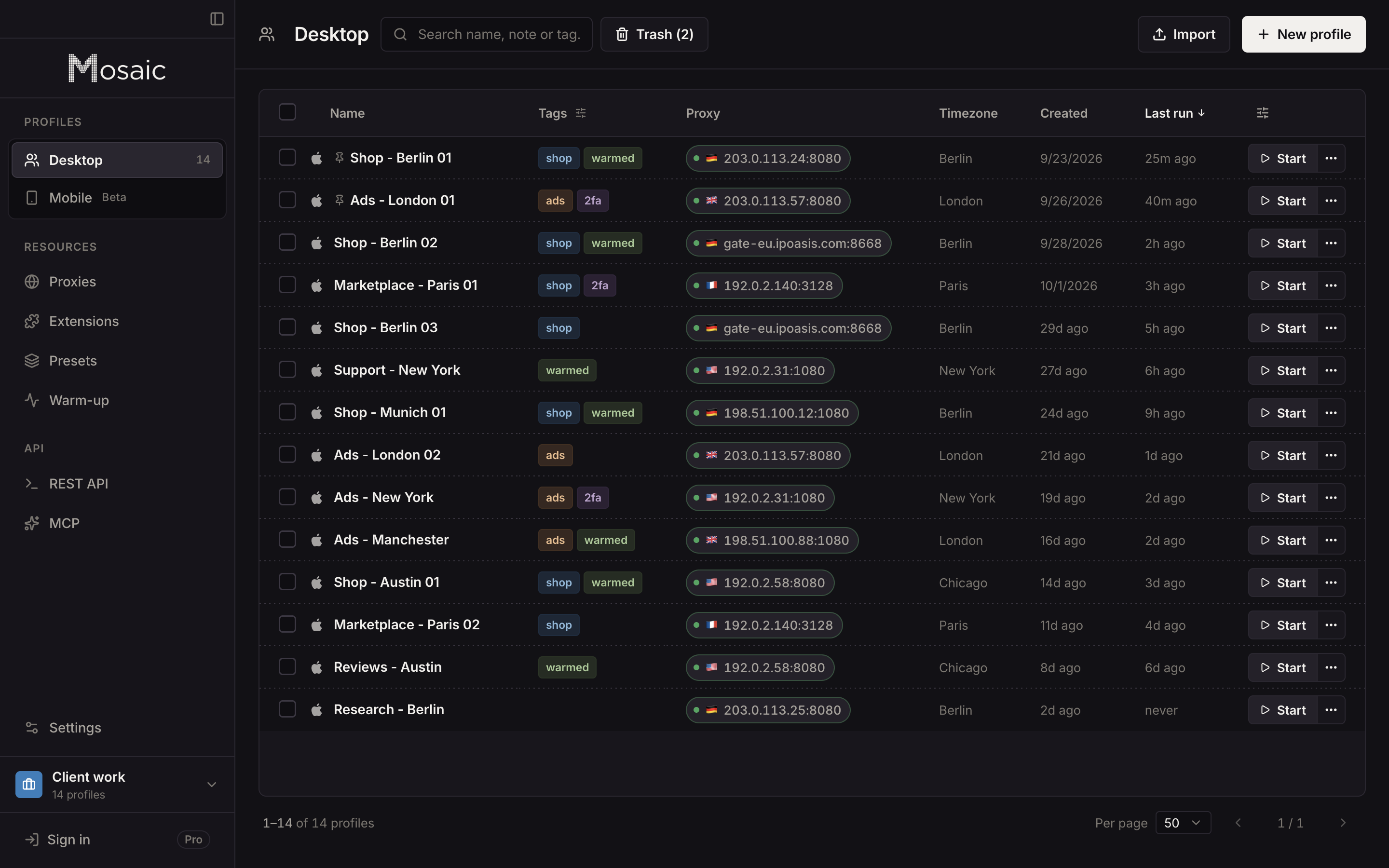
In Mosaic each account gets a profile: a fingerprint drawn from one real device, a cookie jar, and a proxy whose exit sets the timezone and language. A proxy seller's line saved as a provider mints its own session for each profile, so no two profiles share an exit by accident (a sticky session is what keeps that exit steady). Profiles, cookies and proxies stay on your computer. What a platform permits is still the platform's call, and its terms are the first thing to read.
Sources
- Reddit Help: Is it ok to create multiple accounts?, read November 2, 2026
- Amazon Seller Central: Selling policies and seller code of conduct, read November 2, 2026
- LinkedIn User Agreement (effective 3 November 2025), read November 2, 2026
- Amazon Seller Central: Set and edit user permissions, read November 2, 2026