Amazon allows a second seller account in the same region only when two things are both true: you have a legitimate business need for it, and every account you hold is in good standing. The need has to come from the business. Two separate brands run as separate businesses can meet it. A spare account kept in case the first one is suspended never does.
Mosaic keeps accounts you are entitled to run apart. It does not change what Amazon allows, and nothing below is about getting a second account Amazon would refuse.
The clause has two conditions, not one
Most readings stop at "legitimate business need" and treat the rest as boilerplate. The second condition does more work. Good standing is a condition that keeps being checked after the second account opens, and it is written about all the accounts together. So a policy problem on one account is a problem for the other. Sellers sometimes think of a second account as a way to spread risk. Under this clause it does the opposite: it joins two accounts' fates.
That also explains why the rule is per region. Selling in Europe and in North America through each region's Seller Central is not a second account in the sense that needs a reason. Two accounts in the same region is.
What a legitimate business need looks like
Amazon publishes examples rather than a definition, and they share a shape. Each one describes two businesses, or a program, that would be worse off squeezed into one account:
- separate brands, each run as its own business with its own storefront;
- manufacturing for two companies that have nothing to do with each other;
- an Amazon program that itself asks for a separate account.
Read the list for what it leaves out. None of the examples is about the seller's convenience in selling the same goods twice, and none is about protection from Amazon's own enforcement. A test we would apply before asking: could you explain the second account to an accountant without mentioning Amazon at all? Two legal entities with two bank accounts pass that. "In case the first one gets suspended" does not.
Write the recipe once, then make forty profiles from itIn Mosaic: Presets and extensions. One recipe, forty profiles, forty exits. Free holds 3 profiles. Pro is $49 a month for any number.
Mosaic is a desktop app
Email yourself the link and open it on your computer.
How it works: Presets and extensions
What never qualifies
Three reasons sellers give for a second account are not business needs, however they are worded.
- A backup account, opened and kept quiet in case the main one is suspended.
- A new account opened after a suspension, to keep selling while the first is under review or after it is closed.
- A second storefront for the same products, to hold two places in the same search results.
The second is the one that turns a problem into a permanent one, because it is the conduct the rule exists to catch. A suspended seller's route is Amazon's appeal process, not a new registration.
Keep the paper trail before you register
Because the need is yours to show, the useful work happens before the second account exists. We would write down the reason in one sentence, keep the documents that prove it (company registrations, separate bank accounts, separate tax details, the program invitation), and look at the existing account's Account Health page first. If anything is outstanding there, the good-standing half fails on the day you open the second account. If you are not sure the reason counts, ask Selling Partner Support before registering and keep the case number. Our daily account health routine is the habit that keeps the second condition true afterwards.
Two approved accounts, two browsers
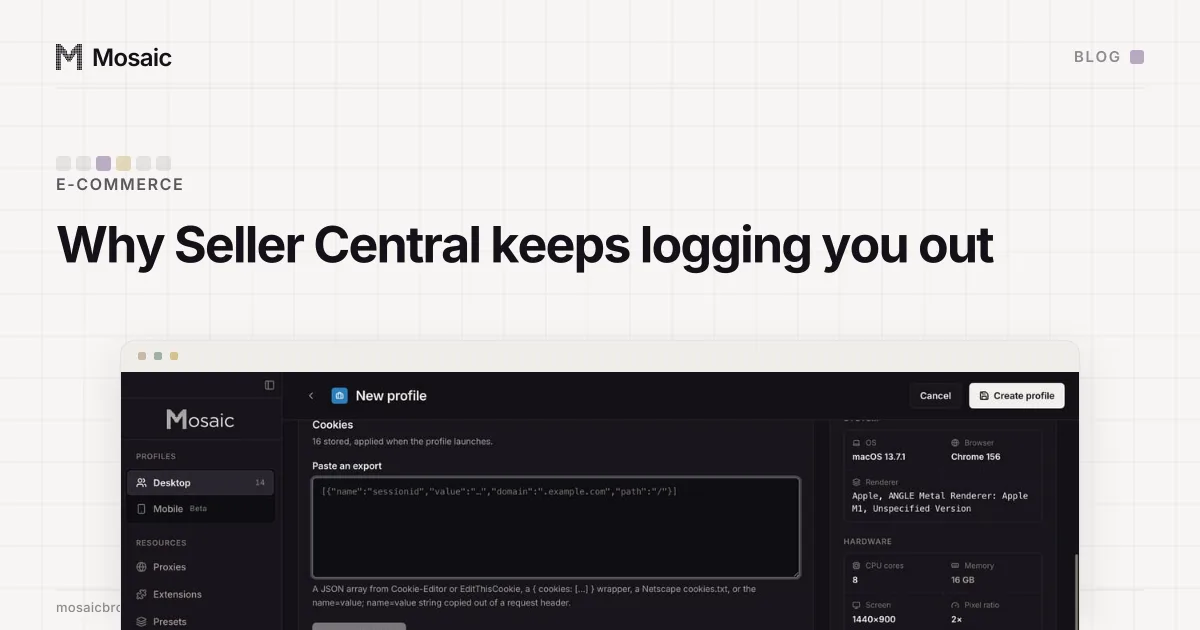
Once both accounts are legitimately yours, the practical trouble is on your side of the screen. Seller Central signs in with an Amazon login, so two seller accounts in one browser compete for one session on one site, and the account you are in is whichever you touched last. That is the symptom in why Seller Central keeps logging you out, and it is how a listing ends up uploaded to the wrong brand.
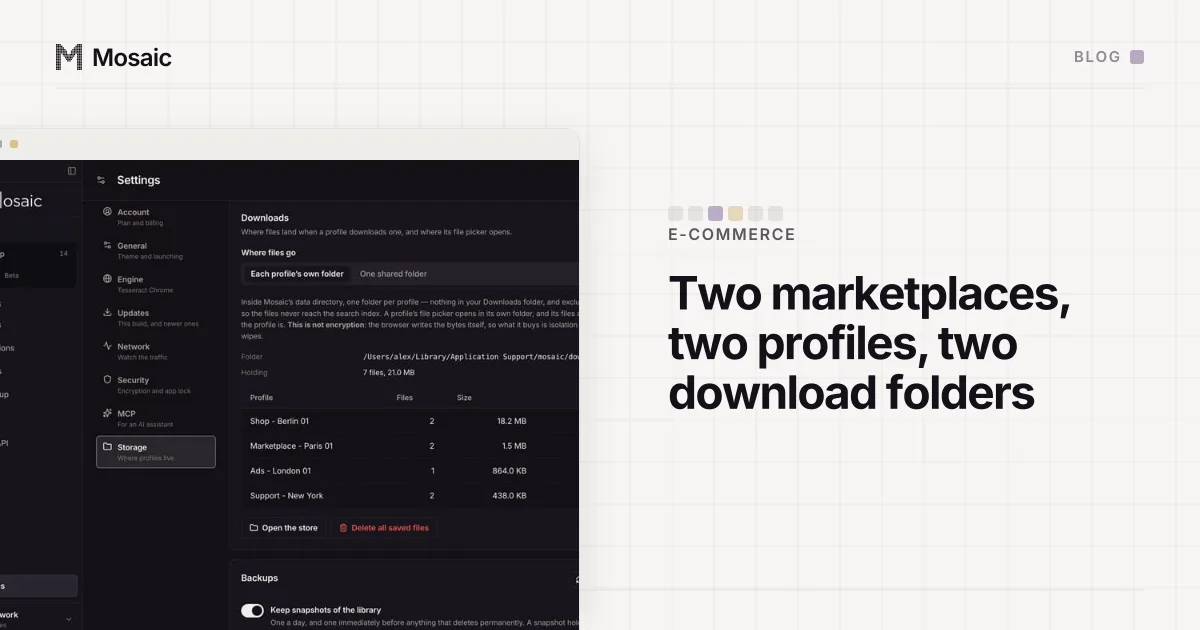
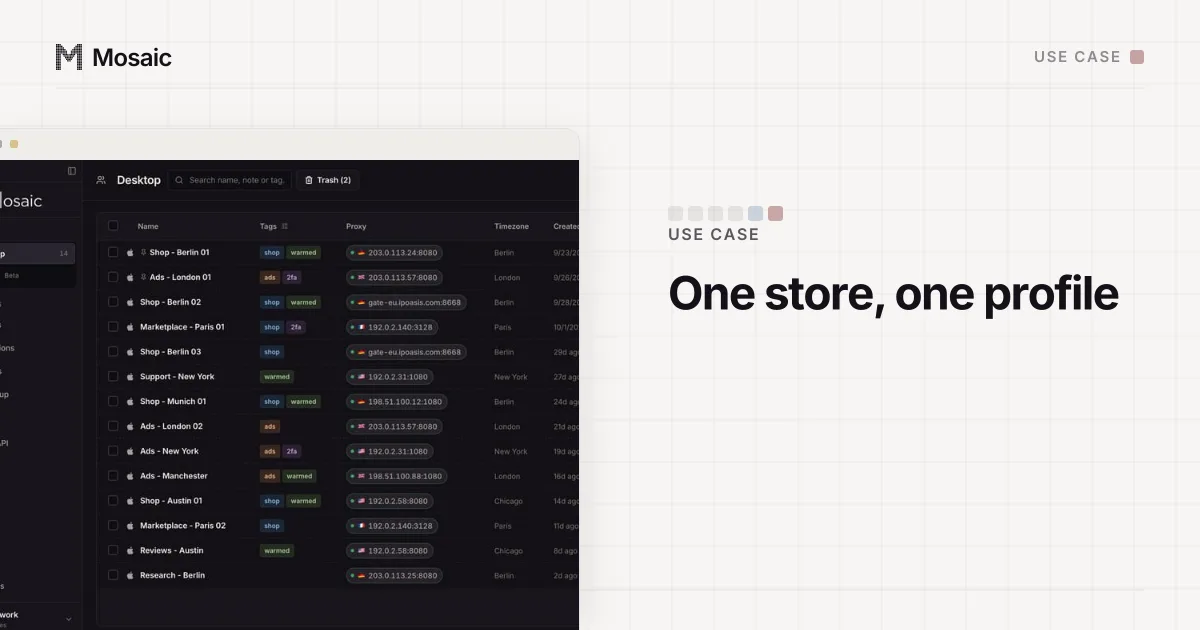
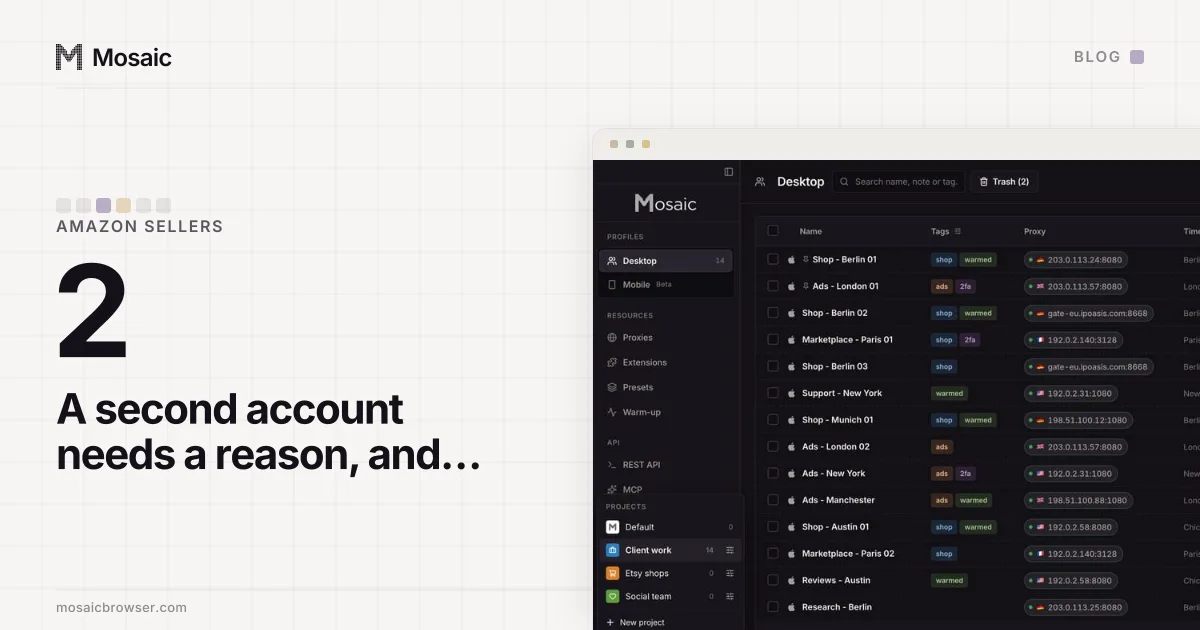
In Mosaic we would give each account a profile of its own in one project, named for the brand and the region. Each profile has its own encrypted cookie jar, so both stay signed in, its own saved password and two-factor code in the companion, and its own downloads folder, so one brand's order reports never land in the other's pile. These accounts belong to one owner who has told Amazon they exist, so there is nothing to disguise: leave the proxy empty and each profile matches this computer's own location, which is the truthful answer. Staff who need one brand's account get their own login through Amazon's user permissions (access for an assistant without your password has the steps), not a copy of yours.
The same layout works when the second channel is a different marketplace; Amazon and eBay side by side covers that case, where no business-need test applies at all.