Selling on Amazon and eBay simultaneously is allowed, and plenty of businesses run one seller account on each. Nothing about the second marketplace has to be hidden from the first. The problems are on your side of the screen: two buyer logins tangled with two seller logins, two marketplaces' reports landing in one Downloads folder, and one unit of stock listed twice.
The rules are worth reading once, because they are different. Amazon's Selling Policies and Seller Code of Conduct allow one selling account per region unless you have a legitimate business need for more. eBay's multiple accounts policy lets one member hold several accounts and forbids opening one to get around a restriction on another. One account on each marketplace sits comfortably inside both. Mosaic keeps accounts you are entitled to run apart; it does not change what a marketplace allows.
Selling on Amazon and eBay simultaneously: where the wires cross
Two marketplaces in one browser do not clash with each other. Amazon's cookies belong to amazon.com and eBay's to ebay.com, and neither reads the other. The collisions happen inside each marketplace.
On Amazon, Seller Central signs in with an Amazon login. If the same browser also holds the account you shop with, two Amazon sessions compete for one site, and the one that wins depends on which you touched last. We wrote up the symptom in why Seller Central keeps logging you out. On eBay the same thing happens with a personal buying account and the business selling account, because both live on ebay.com and one browser keeps one session there at a time.
The second crossing is files. A seller downloads a lot: order reports, shipping labels, payout statements, the occasional listing export. From two marketplaces into one Downloads folder, they sit in one pile sorted by date, and the label you print at four o'clock is whichever one you clicked last.
The third is people. If an assistant handles eBay returns and nothing on Amazon, a shared browser with both logins saved in it gives them both anyway. The marketplace's own user permissions are the right door for that, and giving an assistant access without the password walks through Seller Central's and eBay's.
Write the recipe once, then make forty profiles from itIn Mosaic: Presets and extensions. One recipe, forty profiles, forty exits. Free holds 3 profiles. Pro is $49 a month for any number.
Mosaic is a desktop app
Email yourself the link and open it on your computer.
How it works: Presets and extensions
Keep the stock count honest first
Overselling is the failure both marketplaces measure. A cancelled order counts against your seller metrics on Amazon and on eBay, and a unit listed on both can sell on both inside the same hour. No browser setup fixes that. Either a listing tool keeps one stock figure and pushes it to both channels, or you split the stock by hand: of ten units, list six on Amazon and four on eBay, and move them between channels on purpose rather than by accident.
One profile per seller account
What a browser can fix is the session, the files and who sees what. We would give each seller account a profile of its own, and leave personal shopping in your ordinary browser.
- Make a project for the business and two profiles inside it, named for the marketplace and the store ("Amazon US · Oak & Iron", "eBay · Oak & Iron"), so the profile's name, shown beside the address bar, tells you which store you are in.
- Leave the proxy empty on both. These two accounts belong to one business working from one place, and with no proxy a profile matches this computer's own location, which is the truthful answer. A proxy belongs on a profile that is meant to browse from somewhere else.
- Sign in to Seller Central in the first profile and to eBay in the second, once. Each cookie jar keeps its own login, encrypted on disk, so both stay signed in tomorrow.
- Save each account's password and two-factor setup key in that profile's credentials. The companion in each window shows the code for that account and no other.
- Put the pages you open every morning into each profile's start pages: orders, messages, account health. The routine we use for several stores is in a seller's morning across six stores.
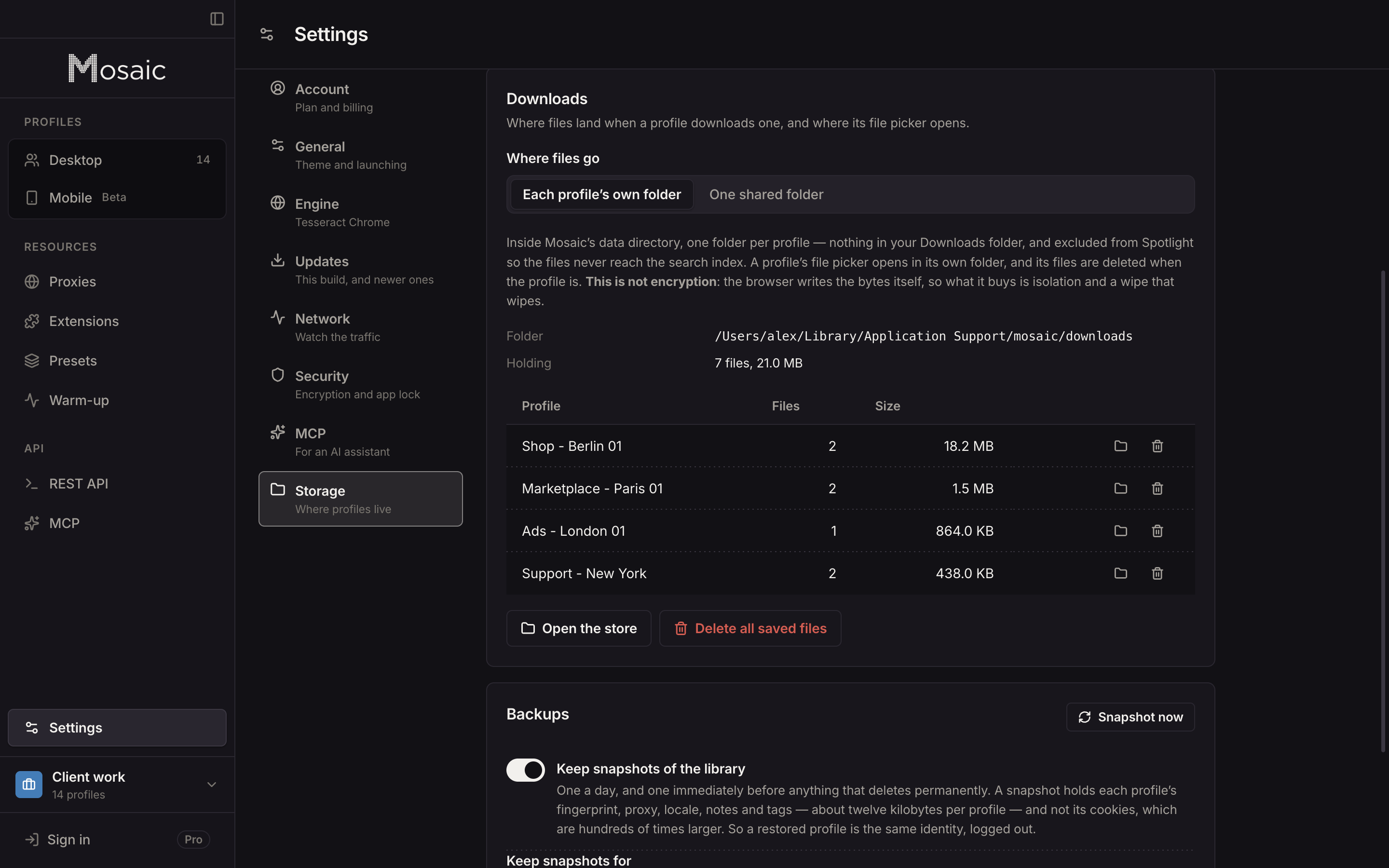
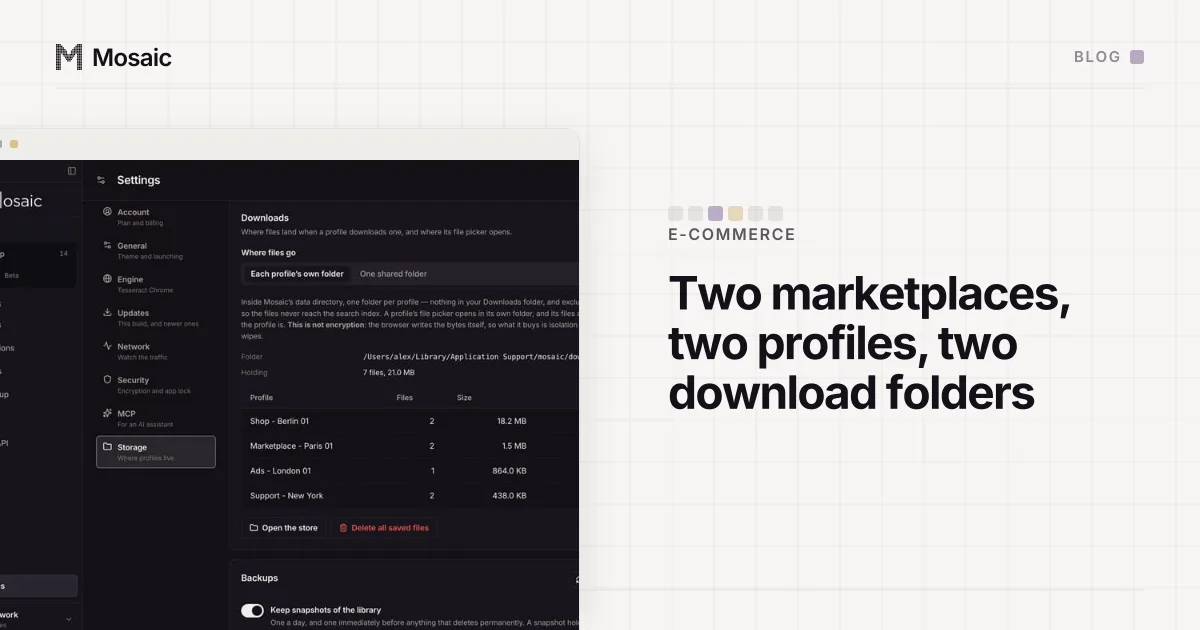
Downloads follow the profile. Each one saves into its own folder inside Mosaic's data directory, the file picker opens there, Spotlight does not index it, and the files are deleted when the profile is. So Amazon's reports and eBay's labels never share a folder. That is separation, not encryption: the browser writes the files as it always does.
When a third or fourth account arrives
Adding Etsy, a Shopify admin or a second eBay account for a separate product line is the same pattern, one profile per account. The second eBay account is the one to check against eBay's policy first, and a second Amazon account in the same region needs the legitimate business need Amazon describes. Mosaic for e-commerce sellers covers the larger setup, with projects, tags and windows arranged side by side.