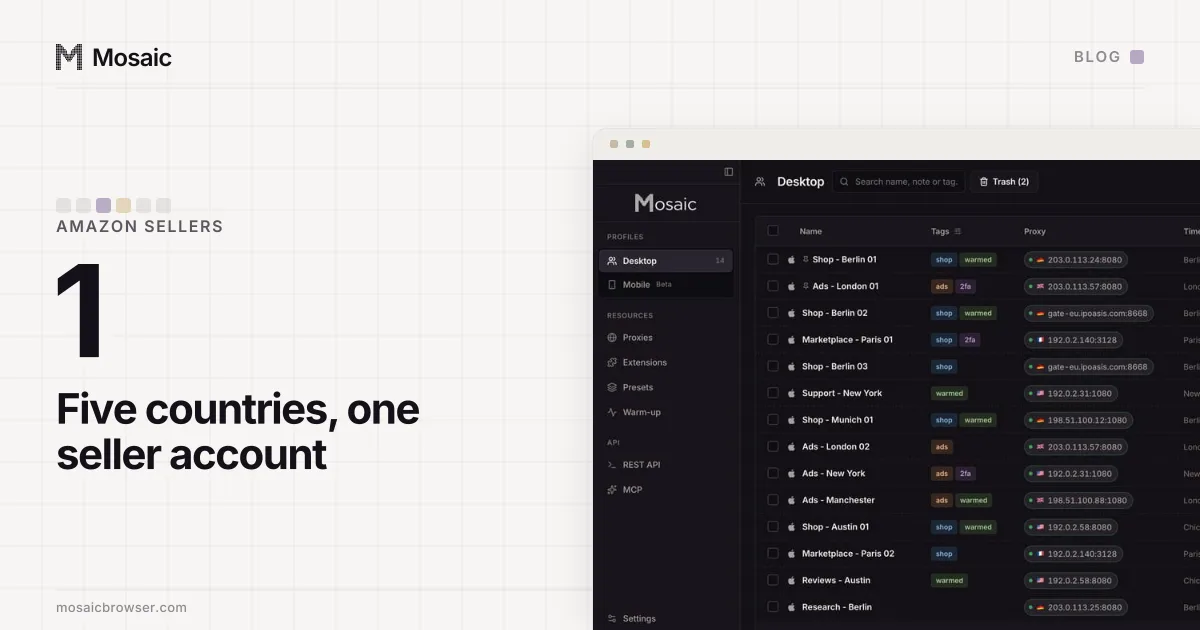
Amazon's unified account in Europe is one seller account that reaches every Amazon store in the region. You register once, sign in to one Seller Central, and switch between Amazon.de, Amazon.fr, Amazon.it, Amazon.es and the other European stores from a menu at the top of the page. Selling in five countries is one account by design.
That design is also the answer to a question sellers ask the wrong way round. They ask how to open an account per country. The unified account exists so that nobody has to, and a second account opened for that reason is the thing Amazon's rules about multiple accounts are written to stop.
Amazon decides what its sellers may run, and its Seller Central help pages carry the current rules. Mosaic keeps accounts you are entitled to run apart; it does not change what Amazon allows.
What the Amazon unified account in Europe shares
The account is one legal relationship with Amazon. It has one owner, one set of verified business details, one set of login credentials and one account health record. Inside it, each European store is a marketplace you are either selling in or not.
A few things are shared across all of them:
- the business identity Amazon verified when you registered
- your users and their permissions
- the performance record that decides whether the account is in good standing
- the catalogue of products you have created, which you can offer in more than one store
Other things are set per store: the listing's language, its price in the local currency, and whether the store is turned on at all. Amazon's Build International Listings tool links an offer in one store to the same product in another and can keep the price in step with a rule you set, so a German listing does not have to be built by hand from the French one.
Inventory sits on top of this. With Fulfilment by Amazon, stock in one country can serve orders from another, or be spread across several countries' warehouses, and either way it is one account's inventory.
Write the recipe once, then make forty profiles from itIn Mosaic: Presets and extensions. One recipe, forty profiles, forty exits. Free holds 3 profiles. Pro is $49 a month for any number.
Mosaic is a desktop app
Email yourself the link and open it on your computer.
How it works: Presets and extensions
Adding a country is a setting, not a registration
A seller who already sells in one European store adds another from inside Seller Central. You choose the store, accept its terms, and Amazon turns it on for the same account. The listings follow with the international listings tool or by hand.
What a new country really brings is work outside the account. Each country has its own VAT and product rules, its own packaging and labelling expectations, and its own customer language. Those are questions for an accountant and a compliance check, not for a second login. The unified account takes the paperwork off the Amazon side so it can be spent where it is owed.
North America works the same way, with one unified account for Amazon's North American stores. A European account and a North American account are two regions, which is a different case from two accounts in one region.
Why a second EU account is the mistake
Because one account already reaches every European store, a second account in Europe has to be justified by something other than geography. Amazon allows a second account in a region only with a legitimate business need and with every account in good standing, and the clause is read closely in Amazon's legitimate business need test. Two genuinely separate businesses can meet it. "One account for Germany and one for France" does not, because the first account could already sell in both.
The second condition matters too. Good standing is judged across all of a seller's accounts, so an extra account does not spread risk. It ties two records together, and a problem on one becomes a problem for both. Amazon also checks who is behind a new account, which is part of why Amazon may verify a new seller on a video call: the account is tied to a person and a business, not to a country.
What this means for your browser
For most European sellers, one unified account means one browser profile for Amazon, not one per country. The marketplace switcher lives inside the account, so a profile per store would just be five copies of the same login fighting over the same session. That fight is the cause in why Seller Central keeps logging you out.
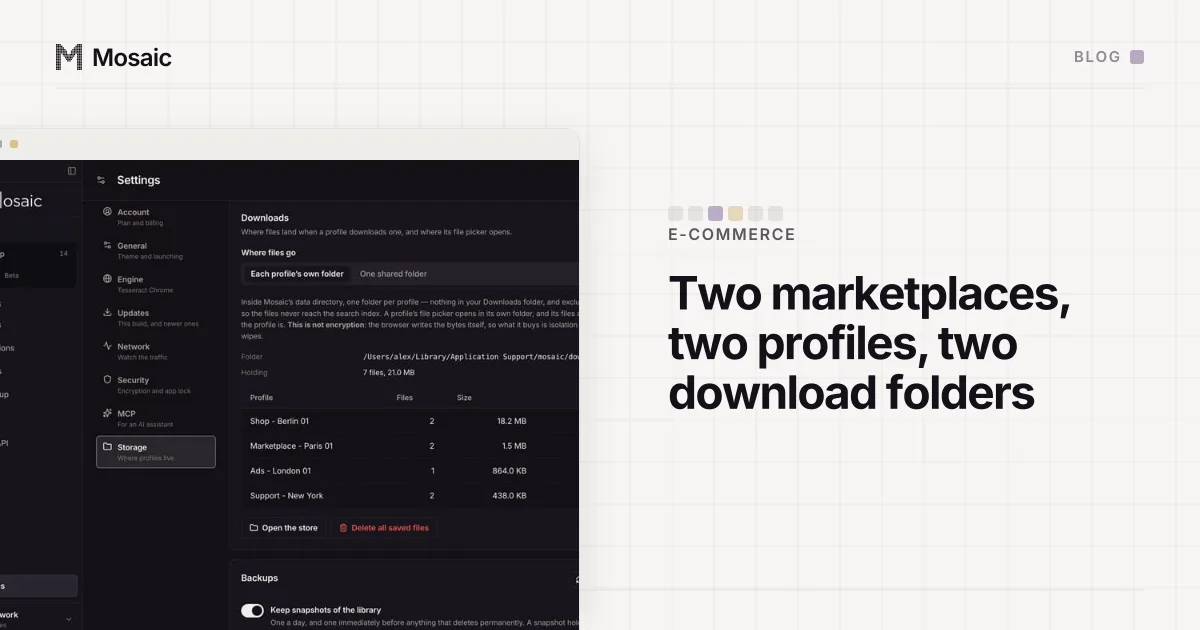
Separate profiles start to matter when there is a genuinely separate account to keep apart: a second business Amazon approved, a client's account you manage through Amazon's user permissions, or a store on another marketplace entirely. In Mosaic each of those gets a profile with its own encrypted cookie jar, so each stays signed in, its own saved login and two-factor code in the companion, and its own downloads folder for order reports.
None of them needs a proxy in the store's country. The account belongs to a business in one place, and Seller Central sees the business signing in from there. Leave the proxy empty and a Mosaic profile matches this computer's own location, timezone and language, which is the true answer. The layout for a seller with more than one marketplace is on Mosaic for e-commerce sellers.