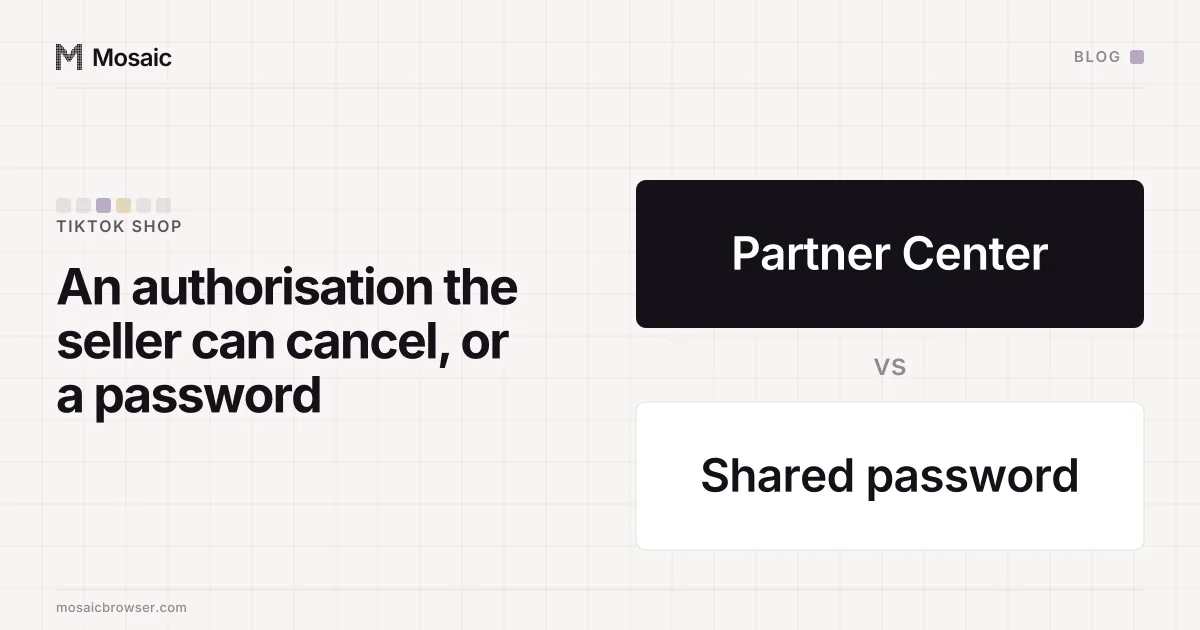
TikTok Shop Partner Center is where an agency works on shops it does not own. The seller authorises the agency as a TikTok Shop Partner from the seller's own Seller Center, choosing which services and permissions it gets. The agency then works from its own Partner Center account, and the seller can cancel the authorisation whenever they like. Signing in to the client's shop with the client's password is the older route, and it gives up everything the authorisation gives the seller.
TikTok Shop's seller guidance describes working through partners, in its Seller University article Work with TikTok Shop Partners for the US market. Mosaic keeps accounts you are entitled to run apart; it does not change what a platform allows.
How a TikTok Shop Partner Center agency gets into a shop
A partner is a business registered with TikTok Shop as a service provider, with its own Partner Center account. It lists services, such as shop management, creative work or advertising. From the seller's side, the relationship starts in one of two ways. The seller finds the partner in the partner and services part of Seller Center, or the partner sends an authorisation link for a service it has set up for that seller.
Either way, the seller sees what the partner is asking for before confirming: which data it can read and which pages it can manage. The authorisation has a term. When it ends or the seller cancels it, the partner's access to the shop ends too, without anybody changing a password.
TikTok renames these menus from time to time, and each market's Seller Center has its own wording. So look for the partner section of your market's Seller Center rather than a fixed path. The markets differ in more than menus: TikTok Shop's rules differ by country, and a US answer is not a UK one.
Write the recipe once, then make forty profiles from itIn Mosaic: Presets and extensions. One recipe, forty profiles, forty exits. Free holds 3 profiles. Pro is $49 a month for any number.
Mosaic is a desktop app
Email yourself the link and open it on your computer.
How it works: Presets and extensions
What the seller's password costs everyone
Before partner access, the agency usually got a username and password, often in a message, and typed them in itself. That works until something goes wrong, and then each of the seller's protections turns out to be missing.
The seller's two-factor codes have to reach the agency. Either the codes are forwarded by hand on every sign-in, or the setup key is copied to the agency, after which the agency holds the second factor as well as the first. Nothing records which person at the agency did what, because everything happens as the seller. Ending the relationship means changing the password and the two-factor setup and hoping nothing else was saved. Agencies collect these logins in a spreadsheet, and we wrote up what a shared password spreadsheet breaks separately.
There is a structural problem too. An agency signing in as ten sellers, from one office, on one computer, can look to the platform like one person running ten shops. Partner access describes that relationship to TikTok openly: the agency is a partner, each seller authorised it, and the shops stay the sellers'. The same idea runs through TikTok Business Center for ad accounts, where an agency gets access to a client's ad account without the client's login.
What partner access does not reach
Partner access covers the services and pages the seller authorised. An agency doing a brand's whole online sales usually needs more than the shop. The brand's own website admin, its email, the creative drive and any other marketplace the brand sells on have no TikTok partner system. Those logins come from the client, are typed in by somebody at the agency, and are where a password still changes hands.
That is the part Mosaic is built for. We would give each client its own profile, and put the agency's own Partner Center sign-in in a profile of its own. A client's profile holds that client's cookies, a fingerprint drawn from one real machine, a proxy exit of its own if you attach one, and the client's two-factor codes in its credentials vault, filled into the page with real keystrokes. Projects keep each client's profiles together. When a client leaves, trashing their profiles closes their browsers, and emptying the trash deletes the cookies and saved logins. The same layout works for sellers who run shops in several marketplaces.
None of this replaces the partner route. Where TikTok Shop offers authorisation, use it, and keep the seller's password with the seller.