Per-GB proxy pricing bills the traffic a profile moves. Per-IP pricing bills you for holding an address each month, whether you use it or not. So a profile that browses lightly for months is cheap per GB and dear per IP, and a busy one is the other way round. To find the crossover, divide the monthly price of an IP by the price of a gigabyte.
We did that division for a single month in what a proxy costs per profile per month. Here we run it over a year, since the profiles worth paying for are usually the ones you keep that long, and a year shows two things one month can't.
Per GB vs per IP over a profile's life
The prices are the round ones from that earlier post, and we made them up so the sums stay readable: $4 per GB on a residential plan, $3 per IP per month on an ISP plan. They are nobody's real prices. Put your own seller's figures in.
one IP for a year     12 × $3          = $36
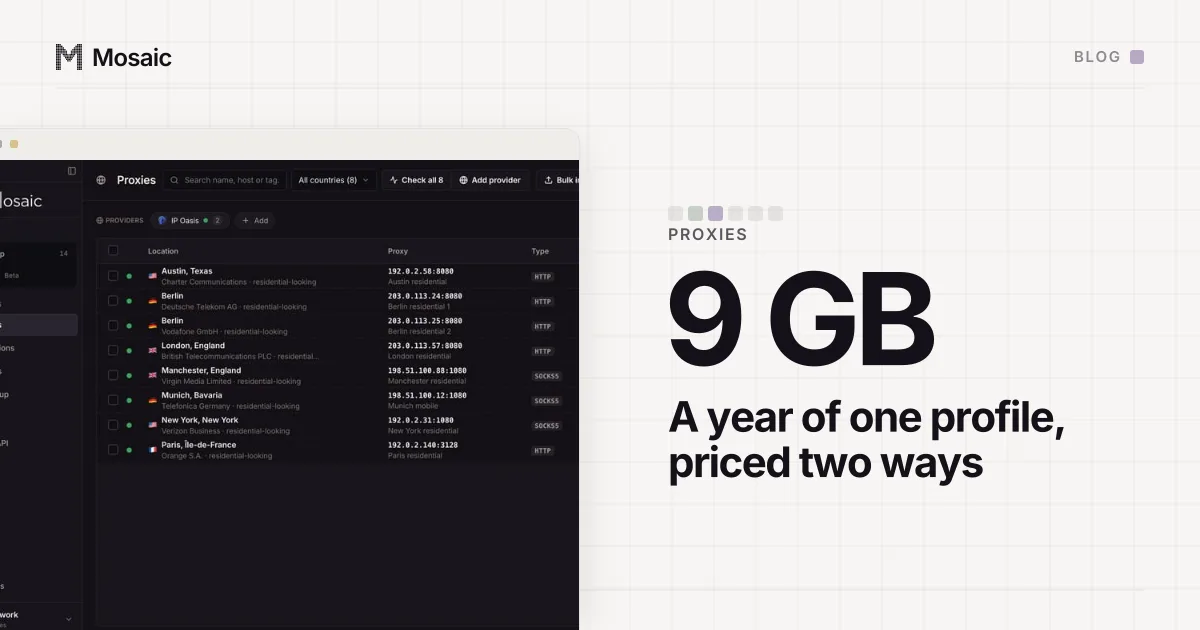
break-even traffic    $36 ÷ $4 per GB  = 9 GB a year
                      $3 ÷ $4 per GB   = 0.75 GB a month
Under 9 GB in the year, per GB is cheaper. Over it, per IP is. For a long-lived profile the test is four steps:
- Estimate the profile's traffic for its whole life, month by month.
- Multiply the total by the price of a gigabyte.
- Multiply the months by the price of an IP.
- Pick whichever number is smaller.
Step 1 is where people guess, and it's better measured: how much proxy traffic a browser profile uses is the week-long test we'd run before buying anything.
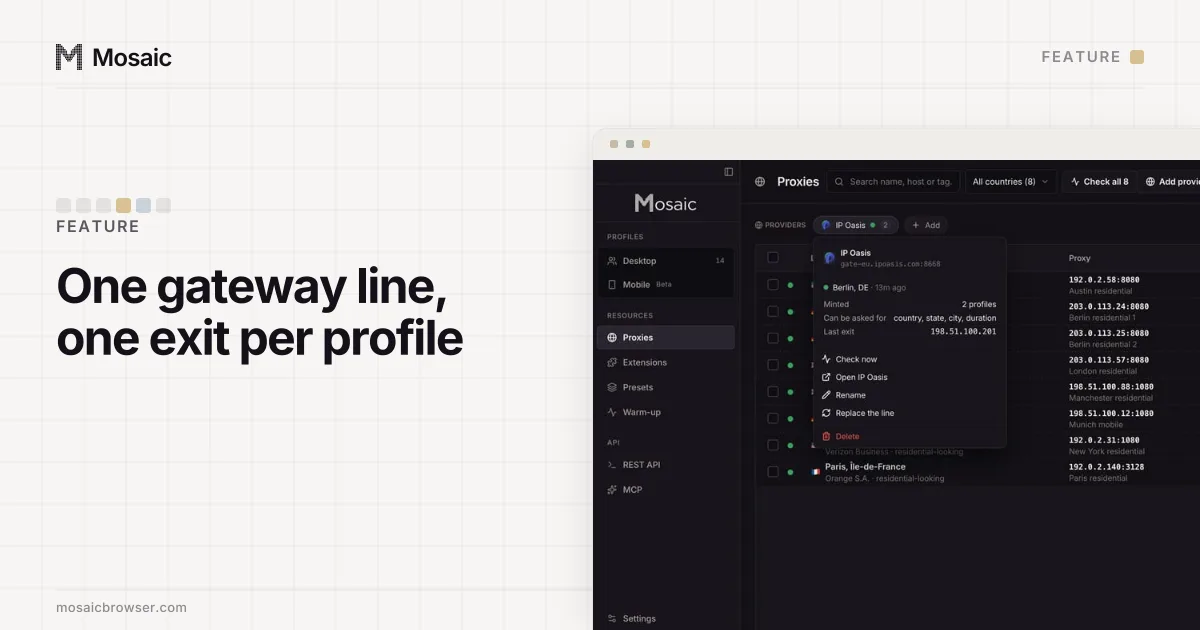
Paste one gateway line. Every profile mints its own exitIn Mosaic: Provider minting. One gateway line, a separate exit for every profile. Free holds 3 profiles. Pro is $49 a month for any number.
Mosaic is a desktop app
Email yourself the link and open it on your computer.
How it works: Provider minting
Month one is not month six
A new profile's first weeks are its dearest, for two reasons:
- its cache is empty, so every font, script and image on every site downloads in full
- a warm-up, if you run one before the site that matters, browses through the same proxy and lands on the same bill
After that the cache does its job. Our two invented profiles below each get an assumed 1.5 GB first month:
| Profile | Month 1 | Months 2–12 | Year total | Per GB at $4 | Per IP at $3 |
|---|---|---|---|---|---|
| Signs in twice a week, reads a dashboard | 1.5 GB | 0.2 GB each | 3.7 GB | $14.80 | $36 |
| Open every day on an image feed | 1.5 GB | 2 GB each | 23.5 GB | $94 | $36 |
The dashboard profile pays $14.80 against $36, less than half. The image-feed profile is at 9.5 GB by the end of month five, already past the line, so its year per GB costs more than a year per IP; by December it has cost $94, more than twice the per-IP bill. Swap in your prices and the dollars move. What decides the answer is still the traffic column.
Idle months cost one plan and not the other
Take an account opened in only three months of the year, say for a seasonal shop, and give it the dashboard profile's rates: 1.5 GB in its first month, 0.2 GB in each of the other two. That is 1.9 GB, or $7.60 per GB. Per IP it is still $36, because the nine quiet months are billed at $3 each, the same as the busy ones.
You can let the address go for the quiet months. It then returns to the seller's pool, and whether you ever get it back is the seller's decision; most don't promise it. For an account whose value is signing in from one place, saving $27 by giving up that place is a bad trade.
Per-GB plans carry idle costs too, and they are on the plan page rather than in the headline price:
- a monthly minimum is shared by every profile on the plan, so each profile left after the library shrinks pays a bigger share
- traffic bought as a bundle may expire at the end of its period, so check whether yours rolls over before you count a quiet month as free
The cheap plan for a quiet account can't hold an address
The dashboard profile is the one the arithmetic sends to per-GB pricing. It is also the one that most needs a steady exit, because a seller account opened twice a week for a year looks most like its owner when every sign-in comes from the same place.
The two plans give it different things:
- Residential, per GB: a sticky session. It keeps one household's connection until its minutes run out or the household goes offline, and the next session is somewhere else, often another town. Some sellers sell sessions of hours or days. None can keep somebody's home router online for a year.
- ISP, per IP: an address. It is the same on 1 January and on 31 December.
So each long-lived profile gets two questions. The division answers which plan is cheaper. The account answers whether it can live with its exit moving every few days, and for some the answer is to pay about $21 more a year, in our example, to keep one address.
One library, two kinds of plan
Nothing stops one library from using both. In Mosaic:
- the busy, important accounts can sit on ISP lines pasted from a per-IP plan, one address per profile
- the light ones can mint from a per-GB pool: paste one gateway line into Proxies › Add provider and Mosaic keeps it as a provider
- each profile then mints its own session id, so no two profiles share an exit by accident, and session length is set per profile where the seller's line format has a word for it
- when a residential session dies, Mosaic asks for a different session instead of retrying the dead one, and writes the new one back so the next launch doesn't open on a failure
- a session you pinned is never moved
On either plan, check the exit's reputation before a long-lived account depends on it, because a shared pool can hand you an address with a past. Scoring a rotating proxy scores one draw from the pool explains what that score can and can't tell you.