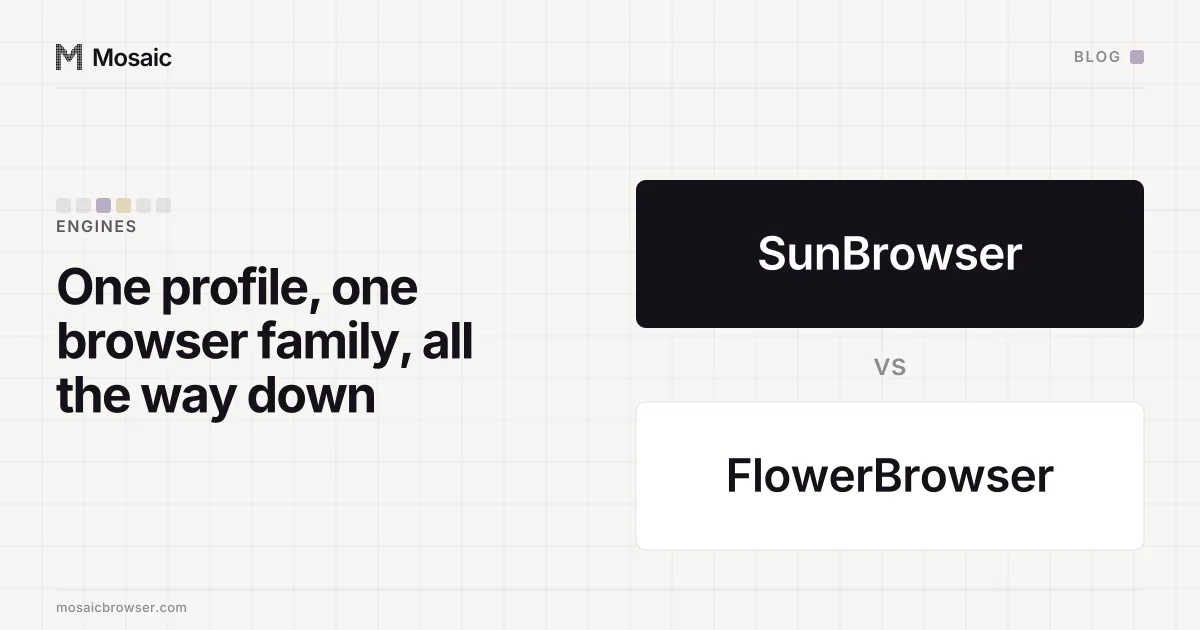
SunBrowser and FlowerBrowser are the two browsers AdsPower ships for its profiles. AdsPower's own pages describe SunBrowser as built on the Chromium kernel and FlowerBrowser on the Firefox kernel. So the choice between them is a choice of browser family: whether a profile is Chrome-like or Firefox-like from the TLS handshake up. That runs much deeper than a User-Agent setting.
We make a competing product, Mosaic, and it has only a Chromium engine, so we have no Firefox engine of our own to sell you here. What follows is what AdsPower says about its two kernels and what any Firefox profile commits you to.
SunBrowser vs FlowerBrowser, in AdsPower's own terms
AdsPower calls the two its own fingerprint browsers, each on a different kernel, and lists them by name on the profile screen. Both come in versions. AdsPower's release notes add new Chrome kernels to SunBrowser and new Firefox kernels to FlowerBrowser as the upstream browsers move. In its local settings you download the kernel versions you want and can uninstall old ones. When you create or edit a profile, you pick SunBrowser or FlowerBrowser and a version from its list, and an existing profile can be moved to another kernel version by editing it.
Stock Firefox also ships with its tracking protection switched on, which blocks many third-party cookies. If a Firefox-based profile keeps that behaviour, a workflow that depends on a third-party login frame can act differently from the same workflow in a Chromium profile, so test it before you rely on it.
Version numbers move every few weeks, so we are not printing any here. AdsPower's release notes have the current ones.
The fingerprint is changed inside the engine, not painted on topIn Mosaic: Its own Chromium. Tesseract Chrome: values changed in C++, not JavaScript. Free holds 3 profiles. Pro is $49 a month for any number.
Mosaic is a desktop app
Email yourself the link and open it on your computer.
How it works: Its own Chromium
What choosing FlowerBrowser commits a profile to
A browser family is not a setting on top of a profile. It is the code that writes most of what a site reads, and most of it cannot be changed from inside.
- Firefox makes its TLS connections with NSS, Mozilla's own library; Chrome uses BoringSSL. Their ClientHellos differ in cipher order, extensions and more, and a server reads that before any page code runs. A Firefox profile's JA4 is a Firefox JA4.
- Firefox's HTTP/2 SETTINGS frame and pseudo-header order differ from Chrome's, and Akamai's HTTP/2 fingerprint reads exactly that.
- Firefox does not send
Sec-CH-UAclient hints and has nonavigator.userAgentData. A Chromium profile that suddenly lacks them looks odd. A Firefox profile that has them looks impossible. - Gecko and Blink expose different sets of APIs, CSS features and quirks. A detector that tests for a Blink-only API learns the family whatever the User-Agent says.
- Chrome Web Store extensions are built for Chromium. Firefox installs its own add-on format. A profile that depends on a Chrome extension belongs on SunBrowser.
- Puppeteer and most Playwright setups for anti-detect browsers attach over the Chrome DevTools Protocol. Firefox has its own remote protocols. Check AdsPower's documentation for which automation libraries FlowerBrowser supports before you move scripted profiles across.
So a FlowerBrowser profile has to claim Firefox, all the way down. Its cookies are portable data. The browser it presents is not.
Why someone picks Firefox anyway
There are honest reasons. A QA team has to test its own site in Gecko, because Gecko lays pages out its own way. A privacy-minded person may simply prefer Firefox and want their separated identities to look like what they actually run. And a profile meant to resemble one specific user should use the browser that user would use.
The reason that does not hold up is "variety for its own sake". A Firefox profile is not harder to recognise than a Chrome one. It is a member of a smaller crowd, and a consistency scanner checks it against Firefox's rules instead of Chrome's. Whichever family you pick, the work is the same: the claim has to match what the engine underneath actually writes.
A Firefox kernel has to keep pace
A second engine is a second thing to keep current, and what happens when a vendor stops updating its Firefox engine is worth reading before you put long-lived accounts on any vendor's Firefox build. A Firefox profile whose kernel falls behind Firefox's own releases claims a browser fewer and fewer real users run. Chromium kernels have the same problem, which is why vendors number them by Chrome major, as GoLogin's Orbita and Multilogin's Mimic core versions both do.
Where Mosaic sits
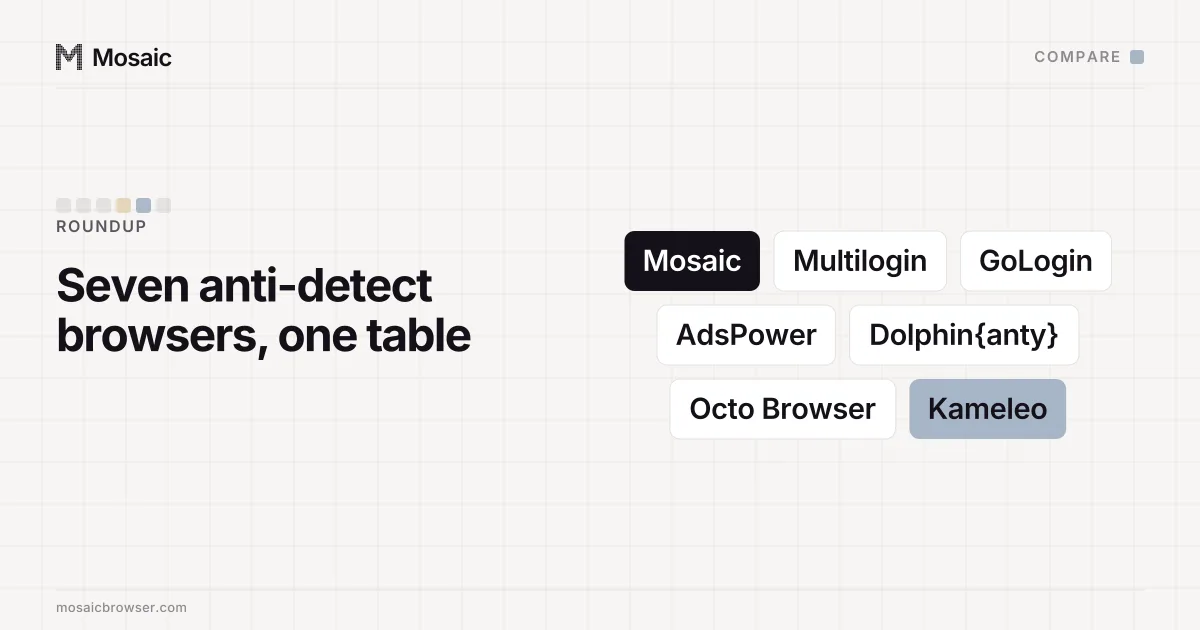
Mosaic runs one engine, Tesseract Chrome, built from stock Chromium source with a patch series, and every profile claims Chrome. The engine even refuses the Edge brand, because our engine could not send Edge's User-Agent and its client hints correctly at the same time. If your work needs Firefox profiles, choose a product with a Firefox engine. The comparison of anti-detect browsers lists which ones do. If your profiles are on SunBrowser, Mosaic recognises AdsPower's export format and brings across each profile's name, notes, proxy, start pages and the cookies the export carries.