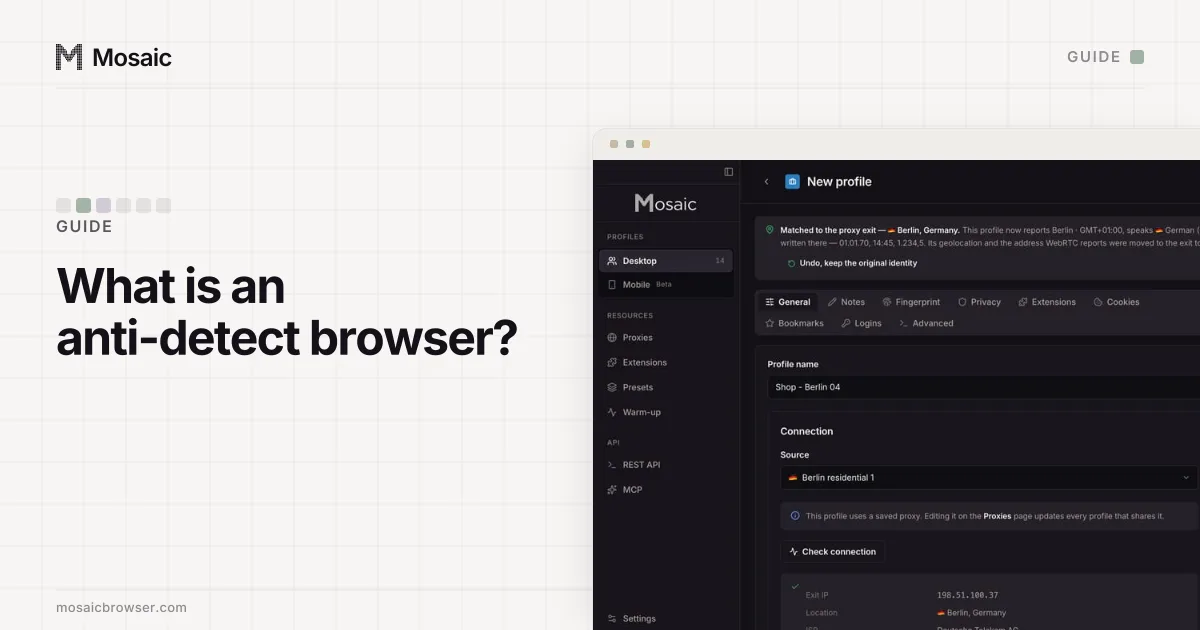
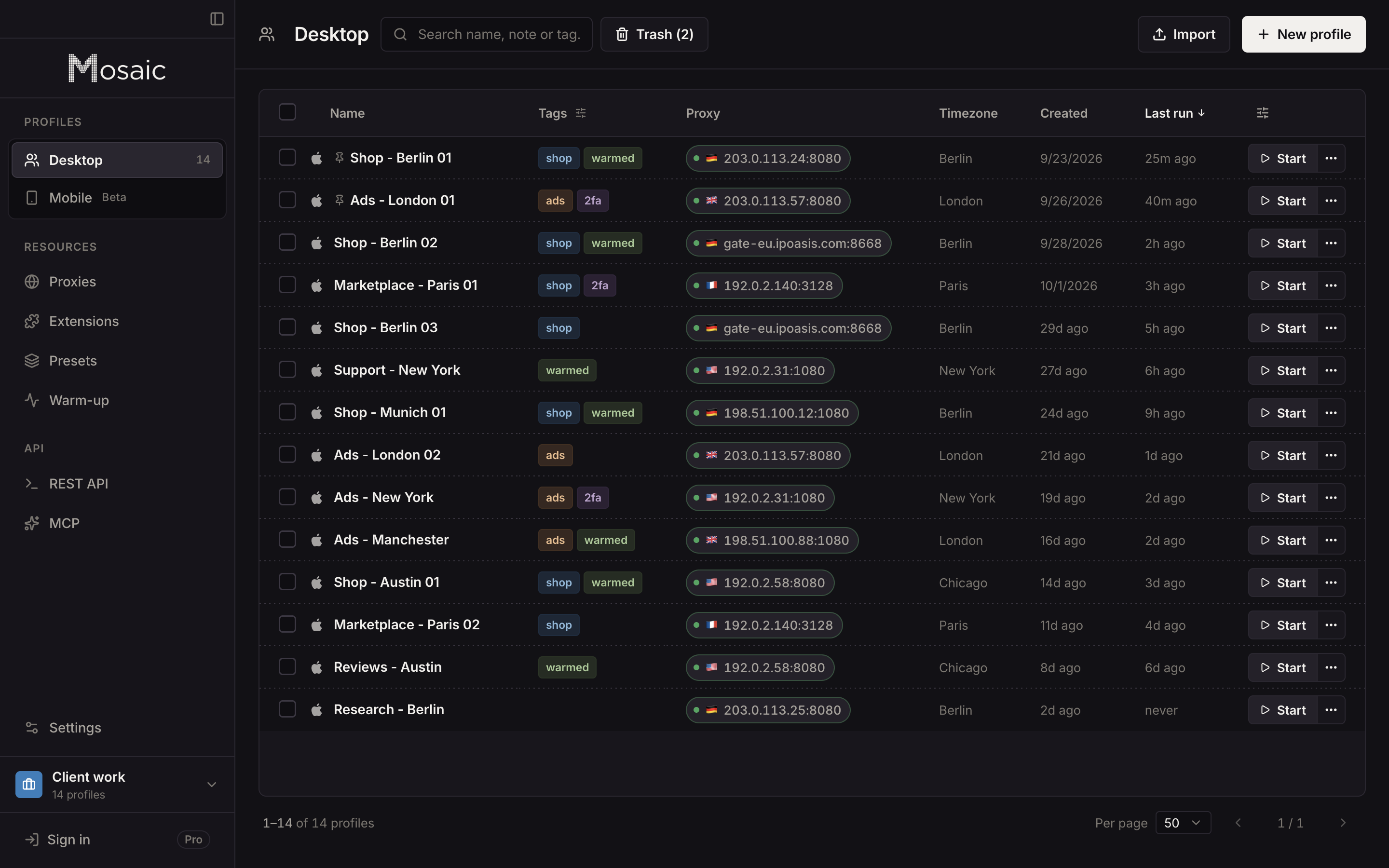
The word "anti-detect" is a little misleading. An anti-detect browser is not hiding that a person is browsing. It stops one computer from looking like the same computer in every account. The unit is the profile, and each profile carries three things that an ordinary browser shares between everything you do: the browser fingerprint (GPU, screen, fonts, timezone, language and dozens of smaller values), the IP address the site sees, and the cookies and storage that say who is logged in.
Start one profile and you get a window with its own cookie jar, its own exit and its own hardware story. Start ten and a site sees ten visitors.
What an anti-detect browser changes, and where
Every product in this category changes roughly the same list of values. The difference between them is where the change happens.
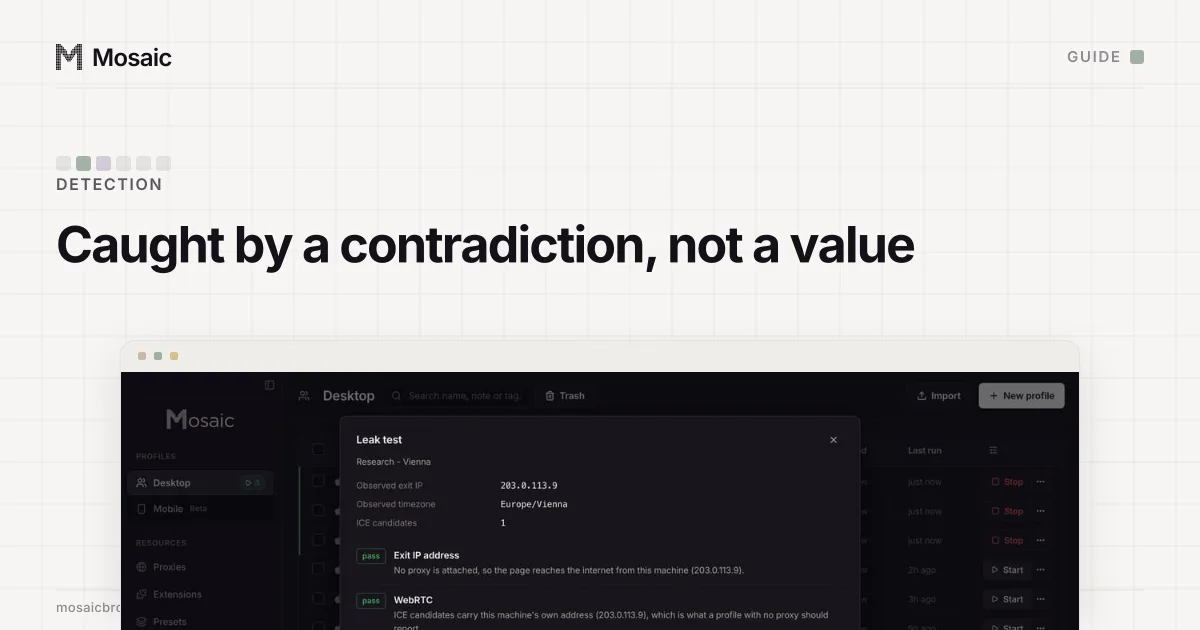
Some inject JavaScript into each page and overwrite what functions like getParameter or toDataURL return. That is quick to build, and it leaves marks: an overwritten function can be told apart from a native one, and a web worker or an iframe that starts before the script runs may read the real value. A detector that compares two places and gets two answers has found the tool.
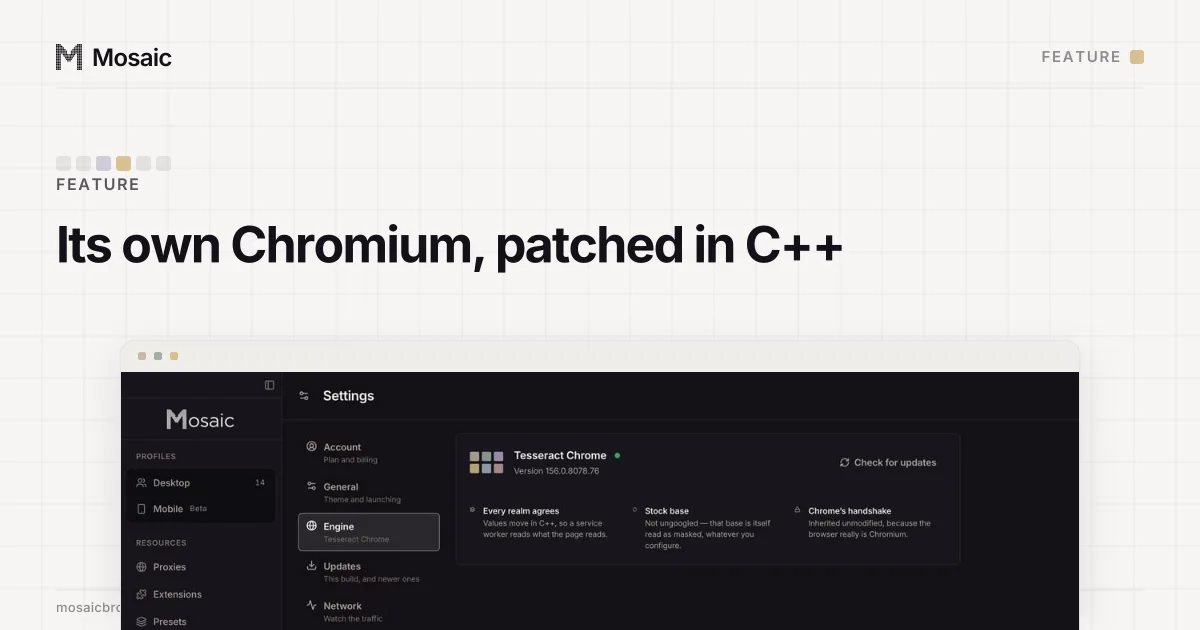
Others change the browser itself. We took that route: Mosaic runs Tesseract Chrome, its own Chromium built from stock source with a series of patches, and the values move in C++ inside the engine, so a page, a frame and a worker all read the same machine. The engine page lists what that covers, including two things unbranded Chromium lacks and Google's Chrome has: the 19 Google speech voices (199 voices against 180) and Chrome's field-trial API surface.
The fingerprint is changed inside the engine, not painted on topIn Mosaic: Its own Chromium. Tesseract Chrome: values changed in C++, not JavaScript. Free holds 3 profiles. Pro is $49 a month for any number.
Mosaic is a desktop app
Email yourself the link and open it on your computer.
How it works: Its own Chromium
Why consistency matters more than randomness
A fingerprint with a random value per field is unique and impossible at the same time: a laptop GPU beside an ultrawide monitor, a Tokyo timezone on a Frankfurt exit. Detectors keep tables of real hardware, so they read that as masking. The better approach draws a whole machine that exists and then sets timezone, language and location from where the proxy actually exits. Mosaic draws from a catalogue of 155 real desktop records and 3 captured Android phones, and it makes profiles for any desktop OS, plus Android phones. A Windows profile on a Mac comes with a caution, because fonts and the way they are drawn come from the real machine and no switch reaches them, so the OS the computer really runs is always the strongest match.
What it does not change
It cannot change what the accounts do. Two accounts that share a payment card, a shipping address or a phone number are linked by account data, whatever the browser reports. And it does not change what a platform allows: if a site's terms permit one account per person, a separate browser does not make a second one permitted. Are anti-detect browsers legal goes through where the law and the terms each draw their lines.
The full explainer, with how to judge one and who uses them, is what is an anti-detect browser. The ways sites still find these tools, with the detectors that check for each one, are in how sites detect anti-detect browsers.