You get one host and port from the seller, and behind it a pool of thousands of addresses. Every time your client opens a connection to that gateway, the seller picks an address from the pool and sends the traffic out through it. Nothing on your side changes; the exit does. That arrangement is also called a backconnect proxy, and most residential sellers sell it as their default.
How a rotating proxy decides when to rotate
Sellers rotate on one of three clocks.
- Per connection. Each new TCP connection gets a new exit. A browser opens several connections to load one page, so one page view can arrive from several addresses.
- Per request. The same idea, applied to each HTTP request where the gateway can see them.
- Per interval. The exit holds for a set number of minutes and then moves, whether you were in the middle of something or not.
The username usually decides which clock you get. Send the login as issued and most residential gateways rotate. Add a session parameter and the same gateway holds an exit for that session, which is a sticky session. IPRoyal, for instance, documents both modes on one endpoint, switched by what you put in the password (IPRoyal rotation docs, read 2 November 2026). Some sellers split the modes by port instead. On one of them we measured the rotating port refusing a session token outright:
400 "Can not use -session- on rotating ports"
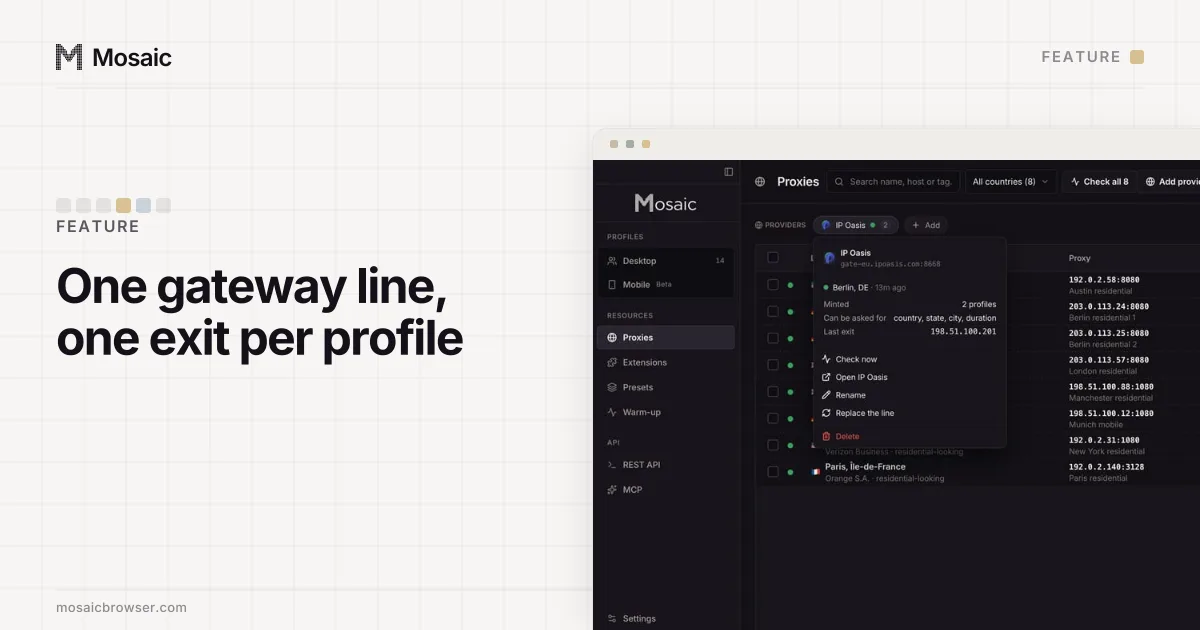
Paste one gateway line. Every profile mints its own exitIn Mosaic: Provider minting. One gateway line, a separate exit for every profile. Free holds 3 profiles. Pro is $49 a month for any number.
Mosaic is a desktop app
Email yourself the link and open it on your computer.
How it works: Provider minting
What it is good for
Rotation spreads load. A crawler fetching ten thousand public pages does not want all of them to come from one address, because the site's rate limits are counted per address. With rotation, each request looks like a different visitor, and none of them needs to be remembered. Price monitoring and checking search results from many places work the same way.
Why it is wrong for accounts
An account is a long conversation, and a rotating exit changes the speaker's address in the middle of it. We pointed Mosaic's proxy check at a rotating residential endpoint and read the exit three times in a row: Peru, Brazil, Bahrain. For a scraper that is the product working. For a profile that claims one timezone and one language, it is three countries in three requests, and a login that moves like that looks like a stolen one. The trade-offs side by side, with how long sticky sessions last at each seller, are in rotating vs sticky proxies.
The fix is not to stop using a rotating gateway. The same gateway, with a different session id per account, gives every account its own steady exit. That is also the answer to how many accounts per proxy: one session each.
How Mosaic handles it
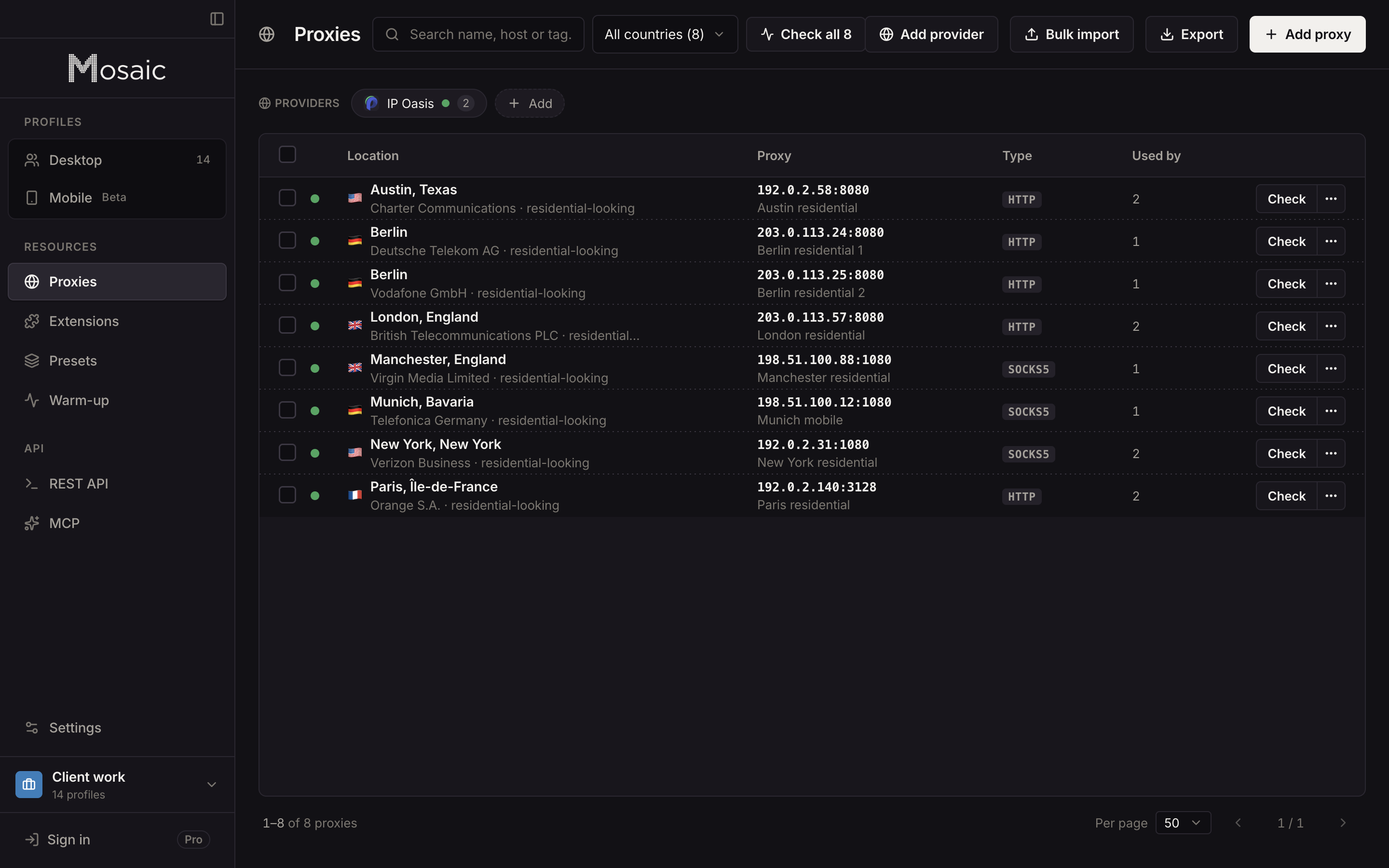
Mosaic finds out whether a proxy rotates instead of assuming. The proxy check opens two connections and compares the exits; if they differ, the proxy is marked rotating with the two addresses shown and the sentence "This endpoint rotates, so a profile behind it cannot hold a timezone or a language." A seller's gateway line saved as a provider mints a sticky session for each profile instead. For one-time and scraping profiles there is a switch, New exit on every launch, which mints a fresh session at each start: one exit for the whole run and a different one next time. In our test of it, three launches came out of three different addresses with it on, and the same address three times with it off. We leave it off for any profile that signs in.
Sources
- IPRoyal Docs: Residential proxy rotation, read November 2, 2026