A Merchant Center multi-client account (MCA) is Google's way of letting one operator run many stores: a parent account with a sub-account per store, brand or client. Agencies, marketplaces and businesses with several brands use it. What it does not change is that each sub-account is one store, with one website it can show it owns. That website claim is where the line sits between several real stores under one roof and one store wearing several names.
Merchant Center allows several stores under one operator through this structure. Mosaic keeps accounts you are entitled to run apart; it does not change what a platform allows.
What a Merchant Center multi-client account is
In an ordinary Merchant Center account, one business uploads one product feed for one website. A multi-client account adds a level above that. The parent holds no products of its own. It holds sub-accounts, and each sub-account has its own feed, its own business information, its own website and its own standing with Google's policies.
The people on the parent see every sub-account from one sign-in. That is the point of it for an agency managing twenty clients' feeds, or a marketplace that lists many sellers' shops. How you set one up, and what it is called on the screen, is in Google's own Merchant Center help, which is the place to check before you convert an account you already use.
Write the recipe once, then make forty profiles from itIn Mosaic: Presets and extensions. One recipe, forty profiles, forty exits. Free holds 3 profiles. Pro is $49 a month for any number.
Mosaic is a desktop app
Email yourself the link and open it on your computer.
How it works: Presets and extensions
Why every sub-account needs a website it can claim
Merchant Center asks each account to verify and claim the website its products link to. Two rules about claims shape everything else:
- a website can be claimed by one Merchant Center account at a time;
- a claim on a domain covers the subdomains and paths beneath it.
So if one account has claimed example.com, a second account cannot claim shop.example.com. The domain is already held at a higher level, and the error says so. A multi-client account is the sanctioned way around that for stores that really share a domain. The parent claims the domain once, and sub-accounts whose stores sit on us.example.com or example.com/de inherit the claim.
Stores on separate domains claim them separately, inside each sub-account. A multi-brand business usually does that itself, because the parent manages every brand's site. For an agency it is often the client who verifies, because the client owns the domain and the agency only manages the feed.
Where the claim draws the line
The claim is a statement that the business behind this sub-account controls this website. The rest of Merchant Center's policies build on it. The business information has to name a real business. The returns policy and contact details have to be ones a shopper can use. Merchant Center's misrepresentation policy comes down to whether a shopper can tell who they are buying from.
That is why a multi-client account is not a way to multiply one store. Ten sub-accounts that all point at the same shop under ten business names, or a fresh sub-account opened to put back products a suspended account was selling, is the exact case the policies exist for. A parent full of real, separate stores, each with its own site and its own business details, is the case the structure exists for.
If you are not sure which side a setup falls on, ask whether each sub-account would make sense to a shopper on its own: a name, a site, a returns address, a business behind it. If two sub-accounts would look like one shop to that shopper, they are one shop.
Where separate browser profiles fit, and where they don't
A multi-client account removes most of the reason to juggle Google logins for Merchant Center itself. One Google account with access to the parent opens every sub-account. You do not need a separate browser per sub-account to manage feeds, and separating them would gain you nothing Google does not already give you.
The juggling comes back around Merchant Center rather than inside it. An agency often works in each client's own Google account for Google Ads, Analytics and Business Profile, and in each client's Shopify or WooCommerce admin. Each of those has its own login, its own two-factor codes and its own cookies. Working through them in one browser means signing in and out all day, and sooner or later editing the wrong client's store. How Google Ads counts accounts per login, and where a manager account fits, is in how many Google Ads accounts one person can make. Advertiser verification, which joins every account under one legal name, is in what Google Ads advertiser verification asks.
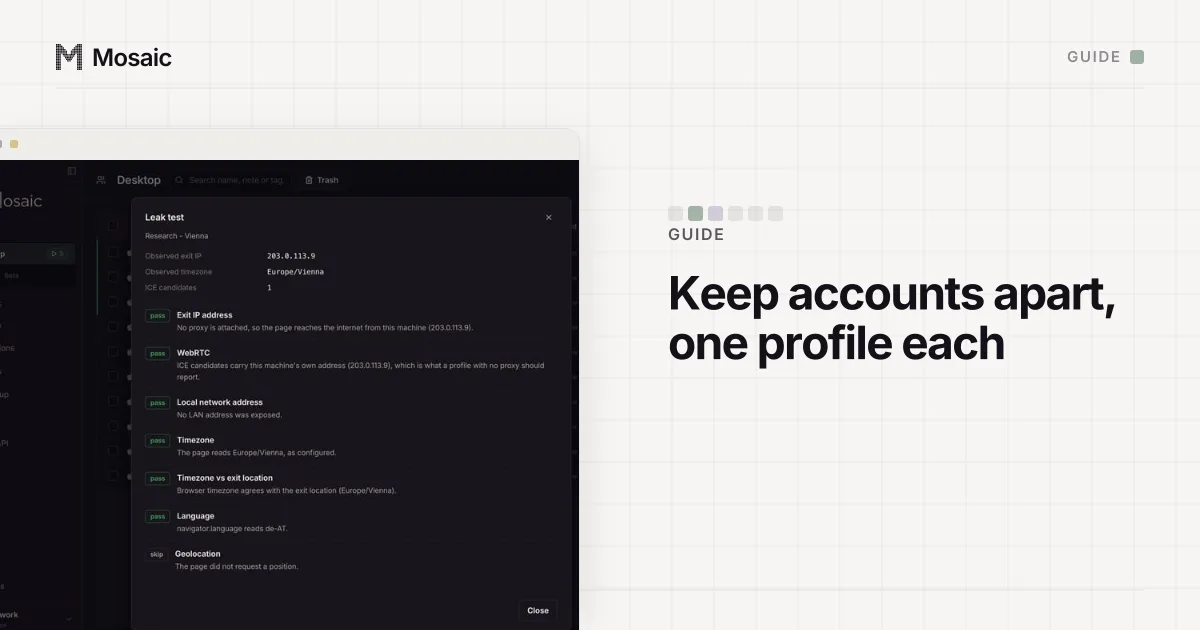
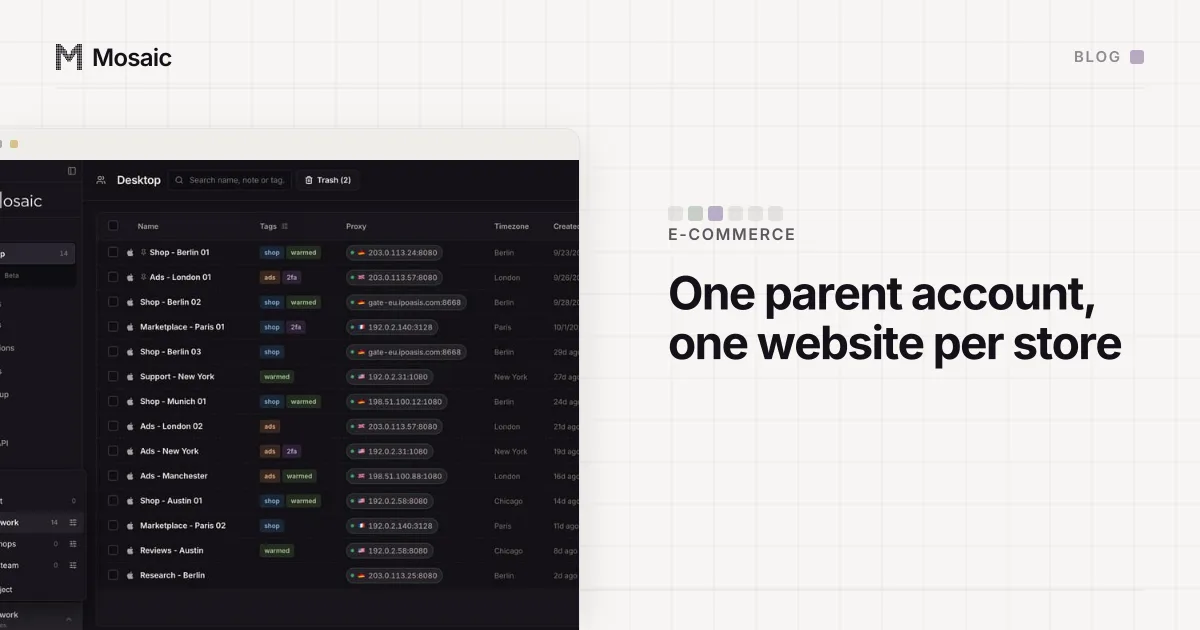
In Mosaic, each client is a profile with its own cookies, fingerprint and proxy exit, and the companion inside it holds that client's logins and two-factor codes and no one else's. Profiles group into a project per client or per team, so the agency's own Google account lives in one profile and each client's in another. A seller's morning across six stores shows that day with every store open at once, and the mechanics of what links accounts that should stay apart are in how to manage multiple accounts without getting linked.