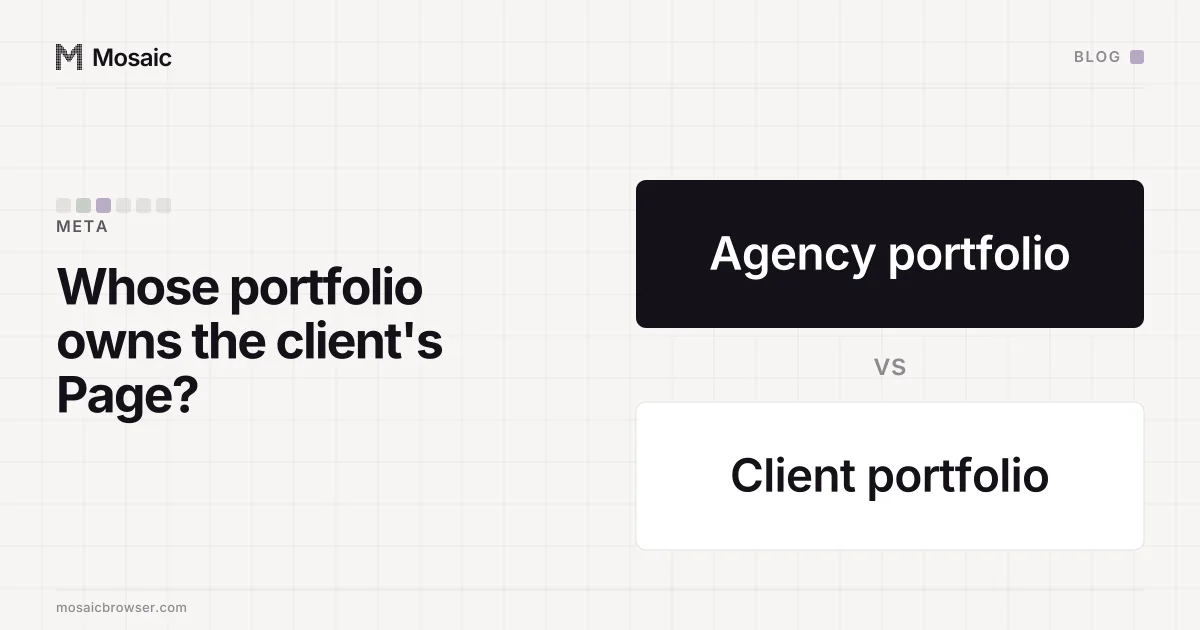
On Meta, a Facebook Page is owned by the business portfolio that created it or claimed it, whatever the contract says about who paid for the work. So when an agency builds a client's Page inside the agency's own portfolio, the agency's portfolio owns it. Most agency-client disputes over a Page start there, and the fix is a rule for day one: the client's portfolio creates the asset, and the agency is added to it as a partner.
Who owns the Facebook Page, agency or client: Meta's answer
Meta does not read contracts. A business portfolio, the thing that used to be called Business Manager, owns assets: Pages, Instagram accounts, ad accounts, pixels, catalogues. Each asset has exactly one owner, and any number of other portfolios can be given access to it as partners.
Ownership comes from how the asset got into a portfolio. A Page created from inside a portfolio belongs to that portfolio. A Page that existed before any portfolio held it belongs to the portfolio that claimed it. Neither step asks who the client is, and the Page's name, the logo on it and the brand it speaks for do not count.
Business portfolio and Business Manager covers the rename and the two ways people reach a portfolio. What matters here is that ownership and access look alike in the lists, and only one of them survives the end of a contract.
Each profile keeps its own passwords and its own 2FA codesIn Mosaic: Logins and 2FA codes. A password vault and TOTP codes for each profile. Free holds 3 profiles. Pro is $49 a month for any number.
Mosaic is a desktop app
Email yourself the link and open it on your computer.
How it works: Logins and 2FA codes
How an agency ends up owning a client's Page
Nobody sets out to take a client's Page. It happens in three ordinary ways.
- The client has no portfolio yet, and the agency, trying to be helpful, creates the Page in its own.
- The Page exists, and someone at the agency adds it to the agency's portfolio as owned, which is a claim, when the job needed a request for access.
- A freelancer creates the Page from their own Facebook profile, and when they join the agency, the agency's portfolio claims it.
In each case the client sees its Page working, its posts going out and its ads running. Nothing tells it the Page is not its own until it asks for it back.
Owning a Page and having access to it
The difference shows up on the last day. The owning portfolio decides who else reaches the Page, and can remove a partner at any time. A partner works with the access it was given, and can hand that much or less to its own people, never more.
So when the client owns the Page and the agency is a partner, ending the work is the client removing a partner, and nothing has to move. When the agency owns it, ending the work means the agency has to give the Page up, and only someone with full control in the agency's portfolio can do that. The client is waiting on somebody else's admin, at the moment the two businesses are least keen on talking. A contract clause saying the client owns the work is worth having in a dispute. It does not change what Meta's settings say.
The day-one rule
The rule that prevents all of this is short: the client creates; the agency is invited.
- If the client has no business portfolio, the client makes one, with a person at the client holding full control.
- The client creates the Page, the Instagram account and the ad account inside its own portfolio, or claims the ones it already has.
- The client adds the agency's portfolio as a partner, using the agency's business portfolio ID, and shares the assets the job needs.
- The agency assigns its own people to those assets, each signing in with their own Facebook account.
Then check it. In the agency's portfolio, every client Page should appear as shared by the client, and none as owned. If one is owned, that is the conversation to have now, while the relationship is good.
Facebook asks for one personal account per person, which Facebook's authentic identity rule covers, and partner access is how an agency works inside it. Mosaic keeps accounts you are entitled to run apart; it does not change what a platform allows.
Where Mosaic fits, and where it does not
For Meta itself, the right setup needs no extra browser: each person at the agency signs in as themselves, and the client's Page appears because it was shared. Mosaic does not change who owns anything.
It helps with what sits outside Meta's partner system. A client's store admin, their newsletter tool and their analytics have no partner role, so the agency often holds a login for each. In Mosaic each of those gets its own profile, with its own cookies, fingerprint and proxy, in a project named after the client, with the login's two-factor setup key kept in that profile's vault. Client onboarding sets that up in the first hour, and client offboarding hands it back in the right order.